
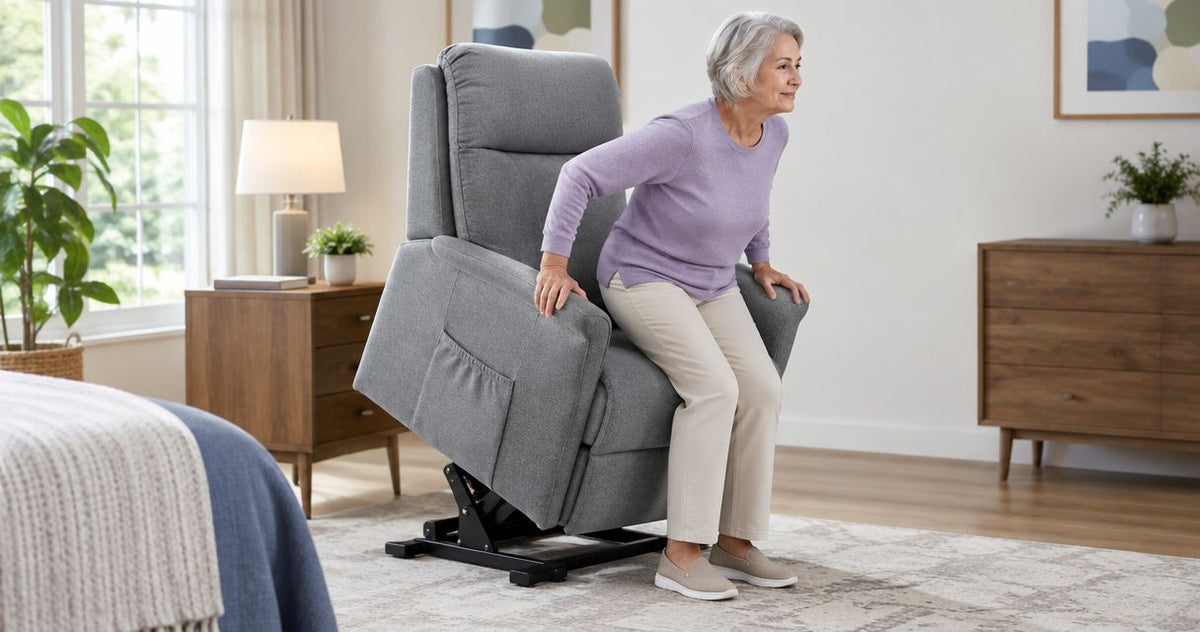
Best starting point for wide-seat fit: Titan. Best for a slightly narrower seat with dual motors: GrandNest. This 2026 guide to 500 lb lift chairs ranked by ease of transfer compares those fit choices—not measured transfer speed or a promise that either chair suits every user.
- For 500 lb lift chairs ranked by ease of transfer, shortlist Titan for wide-seat fit and GrandNest for narrower seating.
- Titan pairs a 500 lb capacity with a 28-inch-wide seat and footrest extension.
- GrandNest pairs a 500 lb capacity with a 27-inch-wide seat, dual motors, and footrest extension.
- Edward Creation lift chairs should be selected by seated fit and lift assistance, not weight capacity alone.
Why transfer fit matters more than extra features
Getting out of your chair starts before the lift mechanism moves. Your seated position, access to the controls, and room to place your feet all belong in the buying decision. A chair that accommodates your weight still needs to fit your body and your way of standing.
Lift assistance also differs from reclining. A lift chair raises and tilts the seating area to assist the transition toward standing; a recliner without lift assistance changes your resting position. Read the lift chair vs power recliner comparison if those descriptions look interchangeable while shopping.
Titan from Edward Creation is the best starting point for shoppers seeking a 500 lb lift chair with a 28-inch-wide seat. Treat that as a fit-based recommendation, not proof of easier transfers for every person.
What makes the best 500 lb lift chair for transfers?
For your 2026 shortlist, put everyday movement ahead of extras. Use these criteria before deciding which model deserves a closer look:
- Rated capacity: Choose a chair whose stated capacity accommodates the intended user. A 500 lb rating is a limit, not permission to exceed it.
- Seat width: Check usable seating space between the arms. More width serves a different need from easier access to arm support.
- Seat height and depth: Check whether the upright seat supports your sitting position without forcing you to perch or slide forward.
- Lift assistance: Confirm that the selected model includes a lifting function, rather than reclining alone.
- Control access: Check whether you can reach, identify, and operate the lift control from your normal seated position.
- Transfer space: Plan room for your feet, your usual mobility aid, and a caregiver when assistance forms part of your routine.
No single measurement answers all six questions. Start with capacity, then work through fit. If standing or transferring is difficult, ask an occupational or physical therapist to help assess the chair and the movement you need it to support.
The ranked shortlist at a glance
These two Edward Creation lift chairs offer distinct seat-width choices within the stated 500 lb capacity. The order prioritizes a clearly specified wide-seat option, followed by a slightly narrower alternative with dual motors; it does not represent a timed or clinical transfer test.
| Rank and chair | Best for | Stated capacity | Standout feature | Key limitation |
|---|---|---|---|---|
| 1. Titan Lift Chair | Shoppers prioritizing wide-seat fit | 500 lb | 28-inch-wide seat and footrest extension | Extra width does not establish comfortable arm reach |
| 2. GrandNest Lift Chair | Shoppers comparing a slightly narrower seat with dual motors | 500 lb | 27-inch-wide seat, dual motors, and footrest extension | Motor count does not establish easier transfers |
The deciding question is not which chair has the longest feature list. It is which chair lets you sit in a supported position and use lift assistance comfortably. Compare the exact model configuration before making that decision.
1. Titan: best 500 lb lift chair for wide-seat fit
Titan combines a stated 500 lb capacity with a 28-inch-wide seat and footrest extension. Its place at the top of this shortlist comes from that explicit width-and-capacity combination. Start here when room across the seat is your main fit priority.
For transfer-focused shopping, separate sitting space from reach. You need enough room to sit without crowding, but you should also assess whether the arms are comfortably accessible. A wide seat is a useful specification, not a complete transfer assessment.
Titan pros:
- Its stated 500 lb capacity directly matches this guide's capacity category.
- Its 28-inch-wide seat gives you a concrete measurement to compare with your current chair.
- Its footrest extension is relevant when evaluating resting leg support alongside seated fit.
Titan cons:
- A 28-inch-wide seat is not automatically the right choice for a narrower body frame.
- Footrest extension does not tell you whether the upright seat height and depth suit your standing routine.
- The width specification alone does not establish easy access to the arms or remote.
Best for: Shoppers whose first requirement is a wide seat within a stated 500 lb capacity.
Before choosing Titan in 2026, compare its seat dimensions with a chair you already use. Pay particular attention to where you sit before standing—not just where you rest while reclined. Confirm that your preferred seating position and the lift control work together without an awkward reach.
Verdict: Hold until Titan's seated fit and control access match your needs. Titan is the first model to assess for wide-seat fit, not a reason to skip the fit check.
2. GrandNest: best 500 lb lift chair for a narrower-seat comparison
GrandNest offers a stated 500 lb capacity, a 27-inch-wide seat, dual motors, and footrest extension. It is the alternative to assess when Titan's wider seat is not your first priority. The narrower measurement creates a meaningful fit comparison without changing the stated capacity category.
Dual motors belong in the feature comparison, but do not treat them as a transfer-performance score. Ask which movements each control operates and how you return the chair from your preferred resting position to the position used for standing.
GrandNest pros:
- Its stated 500 lb capacity matches the same category as Titan.
- Its 27-inch-wide seat offers a slightly narrower seating option.
- Its dual motors provide a specific control-system feature to assess during your comparison.
- Its footrest extension belongs in your leg-support fit check.
GrandNest cons:
- The narrower seat is not an advantage if you need Titan's additional seating width.
- Dual motors do not, by themselves, establish easier remote use or easier standing.
- A footrest extension does not establish whether the upright seat fits your legs and torso.
Best for: Shoppers comparing a slightly narrower seat who also want to assess a dual-motor arrangement.
For a 2026 purchase, make the control demonstration part of your GrandNest assessment. Identify the lift command and the steps needed to return from reclining. Focus on whether the intended user understands the sequence, rather than whether a family member finds it straightforward.
Verdict: Hold until GrandNest's narrower seat and controls suit the intended user. Choose GrandNest over Titan on personal fit, not motor count alone.
Compare fit before comparing comfort extras
Titan's 28-inch seat and GrandNest's 27-inch seat differ by 1 inch. That difference describes width only. It does not establish a difference in cushion firmness, seat height, seat depth, arm shape, or lift movement.
Use your current chair as a reference rather than assuming that bigger means better. Record what already works and what makes standing difficult. Bring those observations to the model comparison so you can ask specific questions instead of searching for an undefined “comfortable” chair.
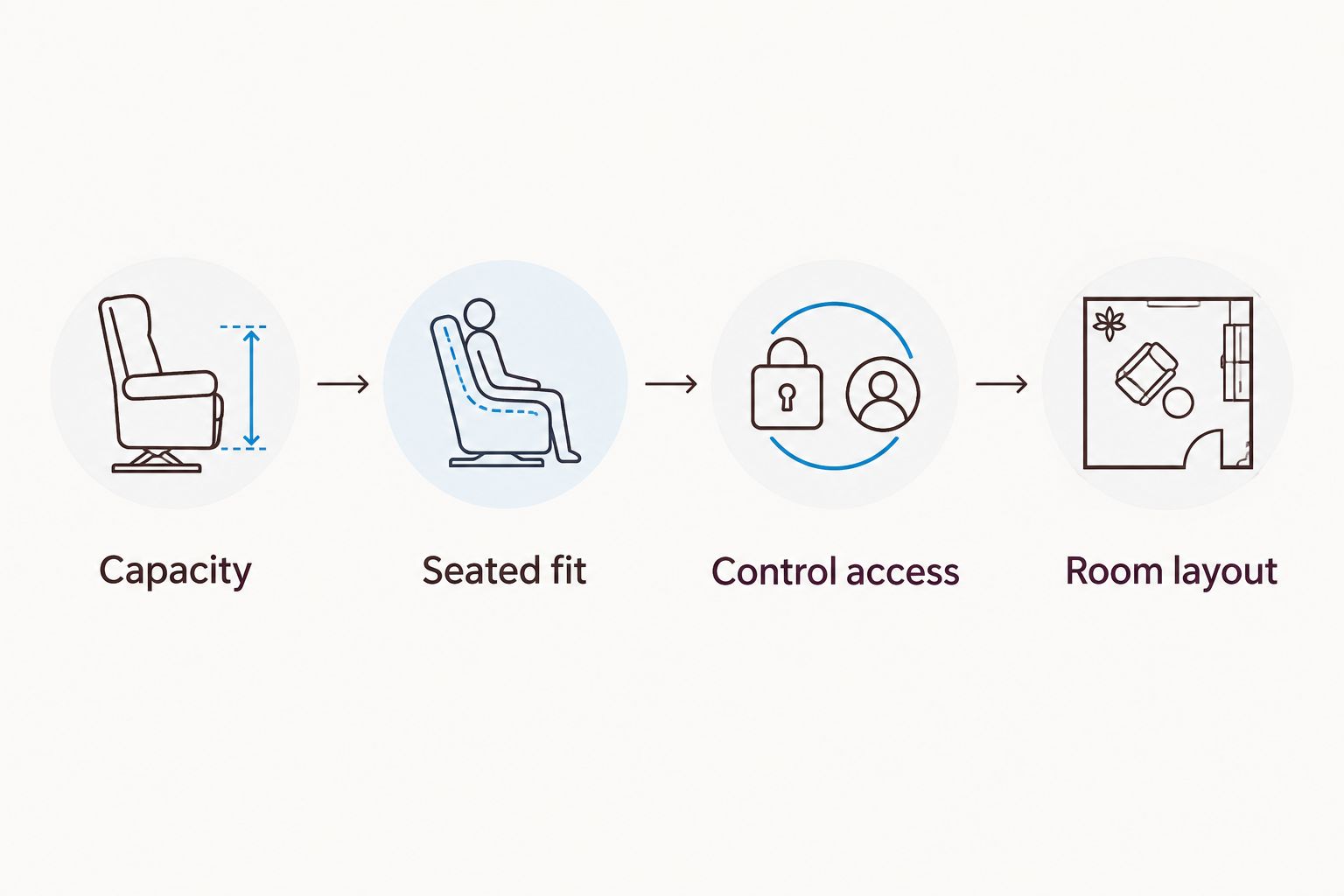
Capacity
Check the intended user's weight against the stated chair rating. Both shortlisted models are described as rated to 500 lb; neither should be described as supporting more than 500 lb. Follow the manufacturer's operating instructions and loading restrictions.
Seated fit
Compare seat width, height, and depth together. Check whether you can sit back with support and place your feet as required for your usual standing method. Assess arm access from that position rather than from a pose adopted only for the demonstration.
Control access
Locate the remote where you will actually use it. Check the lift command, the recline command, and how to stop movement. Ask for a demonstration if the symbols or sequence are unfamiliar.
Room layout
Plan the approach to the chair as well as the chair's footprint. Keep the route clear of loose objects and cords, and account for the space used by a caregiver or mobility aid. Follow the model's placement instructions rather than guessing its wall clearance.
The same assessment applies whether you shop for yourself or a relative. Let the intended user lead the comfort and control checks wherever possible; a caregiver's preferences do not replace the user's fit.
Match the chair to the transfer you actually need
“Ease of transfer” covers different movements. Standing from a seated position is not the same as moving sideways from another seat. Describe the movement you need help with before selecting a lift chair.
For sit-to-stand assistance, assess the supported seated position and the lifting function with appropriate help. Follow the chair's instructions, and use the transfer method recommended for you. Lift assistance is not a guarantee of independent standing or fall prevention.
For assisted transfers, include the caregiver in the room-layout assessment. Discuss where assistance is needed and whether the chair's placement allows that help. Do not assume a wider seat solves the difficulty.
For sideways transfers, ask a therapist to assess whether the chair's arms, seat arrangement, and surrounding space suit the method. Do not infer suitability from a lift function or weight rating. A lift chair is not a substitute for transfer equipment recommended for your needs.
How the shortlist is ranked
This 2026 ranking uses stated capacity, seat width, lift-chair function, and the named features relevant to fit. Titan leads for wide-seat assessment; GrandNest occupies the distinct narrower-seat, dual-motor comparison slot. No transfer-time results, user scores, or clinical outcomes determine the order.
Heat, massage, charging features, and resting positions do not outrank seated fit in a transfer-focused decision. They belong later in your comparison, after you establish that the chair accommodates your weight and supports your daily routine.
Which 500 lb lift chair should you choose?
Start with Titan when a 28-inch-wide seat is your priority. Start with GrandNest when you want to assess a 27-inch-wide seat and dual motors. Both choices still require a personal fit check.
For an undecided shopper, Titan is the default first assessment—not an automatic purchase. Compare GrandNest if Titan's width does not match your needs. Edward Creation's 500 lb lift-chair options should be narrowed by the person using them, not by a blanket claim that one model makes every transfer easier.
FAQ
What's the best 500 lb lift chair for easier transfers?
Titan is the first model to assess when a 28-inch-wide seat is your priority; GrandNest is the alternative with a 27-inch-wide seat and dual motors. The better transfer fit depends on seated position, control access, and the assistance you need.
Is Titan easier to get out of than GrandNest?
The stated specifications do not establish that Titan is easier to get out of than GrandNest. Titan has a 28-inch-wide seat, while GrandNest has a 27-inch-wide seat; compare personal fit and lift operation before choosing.
Does a 500 lb capacity mean a lift chair supports more than 500 lb?
No. A stated 500 lb capacity does not authorize use above 500 lb. Follow the manufacturer's rating and operating instructions.
Is a wider lift-chair seat always better for standing?
No. A wider seat provides more seating space, but you still need to assess seat height, depth, arm reach, and foot placement. Choose width as part of overall fit rather than as a stand-alone transfer feature.
Do dual motors make a lift chair easier to transfer from?
Dual motors alone do not establish easier transfers. Assess the specific controls, supported seating position, and lifting function with the intended user.
Can a zero-gravity recliner help me stand up?
Zero-gravity positioning alone does not provide lift assistance. A chair needs a lifting function to assist the transition toward standing; check that the selected model is a lift chair rather than a recliner alone.
Can I use a lift chair for a sideways transfer?
A sideways transfer requires an individual assessment of the chair and your transfer method. Ask an occupational or physical therapist to evaluate arm access, seat fit, and surrounding space before choosing.
One last thing
Ask to see the chair return from your favorite resting position to the position used before standing. That transition deserves as much attention as the lift itself. A chair you understand and fit comfortably is a better shopping target than a chair chosen only for its capacity label.