
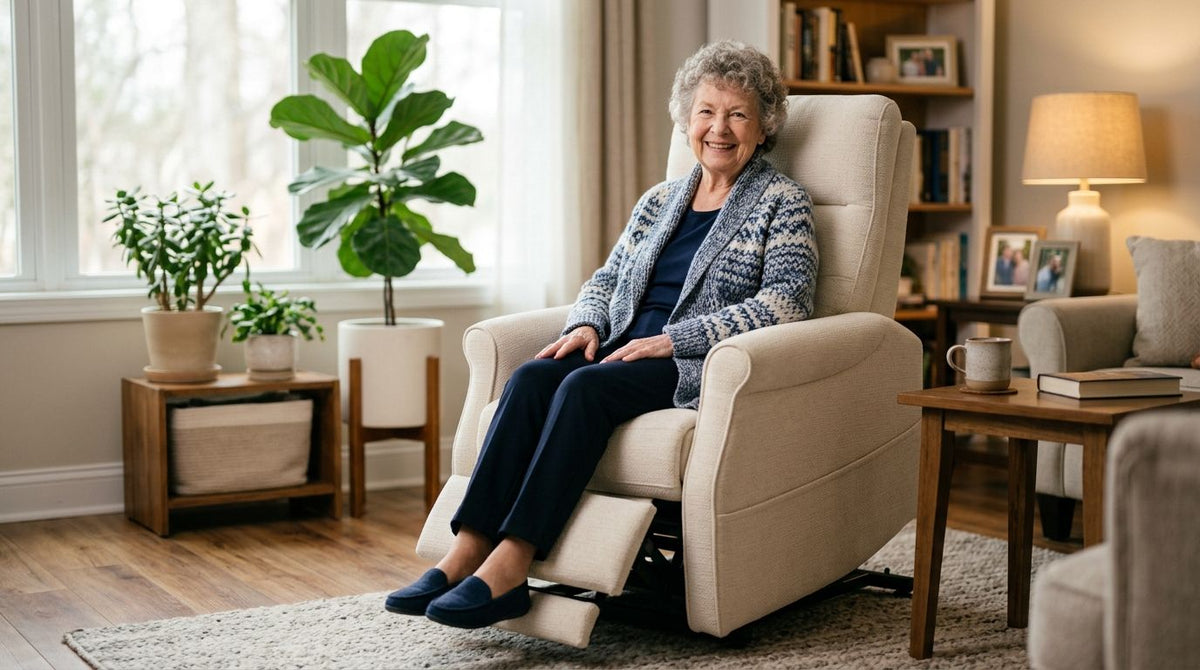
Most lift chairs on the market are built around a frame that's 5'8" to 5'10", and that default sizing is exactly why a lot of shorter adults end up sliding forward in the seat, missing the footrest edge, or straining to reach controls mounted for longer arms. The best lift chairs for small adults in 2026 fix three things at once: seat depth, seat height, and control placement — this guide ranks five configurations built or adjusted specifically for a petite frame.
- Petite-profile power lift recliners are the best lift chairs for small adults overall in 2026 thanks to shorter seat depth and lower seat height.
- Lay-flat lift chairs win for adults who nap or sleep upright; zero-gravity models win for circulation and leg swelling.
- Furniture sizing guides typically classify 'petite' as 5'4" and under, with seat depth trimmed to roughly 19 to 20 inches.
- Heat-and-massage lift chairs help with joint pain but rarely reduce seat depth, so fit still needs checking.
- A lighter-duty lift chair with a lower weight capacity is usually the budget pick for a smaller frame.
Why This Matters
A lift chair that's too deep pushes the knees past the front edge of the cushion, so the lower back loses support and the person ends up perched instead of seated. A lift chair that sits too high means the feet dangle instead of planting flat, which matters more for someone recovering from a hip or knee procedure than it does for an able-bodied user.
Aeva Vital breaks its lift chair guides down by these dimension mismatches instead of just brand name, because petite adults searching "best lift chairs for small adults" usually already know a standard recliner didn't work for them. The five picks below cover the actual use cases: general daily sitting, full recline for sleeping, circulation support, pain relief, and budget.
What Makes the Best Lift Chair for a Petite Frame
- Seat depth: shorter depth (roughly 19 to 20 inches vs. 21 to 22 inches on standard models) keeps knees at the cushion edge instead of past it.
- Seat height: a lower seat (roughly 17 to 18 inches) lets a 5'2" to 5'4" adult plant both feet flat while seated.
- Armrest height: armrests set too high force the shoulders up; petite-profile chairs lower this to match a shorter torso.
- Weight capacity matched to frame: a lighter-duty mechanism isn't a downgrade if the user's weight sits well under the chair's rated capacity.
- Control reach: hand pendant or button placement that a shorter arm can reach without leaning forward.
- Upholstery support at the lumbar: firmer padding at the lower back compensates for a smaller frame settling deeper into soft cushioning.
Lift Chairs for Petite Adults at a Glance
| Chair type | Best for | Standout feature | Key limitation |
|---|---|---|---|
| Petite-profile power lift recliner | Small frames overall | Shorter seat depth and lower seat height | Fewer recline positions than full lift systems |
| Lay-flat lift chair | Sleeping or all-day recline | Reclines to a near-horizontal position | Larger footprint needs more room clearance |
| Zero-gravity lift chair | Circulation and leg swelling | Elevates legs above heart level | Zero-gravity position isn't ideal for reading or TV |
| Heat-and-massage lift chair | Joint and muscle pain | Built-in heat and vibration zones | Seat depth often stays standard-size |
| Lightweight lower-capacity lift chair | Budget-conscious petite users | Lower weight rating keeps mechanism cost down | Not built for a user near the capacity ceiling |
1. Petite-Profile Power Lift Recliners: Best Lift Chair for Small Frames Overall
A petite-profile lift chair is a standard power lift recliner rebuilt with a shorter seat depth and a lower seat height, so a 5'2" to 5'4" adult sits with knees at the cushion edge and feet flat on the floor. It's the closest thing to a direct answer to "best lift chairs for small adults" because it doesn't ask the user to trade off recline range or lift assist to get proper fit.
Petite-profile lift chair pros:
- Feet reach the floor without a footstool
- Lower back stays supported instead of the torso sliding forward
- Armrests sit at a height a shorter arm can actually use
Petite-profile lift chair cons:
- Fewer recline positions than dedicated lay-flat models
- Petite sizing is a smaller share of most catalogs, so selection is narrower
Best for: daily sitting, reading, and general use for adults 5'4" and under. Verdict: Buy.
2. Lay-Flat Lift Chairs: Best Lift Chair for Sleeping or All-Day Recline
A lay-flat lift chair reclines close to horizontal, which matters for someone who naps in the chair or spends most waking hours in it after surgery or during a long recovery. On a petite frame, lay-flat models still need the shorter seat depth check — a full recline doesn't fix a seat that's too deep.
Lay-flat lift chair pros:
- Near-horizontal recline reduces pressure points during long sitting stretches
- Useful for adults who can't comfortably use a bed for daytime rest
- Pairs well with a smaller frame if the seat depth is also petite-sized
Lay-flat lift chair cons:
- Larger reclined footprint needs more floor clearance than a standard lift chair
- Full lay-flat units tend to weigh more, which matters for room layout
Best for: adults who sleep or nap upright for medical or comfort reasons. Verdict: Buy.
3. Zero-Gravity Lift Chairs: Best Lift Chair for Circulation and Leg Swelling
A zero-gravity recliner tilts so the legs sit above heart level, a position associated with reduced lower-leg swelling and easier circulation for adults who sit for long stretches. Petite adults benefit the same way larger adults do, but again the seat depth and height need to be checked separately from the zero-gravity feature.
Zero-gravity lift chair pros:
- Elevates legs above heart level to ease swelling
- Distributes body weight across the recline angle instead of concentrating it at the hips
- Works well alongside a heat or massage add-on
Zero-gravity lift chair cons:
- The zero-gravity angle isn't practical for reading, eating, or working from the chair
- Not every zero-gravity model comes in a petite seat depth
Best for: adults managing edema, poor circulation, or post-surgical leg swelling. Verdict: Buy.
4. Heat-and-Massage Lift Chairs: Best Lift Chair for Joint and Muscle Pain
A heat-and-massage lift chair adds warming pads and vibration zones at the lumbar, seat, and sometimes the calves, aimed at adults managing arthritis, sciatica, or general muscle stiffness. This category is defined by the feature set, not the frame size, so a petite adult still has to confirm seat depth and height separately — heat and massage don't change how the chair fits the body.
Heat-and-massage lift chair pros:
- Built-in heat can ease stiffness before or after getting up
- Massage zones target lower back and thighs, common pain points from sitting
- No separate heating pad or massager needed
Heat-and-massage lift chair cons:
- Seat depth on most heat-and-massage models stays at standard size, not petite
- Extra electronics add another control layer to learn
Best for: adults managing chronic joint or muscle pain who also need a petite-sized seat. Verdict: Hold until seat depth is confirmed petite-sized.
5. Lightweight Lower-Capacity Lift Chairs: Best Budget Lift Chair for a Petite Frame
A lift chair rated for a lower maximum weight typically uses a lighter lift mechanism and frame, which usually costs less than a heavy-duty version rated for 300+ lbs. For a petite adult who doesn't need that higher capacity, a lower-rated mechanism isn't a compromise — it's matched to the actual load. Checking where a specific model sits on the weight capacity spectrum before buying avoids paying for capacity that goes unused.
Lightweight lift chair pros:
- Lower price point than heavy-duty rated chairs
- Often lighter overall, easier to move or reposition in a room
- Mechanism matched to actual user weight rather than oversized
Lightweight lift chair cons:
- Not suitable if weight fluctuates upward over time
- Fewer premium features like dual motors or memory positions
Best for: petite adults on a tighter budget who don't need a high weight rating. Verdict: Buy if current weight sits well under the chair's capacity.
How We Ranked These Lift Chairs
Each category was scored against the six fit criteria above — seat depth, seat height, armrest height, weight-capacity match, control reach, and lumbar support — then matched to the use case where that configuration solves a real problem instead of adding a feature for its own sake. A chair that nails recline range but ignores seat depth still fails a petite adult, which is why every entry above gets both pros and cons instead of a blanket recommendation.
Which Lift Chair Should You Choose?
For most petite adults, the petite-profile power lift recliner is the right starting point in 2026 — it fixes the core fit problem (seat depth and height) without asking for a tradeoff elsewhere. Add lay-flat recline if the chair doubles as a daytime sleeping spot, add zero-gravity if swelling or circulation is the main concern, and check the weight-capacity chart before assuming a lighter-duty chair is a downgrade. Skip any chair — heat-and-massage models included — that doesn't list a petite or adjustable seat depth option.
FAQ
What makes a lift chair good for petite adults?
A petite-friendly lift chair has a shorter seat depth (roughly 19 to 20 inches) and a lower seat height (roughly 17 to 18 inches) so the feet reach the floor and the knees sit at the cushion edge. Armrest height matters too, since standard armrests sit too high for a shorter torso.
How much shorter should the seat depth be for a small frame?
Petite seat depth typically runs 19 to 20 inches, compared to 21 to 22 inches on standard lift chairs. That two-to-three-inch difference is usually enough to stop the knees from sliding past the cushion edge.
Are zero-gravity lift chairs good for small adults?
Yes, zero-gravity lift chairs help small adults the same way they help anyone else, elevating the legs above heart level to ease swelling and circulation. Seat depth and height still need to be checked separately, since zero-gravity is a recline feature, not a sizing feature.
Do lift chairs come in petite sizes?
Some lift chair lines offer a petite-profile version with reduced seat depth and height, though the selection is narrower than standard sizing. Checking the seat dimensions listed for each model is the only reliable way to confirm petite fit.
What's the best lift chair for a 5-foot-tall person?
A petite-profile power lift recliner with roughly 19 to 20 inches of seat depth and 17 to 18 inches of seat height is the best starting point for someone around 5 feet tall. Full recline or heat-and-massage features can be added on top once the base fit is confirmed.
Is a lay-flat lift chair better than a standard recliner for petite frames?
A lay-flat lift chair is better for someone who sleeps or naps upright, but it isn't automatically better sized for a petite frame. Seat depth and height still need to match the user's height regardless of how far the chair reclines.
How much do lift chairs cost in 2026?
Lift chair pricing varies widely by brand, feature set, and weight capacity, so checking current pricing directly on a retailer's site is more reliable than any fixed figure. Heat-and-massage and lay-flat features generally add cost over a base power lift recliner.
Can petite adults use heavy-duty lift chairs?
Yes, but a heavy-duty lift chair rated for 300+ lbs is usually oversized for a petite adult's actual weight and doesn't solve the seat depth or height problem on its own. A lighter-duty, petite-profile chair typically fits better and costs less.
One Last Thing
The detail most petite shoppers miss isn't the lift mechanism at all — it's armrest height. A chair with the right seat depth but armrests set for a 5'9" frame still forces the shoulders up every time the arms rest, which defeats the point of getting the seat dimensions right in the first place. Check armrest height alongside seat depth before finalizing any pick from this list.