
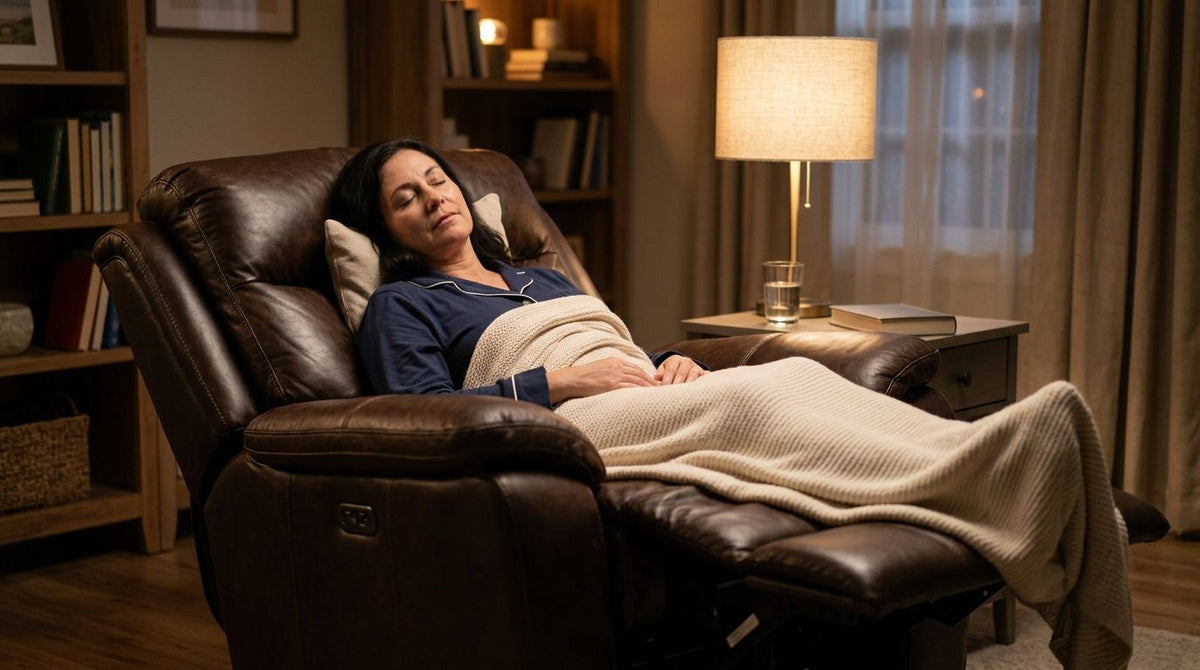
Sleeping in a recliner every night — because of sleep apnea, GERD, post-surgical mobility limits, or a preference for an upright position — is common in 2026, and the recliner type you pick decides whether that habit helps your spine or wrecks it. This guide ranks recliners by the specific nightly-sleep problem each one solves, not by brand hype.
- Best recliner for sleeping every night overall: a zero gravity recliner, which floats the spine neutral and elevates legs above heart level.
- Best for small bedrooms: a wall hugger recliner that reclines within a few inches of the wall.
- Best for reduced mobility: a power lift recliner with a motorized lift-assist seat.
- Best for pre-sleep reading or streaming: a power recliner with USB charging and built-in heat or massage.
- If nightly recliner sleep causes hip or shoulder soreness by 2026 standards of sleep hygiene, the fix is usually a hybrid mattress, not a bigger recliner.
Why this matters
People sleep in recliners nightly for real medical reasons: acid reflux eases when the torso stays elevated, edema in the legs drains better when feet sit above heart level, and post-surgical patients often can't lie flat for weeks. Chiropractors also flag the downside — a recliner that doesn't hold the lumbar curve for six to eight hours can leave the neck and hips misaligned by morning, night after night.
That's the tension this list resolves. Not every recliner built for daytime lounging is built for nightly sleep, and the difference shows up in recline angle, lumbar support, and how the frame holds a body still for hours instead of minutes.
What makes the best recliner for everyday sleeping
- Full recline range — most nightly-sleep recliners hit somewhere between 130 and 180 degrees for a near-flat position.
- Independent leg and back adjustment — separate motors or levers let you dial in an elevation angle instead of one fixed recline.
- Lumbar support that holds — the seat back needs to keep the lower spine's natural curve for a full night, not just a nap.
- Wall clearance — matters if the chair sits in a small bedroom rather than an open living room.
- Weight capacity matched to the user — a chair rated for an average adult sags fast under a larger frame used nightly.
- Simple nightly operation — a remote or lift-assist that works half-asleep at 2 a.m. beats a manual lever every time.
Recliners for everyday sleeping at a glance
| Recliner type | Best for | Standout feature | Key limitation |
|---|---|---|---|
| Zero Gravity Recliner | Full-body pressure relief for nightly sleep | Legs elevate above heart level, spine sits neutral | Bulkier footprint, needs several feet of recline clearance |
| Wall Hugger Recliner | Small bedrooms and apartments | Slides forward on the seat so it reclines near the wall | Recline angle is usually shallower than zero gravity models |
| Swivel Rocker Recliner | Everyday multi-position comfort | Rocks and swivels 360 degrees, easy day-to-night switch | Limited flat recline, weak fit for GERD or apnea elevation |
| Power Lift Recliner | Reduced mobility, getting up solo | Motorized lift tilts the whole chair forward to standing | Needs a nearby outlet, more moving parts than a manual chair |
| Power Recliner with USB Charging | Falling asleep reading or streaming | Built-in USB ports, often paired with heat and massage | More electronics mean more parts that can fail over years |
| Heavy-Duty Big & Tall Recliner | Larger-frame nightly sleepers | Reinforced frame and wider seat depth | Larger overall footprint, fewer style choices |
1. Zero Gravity Recliner: best recliner for sleeping every night for full-body pressure relief
A zero gravity recliner tilts so the legs sit above the heart and the seat back and leg rest move together, distributing body weight evenly across the frame instead of concentrating it at the hips and lower back. It's the closest a recliner gets to replicating the position astronauts use to reduce spinal load, which is why it's become the default recommendation for nightly recliner sleepers dealing with lower back pain or poor circulation.
Zero Gravity Recliner pros:
- Distributes weight evenly, easing pressure on the lumbar spine over a full night
- Elevates legs above heart level, which helps with swelling and mild circulation issues
- Most models offer a near-flat recline angle suited to actual sleep, not just lounging
Zero Gravity Recliner cons:
- Takes up more floor space than a standard recliner when fully reclined
- Heavier frames make repositioning the chair in a room harder
Zero Gravity Recliner verdict: Buy if nightly recliner sleep is a long-term habit and lower back or leg swelling is the main complaint.
2. Wall Hugger Recliner: best recliner for sleeping every night in a small bedroom
A wall hugger recliner uses a sliding-seat mechanism instead of the traditional back-swing recline, so the chair only needs a few inches of clearance from the wall to fully open. That makes it the practical pick for a small bedroom, a studio apartment, or a room where a full zero gravity chair simply won't fit.
Wall Hugger Recliner pros:
- Fits rooms where a standard or zero gravity recliner has no clearance to recline
- Frees up floor space for a nightstand, dresser, or walking path
- Works well against a wall shared with a headboard in a combined sleep-and-lounge room
Wall Hugger Recliner cons:
- Recline angle typically falls short of the near-flat position zero gravity models offer
- Sliding mechanisms have more parts that can wear or squeak with nightly use
Wall Hugger Recliner verdict: Buy if square footage is the limiting factor, not spinal pressure relief.
3. Swivel Rocker Recliner: best recliner for sleeping every night as an everyday multi-position chair
A swivel rocker recliner rocks, swivels a full 360 degrees, and reclines, which makes it the most versatile option for someone who uses the chair all day and only sometimes sleeps in it overnight. It's built for comfort variety, not maximum flat recline.
Swivel Rocker Recliner pros:
- Handles daytime lounging, TV watching, and occasional overnight sleep in one chair
- Swivel function makes it easy to face a room, a window, or a TV without moving the chair
- Generally lighter and easier to reposition than zero gravity or lift models
Swivel Rocker Recliner cons:
- Recline angle rarely reaches the near-flat position needed for GERD or sleep apnea elevation
- Rocking base isn't ideal for someone who needs the chair fully stationary while sleeping
Swivel Rocker Recliner verdict: Hold for occasional overnight use; skip it as a primary nightly-sleep solution if elevation is medically necessary.
4. Power Lift Recliner: best recliner for sleeping every night with reduced mobility
A power lift recliner adds a motorized lift function that tilts the entire chair forward, helping someone stand up without pushing off the armrests. For people who sleep in a recliner nightly because lying flat is difficult after surgery or due to a mobility condition, the lift function solves the getting-in-and-out problem that other recliner types don't address.
Power Lift Recliner pros:
- Motorized lift reduces strain on knees and hips when standing up, especially at night
- Independent back and leg motors allow a custom elevation angle for reflux or edema
- Remote control operation works well for users with limited grip strength
Power Lift Recliner cons:
- Requires a nearby power outlet, which limits placement in some rooms
- More motors and electronics than a manual recliner means more that can eventually need service
Power Lift Recliner verdict: Buy if getting up unassisted is a daily concern alongside nightly sleep needs.
“If you wake up with hip or shoulder soreness after months of recliner sleep, that's the body flagging a mattress problem, not a recliner problem.”
5. Power Recliner with USB Charging: best recliner for sleeping every night for reading or streaming beforehand
A power recliner with USB charging is built around the pre-sleep routine as much as the sleep itself — built-in ports keep a phone, tablet, or e-reader charged without a bedside cord, and many models pair the charging port with heat and massage functions. It's a good fit for someone whose nightly recliner sleep starts with an hour of reading or a show.
Power Recliner with USB Charging pros:
- Keeps devices charged without a separate charging station next to the chair
- Heat and massage functions common on these models help with pre-sleep muscle tension
- Convenient for a recliner that doubles as a media chair before it becomes a sleep chair
Power Recliner with USB Charging cons:
- More electronics packed into the chair, which is more that can fail over years of nightly use
- Charging and massage features add bulk and cost without improving the actual recline angle
Power Recliner with USB Charging verdict: Buy if the pre-sleep routine matters as much as the sleep position; skip it if elevation angle is the priority.
6. Heavy-Duty Big & Tall Recliner: best recliner for sleeping every night for larger frames
A heavy-duty big and tall recliner uses a reinforced frame and a wider, deeper seat built to hold up under nightly use from a larger body. Standard recliners rated for an average adult sag and lose lumbar support fast when used every night by someone outside that weight range — a reinforced frame is the fix.
Heavy-Duty Big & Tall Recliner pros:
- Reinforced frame holds shape and support through nightly use over years, not months
- Wider seat depth accommodates larger frames without cramping the hips or shoulders
- Higher weight capacity than standard recliner frames
Heavy-Duty Big & Tall Recliner cons:
- Larger overall footprint needs more room clearance than a standard-size recliner
- Fewer style and upholstery options compared to standard-size lines
Heavy-Duty Big & Tall Recliner verdict: Buy if body size, not medical elevation need, is the main sleeping-in-a-recliner challenge.
How we ranked these
Each recliner type here was matched to one distinct nightly-sleep problem — pressure relief, room size, mobility, pre-sleep habits, or body size — using the six criteria above: recline range, independent leg and back adjustment, lumbar support that holds overnight, wall clearance, weight capacity, and ease of nightly operation. No two entries compete for the same use case, so the list reads as a decision tree: pick the row that matches your actual problem, not the one with the most features.
Which recliner should you choose for everyday sleeping?
The zero gravity recliner is the default pick for anyone sleeping in a recliner nightly without a specific mobility or space constraint — it's the only type built around full-body pressure relief rather than a single convenience feature. If space is the constraint, the wall hugger recliner wins instead. If getting up unassisted matters, the power lift recliner is the right call regardless of what else is on the list.
One thing worth saying plainly: a recliner is a workaround, not a permanent sleep solution, for most healthy adults. If nightly recliner sleep started as a temporary fix and turned into a permanent habit, a hybrid mattress ranked to the right firmness level solves the pressure-point problem at its source instead of managing it chair by chair.
Compare hybrid mattresses for nightly sleep
See Aeva Vital's hybrid mattress lineup built for full-time sleepers in 2026.
FAQ
What is the best recliner for sleeping every night?
A zero gravity recliner is the best recliner for sleeping every night for most people because it elevates the legs above heart level and distributes weight evenly across the spine. Power lift recliners are the better choice when reduced mobility, not pressure relief, is the main concern.
Is it bad to sleep in a recliner every night?
Sleeping in a recliner every night isn't automatically bad, but a chair that doesn't hold the lumbar curve for a full night can cause neck and hip misalignment over months. Choosing a recliner built for a near-flat recline angle, like a zero gravity model, reduces that risk.
What's the difference between a zero gravity recliner and a regular recliner?
A zero gravity recliner tilts so the legs sit above the heart and the back and leg rest move together as one motion, spreading weight evenly. A regular recliner typically reclines at a fixed angle without that even weight distribution.
Can a wall hugger recliner fully recline for sleep?
Most wall hugger recliners recline enough for comfortable overnight use, but the angle is usually shallower than a zero gravity model. They're the right trade-off when room size is the limiting factor rather than maximum recline.
How much recline angle do you need to sleep comfortably in a recliner?
Recliners built for nightly sleep typically recline between 130 and 180 degrees, with 180 degrees being a near-flat position. Anything under that range is better suited to naps than full nights.
Are power lift recliners good for sleeping every night?
Power lift recliners work well for nightly sleep when reduced mobility is the primary concern, since the motorized lift helps with standing up unassisted. They typically also offer independent back and leg adjustment for a custom elevation angle.
Do recliners cause back pain over time?
A recliner without proper lumbar support can contribute to back pain when used for sleep every night over months, because the spine loses its natural curve support for hours at a stretch. Zero gravity and power lift models with adjustable lumbar support reduce that risk.
Should I switch from a recliner to a mattress?
If nightly recliner sleep is causing hip or shoulder soreness and there's no ongoing medical reason for elevation, switching to a hybrid mattress at the right firmness level usually addresses the root pressure-point issue better than a bigger recliner.
One last thing
The detail most people miss: the recliner isn't always the fix, it's the diagnostic. If you've cycled through two or three recliner types since 2026 started and still wake up sore, the problem probably isn't the chair — it's that a flat sleep surface with the right firmness was the answer all along, and the recliner was just buying time.