

Best starting point: a manual wall-hugger recliner if you can comfortably operate it; best for easier adjustment: a power wall-hugger recliner. Edward Creation’s Nimbus Zero-Gravity Power Recliner with Power Headrest and Wall-Hugger Design is a feature comparison, not a verified pick for the budget in this search; this 2026 guide helps you choose by room fit, seat fit, and everyday use.
- For wall hugger recliners under $500, check room fit and operating effort before comparing extras.
- Manual wall-hugger recliners suit shoppers who can comfortably operate the reclining mechanism.
- Power wall-hugger recliners suit shoppers who prefer powered adjustment and have a suitable outlet nearby.
- Edward Creation’s Nimbus combines wall-hugger design, zero-gravity reclining, and a power headrest; treat it as a feature comparison.
Why this matters
A recliner can fit against your wall and still crowd the room when its footrest opens. You need to check the chair in use, not just its upright footprint.
The same distinction applies to comfort. A narrow outside width does not tell you whether the seat supports your legs, whether the arms feel cramped, or whether you can close the footrest comfortably. Choose the chair you can use easily, not the one with the longest feature list.
For your 2026 shortlist, keep wall-hugger design separate from other reclining features. Zero-gravity positioning describes a reclining position; power describes adjustment; lift assistance helps move the seat toward a standing position. None of those terms automatically confirms the others.
What makes the best wall-hugger recliner?
Use these criteria before you compare models:
- Documented wall clearance: Look for the specific model’s required distance from the wall. Do not substitute a general rule for its instructions.
- Open-chair footprint: Check the fully reclined length and the space needed for the footrest, nearby furniture, and your walking route.
- Usable seat fit: Compare seat width, depth, and height with a chair you already find comfortable. Overall width includes the arms.
- Manageable controls: Choose manual or powered adjustment according to what you can comfortably operate, including returning the chair upright.
- Delivery access: Check doorway openings, hallway turns, and the chair’s delivery configuration before ordering.
- Relevant features: Headrest adjustment and reclining positions should solve a real comfort need. They do not replace a good fit.
Treat the first five criteria as requirements. The last one helps you decide between chairs that already work for your body and your room.
Wall-hugger options at a glance
These are ranked shopping routes, not a list of models confirmed within the requested budget. Nimbus is the named feature reference; the other entries describe designs to look for when comparing current listings.
| Option | Best for | Standout feature | Key limitation |
|---|---|---|---|
| Manual wall-hugger recliner | Simple reclining without an electrical connection | Manually operated reclining mechanism | You must comfortably operate and close the mechanism |
| Basic power wall-hugger recliner | Powered adjustment without unnecessary extras | Button-operated reclining | Requires a suitable power connection; controls vary by model |
| Nimbus Zero-Gravity Power Recliner | Shoppers comparing powered headrest adjustment and reclining positions | Wall-hugger design, zero-gravity reclining, and power headrest | Recliner-only design, not lift assistance; check fit separately |
A wall-hugger label is not a room-fit guarantee. The deciding evidence is the model’s clearance instructions and dimensions in the position you intend to use.
1. Manual wall-hugger recliner: best for straightforward reclining
A manual wall-hugger recliner combines a space-saving reclining mechanism with manual operation. Depending on the model, you use a handle, lever, or body movement to adjust it. Check the actual operating method rather than assuming every manual recliner works the same way.
This is the first design to consider when you want basic reclining and do not need powered adjustment. Its suitability depends on your ability to operate the chair comfortably, especially when bringing the footrest back down.
Manual wall-hugger recliner pros:
- Does not require electrical power for manual reclining.
- Keeps the shopping decision focused on fit and the reclining mechanism.
- Suits a location where a power cord would complicate the layout.
Manual wall-hugger recliner cons:
- Operating and closing the mechanism requires physical effort.
- Adjustment positions and control methods vary between models.
- Manual operation does not provide lift assistance.
Best for: You can comfortably work the reclining mechanism and want a straightforward chair without powered controls.
Before choosing one, try the complete movement: sit down, recline, close the footrest, and stand up. A chair that opens easily but is difficult to close is not an easy chair for your daily routine. If you cannot try it, request clear instructions or a demonstration of that exact model.
Verdict: Buy only after confirming wall clearance, seat fit, and comfortable operation. Skip manual operation if closing the footrest is a struggle.
2. Basic power wall-hugger recliner: best for easier adjustment
A basic power wall-hugger recliner uses powered controls to change its reclining position. It suits shoppers who prefer operating buttons to working a manual mechanism. The number of controls and the way the back and footrest move depend on the model.
Keep your requirements simple. If your main goal is to sit back and raise your feet without manually operating the chair, start there rather than building your shortlist around heat, massage, or charging features.
Basic power wall-hugger recliner pros:
- Powered adjustment replaces manual operation of the reclining movement.
- Controls let you adjust while seated.
- A straightforward control layout can keep everyday use simple.
Basic power wall-hugger recliner cons:
- Needs a suitable electrical connection for powered operation.
- Backup operation must be confirmed for the particular model.
- Power reclining alone does not help lift you toward standing.
Best for: You want powered reclining, have a suitable outlet nearby, and do not need a lifting seat.
Look closely at the controls before deciding. Check whether you can reach them while seated, identify the buttons, and return the chair upright without confusion. If someone else will use the chair, let that person judge the controls rather than choosing on their behalf.
For a 2026 purchase, confirm how the selected chair operates during a power interruption. Do not assume a battery accessory is included or compatible because another chair offers one.
Verdict: Buy when the controls suit you and the documented footprint fits. Hold if power-interruption operation is essential but unclear.
3. Nimbus: best for comparing headrest and reclining features
The Nimbus Zero-Gravity Power Recliner combines wall-hugger design, powered reclining, and a power headrest. Those named features make it a useful reference when you want to understand what a more feature-focused recliner adds to basic reclining.
Edward Creation’s Nimbus wall-hugger recliner is best suited to shoppers comparing powered reclining with adjustable head support, not shoppers seeking lift assistance. Keep it separate from any shortlist that requires confirmed eligibility for your spending limit.
Nimbus pros:
- Wall-hugger design is explicitly identified in the model name.
- Powered reclining avoids a manually operated reclining mechanism.
- Power headrest adjustment is a named feature.
- Zero-gravity reclining is a named feature.
Nimbus cons:
- It is a recliner, not a lift chair.
- Wall-hugger design does not establish a universal clearance distance.
- Seat fit, room fit, and control suitability still require individual checks.
Best for: You want to compare a wall-hugger recliner with powered headrest adjustment and zero-gravity reclining.
When considering Nimbus, make a short list of the features you would actually use. If headrest adjustment is central to your comfort, examine it closely. If straightforward reclining is enough, keep the simpler manual and power categories in your comparison.
The Edward Creation wall-hugger recliner example should help clarify features, not distract you from your original requirements. Verdict: Hold until its current purchase terms and documented dimensions match your requirements; skip it if you need lift assistance.
Measure the room before choosing the chair
A useful room check follows the chair’s movement, not just the outline of its base. Measure the intended location, then compare it with the exact model’s upright and fully reclined dimensions.
Work through this sequence:
- Wall clearance: Measure from the position specified in the chair’s instructions. Include baseboards, window trim, or other obstacles behind it.
- Footrest space: Check the area in front of the chair when fully open. A nearby coffee table must not prevent the intended movement.
- Walking route: Keep access to the room and other furniture usable with the chair reclined.
- Doorway access: Measure the narrowest opening and check turns along the delivery route.
- Outlet access: For powered chairs, plan a cord route that does not cross a walking path or interfere with moving parts.
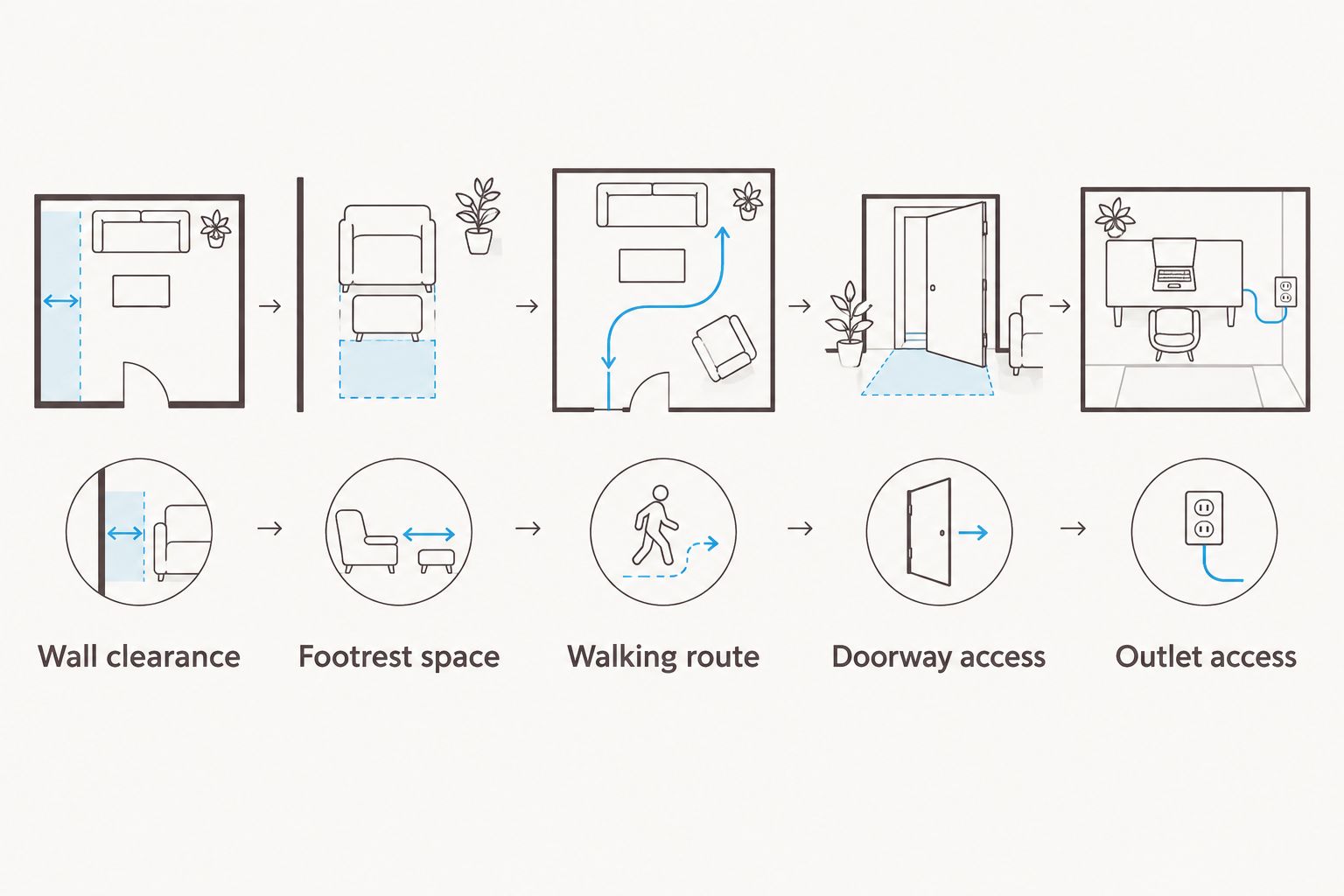
Use removable tape to mark the chair’s documented footprint on the floor. Mark the fully open position too, then walk around it as you normally would. This makes conflicts with tables, door swings, and room access easier to spot before the chair arrives.
A wall-hugger mechanism saves space behind the chair by moving the seat forward as it reclines. That does not eliminate the space needed in front. If the open footprint blocks your route, a different placement or chair size is the better answer.
Check seat fit separately from room fit
Your room can accommodate a chair that does not accommodate you comfortably. Start with a familiar chair and compare its usable seat dimensions with the recliner you are considering.
Check these points while seated:
- Your feet have comfortable support in the upright position.
- The seat edge does not press uncomfortably behind your knees.
- You can rest your arms without feeling squeezed between the armrests.
- The back and head support meet you where you need support.
- You can reach the controls without an awkward stretch.
Do not equate a large outside width with a wide seat. Thick arms can take up room without adding usable sitting space. Likewise, a compact chair is not automatically suitable for a shorter adult; seat height and depth matter separately.
If you are shopping for a parent or partner, use that person’s measurements and preferences. Ask about their current chair: what feels comfortable, what makes standing difficult, and which controls they find easy. Those answers give you a more useful shortlist than choosing upholstery first.
How these shopping routes are ranked
This 2026 ranking puts everyday operation ahead of extras. Manual wall-hugger reclining comes first for shoppers who can operate it comfortably; basic powered reclining follows for shoppers who prefer powered adjustment. Nimbus provides the named comparison for additional headrest and reclining features.
The order is not a claim that manual chairs are more comfortable or that powered chairs fit smaller rooms. Comfort and clearance belong to the individual model. A chair moves onto your shortlist only after it passes your fit and operating checks.
These recommendations follow the criteria above: documented clearance, open footprint, seat fit, controls, access, and relevant features. They are not presented as hands-on test results.
Which wall-hugger recliner should you choose?
Choose a manual wall-hugger recliner as your default only if operating it feels comfortable. Choose a basic power wall-hugger recliner when powered adjustment solves a real difficulty and the room has a suitable power connection.
Use Nimbus as the feature comparison when you want a power headrest and zero-gravity reclining. Do not treat those features as substitutes for checking clearance or as evidence of lift assistance.
For your final 2026 decision, write down the requirements you will not compromise on. Include operating method, usable seat dimensions, documented clearance, and delivery access. If a listing does not establish a requirement, get the answer before ordering rather than assuming the chair will work.
FAQ
What’s the best way to choose wall hugger recliners under $500?
Choose by documented wall clearance, seat fit, and operating effort before comparing extras. Confirm that the specific model meets your spending limit under its current purchase terms; do not infer eligibility from a roundup title.
Is a manual wall-hugger recliner better than a power one?
A manual wall-hugger recliner is the better match when you can comfortably operate it and prefer reclining without electrical power. A power model is the better match when you prefer powered adjustment and have a suitable power connection.
How close can a wall-hugger recliner sit to the wall?
Use the clearance specified for the exact model. Wall-hugger design does not establish one universal distance, and trim or other obstacles behind the chair still need consideration.
Does a wall-hugger recliner need space in front?
Yes, a wall-hugger recliner needs room for its forward movement and open footrest. Check its fully reclined dimensions and keep your walking route usable.
Can the Nimbus recliner help lift me to standing?
Nimbus is a power recliner, not a lift chair. Its wall-hugger design, zero-gravity reclining, and power headrest do not provide lift assistance.
Is zero-gravity reclining the same as wall-hugger design?
No, zero-gravity describes a reclining position, while wall-hugger describes the space-saving reclining mechanism. A chair can include both features, but one term does not establish the other.
What should I check before ordering a wall-hugger recliner online?
Check the model’s seat dimensions, upright and reclined footprint, required wall clearance, controls, and delivery configuration. For powered models, also confirm the power connection and any required power-interruption operation.
One last thing
Try the movement you are most likely to overlook: returning upright and getting out. Reclining is only half the routine. A chair that feels comfortable while resting can still be the wrong choice if its controls or footrest make leaving it difficult.
Before you finish your 2026 shortlist, picture the chair in use during an ordinary evening—not an empty showroom. Keep the table, lamp, walking route, and outlet in the plan. That is how you choose a recliner that fits your daily life as well as your room.