

Medicare Part B covers a lift chair's seat lift mechanism, not the chair itself, and only after your doctor documents five specific medical criteria tied to severe arthritis or a neuromuscular disease. Skip the face-to-face exam or miss one of those five boxes, and the claim gets denied before it ever reaches a supplier in 2026.
- Medicare covers 80% of the seat lift mechanism cost only, never the chair's frame or fabric, in 2026.
- You need a face-to-face exam plus a physician-signed order documenting five specific medical criteria.
- The supplier must be Medicare-enrolled or the claim pays nothing at all.
- Battery backup, delivery, heat and massage features are out-of-pocket costs Medicare never reimburses.
- Weight capacity does not change reimbursement — a 500-lb capacity lift chair qualifies under the same rules as a standard one.
Why this matters
Most people shopping for a lift chair assume Medicare pays for the whole thing. It doesn't. The Durable Medical Equipment (DME) category that applies here is the seat lift mechanism, billed under HCPCS code E0627 — the motorized part that tilts and raises the seat, not the recliner wrapped around it.
That distinction is the single biggest reason claims get denied in 2026. Families order a chair, expect a reimbursement check, then find out the supplier billed the entire unit as one line item instead of separating the lift mechanism cost. Get the documentation right before you buy, not after.
How to qualify for Medicare lift chair coverage
Qualifying is a paperwork sequence, not a purchase decision. Follow it in order:
- Schedule a face-to-face exam with your treating physician — this has to happen before the order is written, not after you've already bought a chair from Edward Creation or anywhere else.
- Have the physician document severe arthritis of the hip or knee, or a severe neuromuscular disease in your medical record. General weakness or "getting older" doesn't meet the bar.
- Confirm in the chart that you're completely unable to stand up from a regular armchair without assistance, but that you can walk once you're upright, with or without a cane or walker.
- Get a written order for the seat lift mechanism, dated after the exam, signed by the physician — not a verbal recommendation.
- Buy from a Medicare-enrolled DME supplier. If the supplier isn't enrolled, Medicare pays nothing regardless of how solid your paperwork is.
- Submit the claim so Medicare can reimburse 80% of the allowed amount for the E0627 lift mechanism after your Part B deductible is met.
Skip step one and the whole chain collapses — a chair bought before the exam almost never qualifies retroactively.
The five medical conditions Medicare requires for lift chair coverage
These five criteria come from CMS's own coverage policy for seat lift mechanisms, and a physician has to document all five, not just one or two:
- You have severe arthritis of the hip or knee, or a severe neuromuscular disease.
- The seat lift mechanism is part of your physician's course of treatment, not a comfort upgrade.
- You're completely incapable of standing up from a regular armchair, or any chair, without help.
- Once you're standing, you can walk independently, with a cane, or with a walker.
- Other treatment options that could get you standing on your own have already been tried and haven't worked.
Miss any one of these, and the claim gets rejected on medical necessity grounds, not paperwork technicalities.
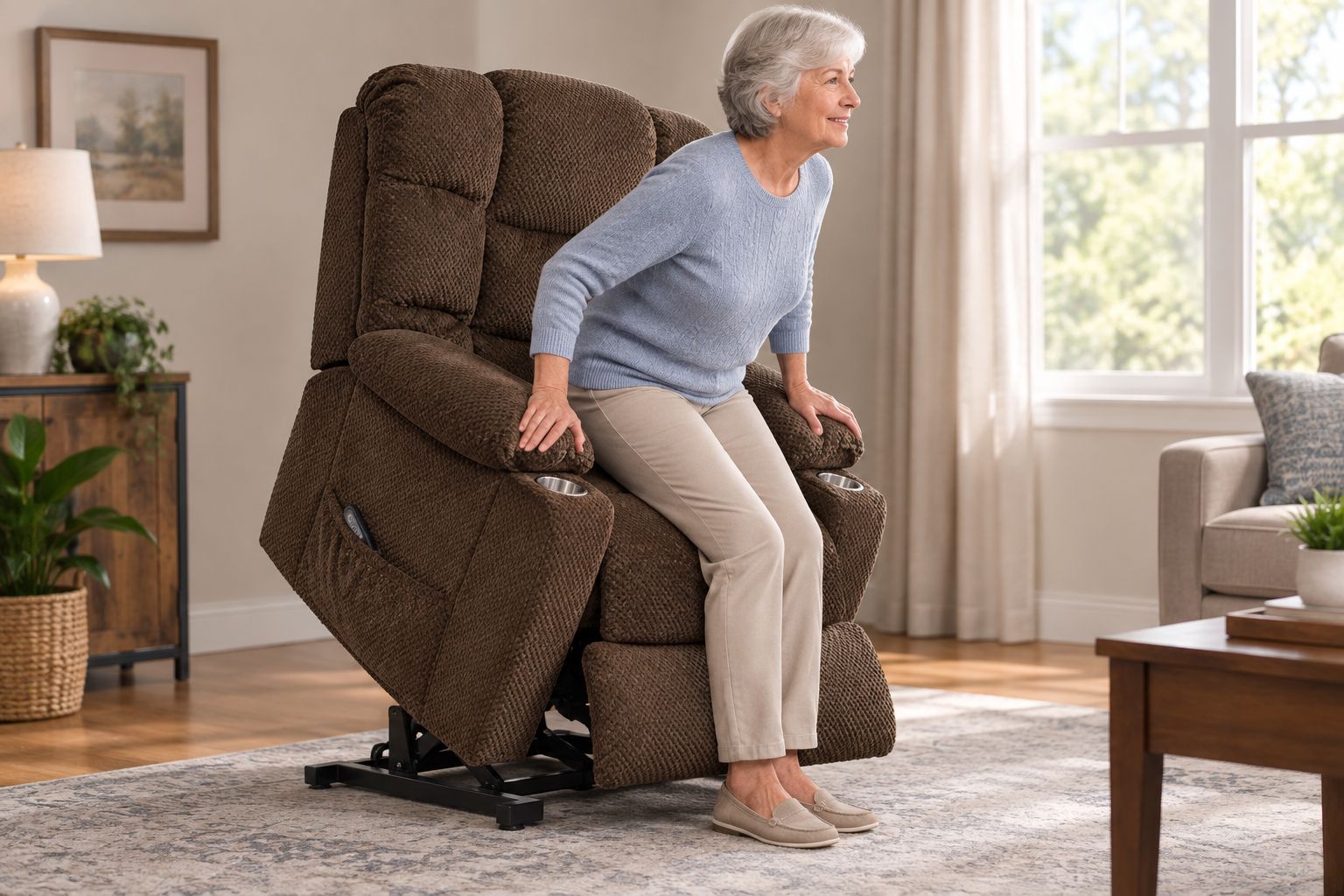
A 500-lb capacity lift chair like the 500-lb capacity lift chair qualifies under the exact same five criteria as a standard-weight model — Medicare's rules don't scale by seat width or weight rating, only the supplier's price for the frame around the mechanism changes.
What Medicare does NOT cover on a lift chair
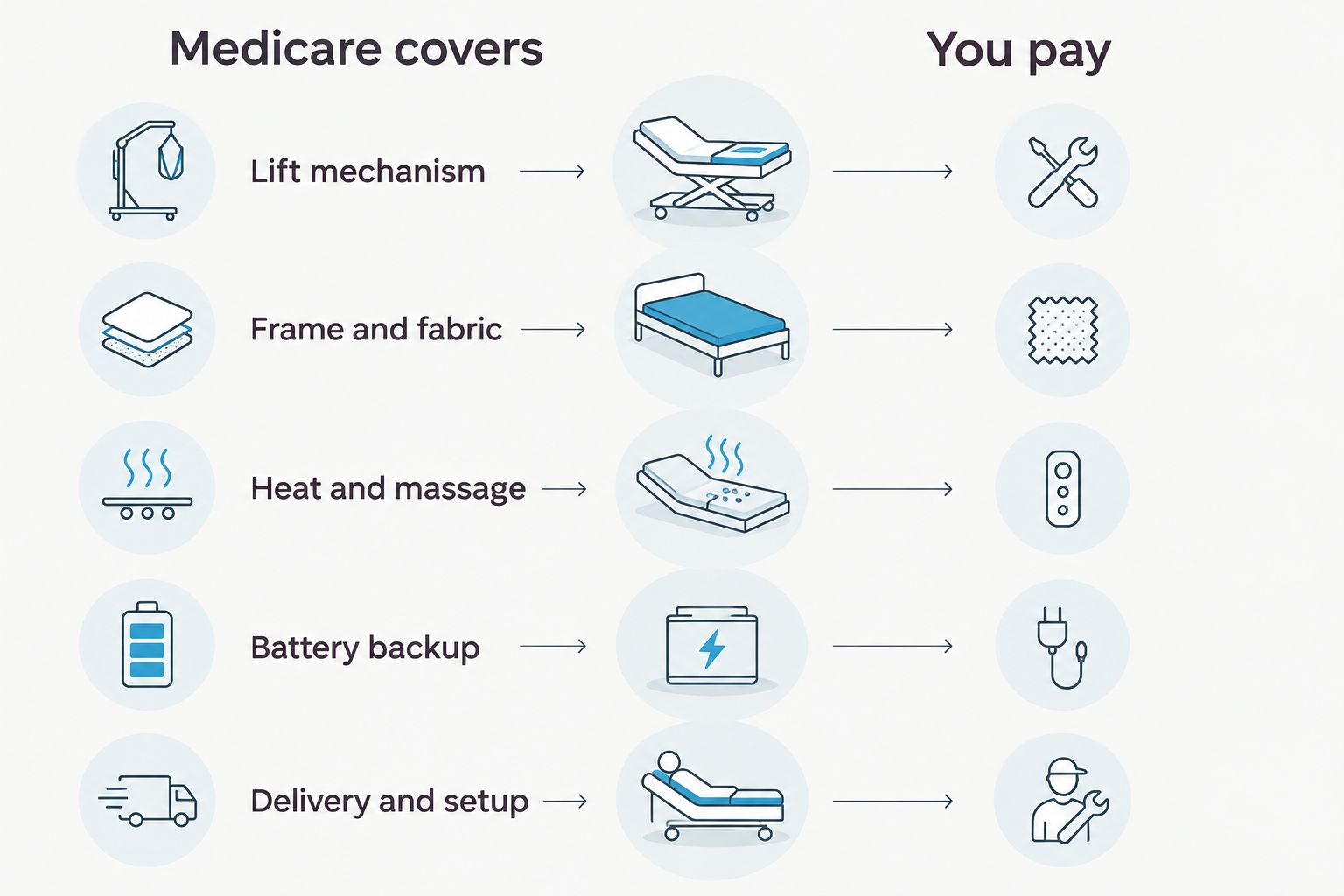
Medicare's 80% applies to the lift mechanism only. Everything else on the invoice is your responsibility:
- Frame, cushioning, and fabric or leather choice
- Heat and massage features
- Battery backup for power outages
- Delivery, setup, and haul-away of the old chair
- Extended warranty coverage
If you want the mechanical function that gets Medicare-approved, start there and treat comfort features as separate purchases you pay for directly. Edward Creation lists both types side by side so you can see which lift chair models pair a true seat lift mechanism with the extras Medicare won't touch.
Why the amount Medicare pays varies
The reimbursement isn't a flat number nationwide. A few things move it in 2026:
- Your state and locality fee schedule — CMS sets a different allowed amount for E0627 by region.
- Whether you've met your Part B deductible for the year before the claim is filed.
- Whether you carry a Medigap or Medicare Advantage plan that covers some or all of the 20% coinsurance.
- How complete the physician's documentation is on the first submission — incomplete charts trigger appeals that add months.
- Whether the supplier bills the lift mechanism as its own line item (E0627) instead of folding it into the price of the whole chair, which gets the entire claim rejected.
“Medicare pays for the standing motor, not the recliner wrapped around it — treat that difference as the number one gotcha in the whole process.”
Does Medicare cover 100% of a lift chair?
No — Medicare covers 80% of the seat lift mechanism only, after your Part B deductible, leaving you responsible for the remaining 20% coinsurance plus the entire cost of the chair's frame, fabric, and any comfort features.
Do I need a doctor's prescription to get Medicare to pay for a lift chair?
Yes — you need a face-to-face exam and a written order documenting all five medical criteria (severe arthritis or neuromuscular disease, inability to stand unassisted, ability to walk once standing, treatment necessity, and failed alternatives) before Medicare will consider the claim.
Will Medicare pay for a heavy-duty or bariatric lift chair?
Yes — weight capacity doesn't change the five qualifying criteria, so a heavier-duty frame still gets the same 80% reimbursement on the lift mechanism; you just pay more out-of-pocket for the reinforced frame itself.


Browse the wider shop lift chairs catalog to compare seat width, weight capacity, and recline depth once your paperwork is in order — none of that affects the Medicare qualification itself, but it determines how much you'll spend beyond the reimbursed mechanism.
If you're weighing a lift chair against a standard power recliner for insurance purposes, the lift chair vs. power recliner comparison lays out why only the lift mechanism qualifies as DME at all — a power recliner without a standing-assist motor never meets Medicare's criteria, no matter how the physician documents it.
FAQ
How much of a lift chair does Medicare pay for in 2026?
Medicare pays 80% of the seat lift mechanism cost in 2026, after your Part B deductible, and nothing toward the chair's frame, fabric, or comfort features.
What five conditions does Medicare require to approve a lift chair?
Medicare requires five documented conditions: severe arthritis or neuromuscular disease, medical necessity, inability to stand from a regular chair, ability to walk once standing, and failed alternative treatments.
Does Medicare Advantage cover lift chairs differently than Original Medicare?
Medicare Advantage plans must cover at least what Original Medicare covers for the seat lift mechanism, though some plans reduce or eliminate the 20% coinsurance — check your specific plan's DME benefit.
Can I buy the lift chair first and get reimbursed later?
No — the face-to-face exam and physician's written order need to happen before the purchase, or the supplier's claim typically gets denied for lacking prior documentation.
Does Medicaid cover the rest of a lift chair Medicare doesn't pay for?
Coverage for the remaining 20% and non-mechanism costs depends on your state's Medicaid program and whether you're dual-eligible — rules vary by state and aren't set by Medicare.
Will Medicare cover a lift chair for someone with COPD instead of arthritis?
Medicare's seat lift mechanism criteria are written around severe arthritis or neuromuscular disease specifically, so a COPD diagnosis alone typically doesn't meet the medical necessity standard without a qualifying condition also present.
Do I need to buy from a specific supplier for Medicare to pay?
Yes — the supplier must be enrolled in Medicare's DME program, or the claim pays nothing regardless of how complete your physician's documentation is.
One last thing
The most common reason a correctly documented claim still gets denied in 2026 isn't the medical criteria — it's the invoice. Suppliers who bill the entire chair as one line item instead of separating out the E0627 lift mechanism code get the whole claim rejected, paperwork aside. Ask for an itemized invoice that isolates the lift mechanism cost before you submit anything to Medicare.