
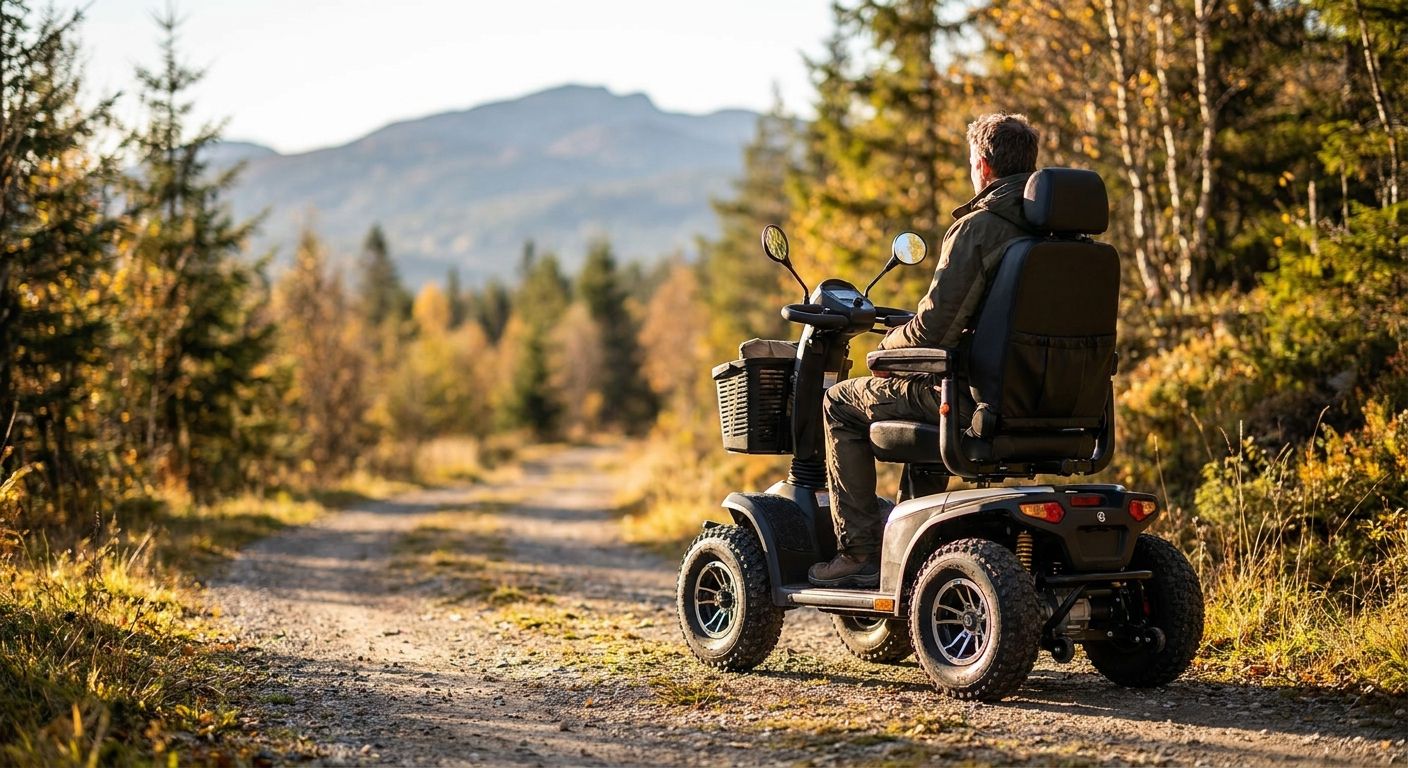
Outdoor mobility scooters are built for a different job than the models designed for hallways and grocery aisles: bigger tires, more ground clearance, and a battery sized for real distance instead of a quick trip to the mailbox. Active seniors who want to keep gardening, visiting a farmers market, or walking a dog on uneven sidewalks need a heavier-duty machine than someone who only rolls from the bedroom to the kitchen. The gap between an indoor scooter and a true outdoor one shows up the first time a small front wheel hits a crack or a curb cut and stalls.
- A 4-wheel outdoor mobility scooter with pneumatic tires handles gravel, grass, and curb cuts better than indoor models.
- Battery range drops faster on hills and headwinds, so map your round trip before trusting a single charge.
- Weight capacity should account for jackets, cargo baskets, and bags, not just body weight.
- A supportive chair by the entryway lowers fall risk during the transfer off the scooter.
- Outdoor mobility scooter buyers in 2026 should test turning radius in an open space before committing to a model.
Why outdoor mobility scooters matter for active seniors
Losing mobility outdoors isn't only about distance covered — it's about independence kept. A scooter that only manages smooth, flat floors keeps someone confined to one block, while an outdoor-rated model opens up parks, trail systems, and neighborhood walks lined with curbs and gravel driveways. Edward Creation carries mobility and home wellness equipment built for exactly that shift, from the scooter that gets someone outside to the chair that gets them safely back up once they're home.
Staying active outdoors also ties directly to fall prevention, and this is where the segment's real constraint shows up. Balance issues don't disappear because a rider is seated; uneven terrain, curb cuts, and quick stops all test stability in ways a flat kitchen floor never does. The same logic behind reducing fall risk at home applies outdoors — wider wheelbases, lower centers of gravity, and predictable braking matter more than top speed ever will.
The other constraint is trip planning. Someone shopping for an outdoor mobility scooter in 2026 usually already knows their routes: the park loop, the route to a friend's house, the sidewalk with the bad crack two blocks down. That knowledge should drive the spec sheet, not a brochure's top speed number.
How to choose the right outdoor mobility scooter
Work through these steps in order. Terrain and weight come first because they eliminate half the catalog before price or styling even enter the picture.
Map the terrain you'll actually cover
Before looking at a single scooter, walk or wheel the routes you take most. Terrain dictates tire type, ground clearance, and suspension needs more than any spec sheet does.
- Note every curb, crack, and gravel patch on your usual routes.
- Check whether nearby parks have paved paths or packed dirt trails.
- Identify the steepest incline within a half-mile of home.
- Track how weather changes the surface — wet pavement and dry gravel behave differently.
Confirm your weight capacity and seat width
Capacity numbers on a spec sheet are measured on flat ground with an empty seat, not a rider bundled up with a cargo basket attached.
- Weigh yourself with the jacket, bag, and shoes you'd actually wear outdoors.
- Add the weight of any cargo basket, oxygen tank, or shopping bags you'll carry.
- Measure hip width while seated to confirm the seat won't pinch on longer rides.
- Check armrest height against a chair you already sit in comfortably at home.
Choose the right tire and suspension setup
Tires make the single biggest difference between an indoor scooter and an outdoor one. This is where most buyers under-spec.
- Pneumatic, air-filled tires absorb bumps far better than solid foam tires on gravel and grass.
- Look for tires in the 9 to 10-inch range for outdoor stability.
- Front or full suspension cuts down on jolt over cracked sidewalks and curb cuts.
- A wider wheelbase resists tipping on cambered sidewalks and grassy slopes.
Plan around battery range and charging stops
Range claims are almost always measured on flat, dry pavement at a steady speed — real outdoor routes rarely match that.
- Map your round-trip distance before committing to a new route.
- Add a buffer for hills and headwinds, which drain batteries faster than flat ground.
- Charge fully the night before any outing longer than a quick errand.
- Carry a phone and know your walk-back distance in case the battery runs low.
Prioritize stability features for turns and inclines
Stability outdoors comes from wheel geometry and braking, not from a higher top speed.
- Anti-tip wheels at the rear catch sudden weight shifts on slopes.
- A lower seat height keeps the center of gravity closer to the ground.
- Hand brakes with a parking lock hold position on an incline at a stop.
- Test the turning radius in an empty parking lot before trusting it on a narrow path.
“If a scooter can't turn in an empty parking lot, it won't turn on a narrow trail.”
Weatherproof your ride and your routine
Electronics, not the frame, are usually the first thing to fail in bad weather.
- Check the control panel's weather resistance rating before riding in light rain.
- Add a canopy or poncho attachment for sun and drizzle.
- Avoid puddles — they hide potholes and cracked pavement underneath.
- Dry the seat and tiller fully before storing the scooter indoors.
Build a home base for pre- and post-ride comfort
The outdoor scooter conversation doesn't end at the front door. What a rider transfers onto after a longer outing matters just as much as what got them there.
- Keep a supportive chair near the entryway for an easy transfer off the scooter.
- A wall-hugger recliner design works in tight entryways without blocking the door.
- Look for a chair with a power headrest for resting sore muscles after a longer ride.
- Consider a model with battery backup so a power outage doesn't strand a comfort routine mid-recline.
Round out your mobility setup
Browse lift chairs and recliners built for easy transfers at home.
Compare outdoor mobility scooter types
No single outdoor mobility scooter fits every route. The table below breaks down the four common categories by what they're actually good at.
| Option | Best for | Key limitation |
|---|---|---|
| 3-wheel outdoor scooter | Tight turns on paved paths and errands close to home | Less stable on grass, gravel, or uneven curb cuts |
| 4-wheel outdoor scooter | Trails, parks, and uneven sidewalks needing more stability | Wider turning radius takes more space to maneuver |
| Heavy-duty all-terrain scooter | Big and tall riders and rougher, unpaved trails | Heavier to transport and load into a vehicle |
| Folding travel scooter | Frequent travelers needing trunk or airline storage | Shorter battery range and lower ground clearance |
A 4-wheel outdoor mobility scooter is the safest default for mixed terrain in 2026 — only step down to a 3-wheel model if every route is smooth, flat pavement. Heavy-duty all-terrain models earn their weight penalty on gravel trails and grass; folding travel scooters trade range and clearance for portability, which is the right trade for someone who mostly drives to a destination and scoots once there.
Common mistakes active seniors make with outdoor scooters
- Buying an indoor or travel scooter for trail use. Small solid tires and low ground clearance tip on grass and gravel that a proper outdoor tire rolls straight over.
- Ignoring weight capacity margins. Hills, headwinds, and a full cargo basket add strain that a capacity number measured on flat ground doesn't show.
- Skipping the tire upgrade. Solid tires transmit every crack and root directly into the seat; pneumatic tires absorb the impact instead.
- Planning a route with no charging buffer. A scooter that dies half a mile from home turns a pleasant outing into a rescue call.
- No weather plan. Getting caught in rain with an unrated control panel can strand a rider outdoors with a dead controller.
FAQ
What's the best outdoor mobility scooter for seniors in 2026?
The best outdoor mobility scooter for most active seniors in 2026 is a 4-wheel model with pneumatic tires and a wide wheelbase, since it handles uneven sidewalks, gravel, and curb cuts better than 3-wheel or indoor designs. Riders who only travel smooth, flat pavement can get by with a lighter 3-wheel scooter.
Is a 3-wheel or 4-wheel scooter better outdoors?
A 4-wheel scooter is more stable outdoors because it spreads weight across a wider base on grass, gravel, and cambered sidewalks. A 3-wheel scooter turns tighter and works fine on smooth, paved routes close to home.
How far can an outdoor mobility scooter go on one charge?
Range depends on terrain, rider weight, and battery size, and it drops faster on hills or headwinds than on flat pavement. Map your round-trip distance and add a buffer before relying on a single charge for a longer outing.
Can outdoor mobility scooters handle grass and gravel?
Outdoor scooters with pneumatic tires and higher ground clearance handle grass and packed gravel far better than indoor models with solid foam tires. Loose gravel and wet grass still call for slower speeds and wider turns.
How much weight can an outdoor mobility scooter hold?
Weight capacity varies by model, so check the manufacturer's rated limit and subtract the weight of any cargo basket, jacket, or bag carried on rides. Riders near the upper limit should look at a heavy-duty model instead of a standard one.
Are outdoor mobility scooters waterproof?
Most outdoor scooters resist light rain and morning dew but aren't fully waterproof, since the control panel and battery connections are the weak points. Check the electronics' weather rating and use a canopy or poncho accessory for wet rides.
Do I need a supportive chair if I use a mobility scooter?
A supportive chair at the entryway makes transferring off a scooter safer, since fatigue and stiffness after a ride raise fall risk during the transfer itself. A wall-hugger or power lift design gives a stable seat close to the door without blocking it.
What should I check before buying an outdoor mobility scooter?
Check tire type, ground clearance, weight capacity against your actual gear, and battery range against your real routes before buying. Test the turning radius in an open space and confirm the seat width fits comfortably.
One last thing
The riskiest moment on an outdoor scooter outing usually isn't the trail itself — it's the transfer on and off the seat, when legs are stiff from sitting for an hour or more. Park the scooter next to a chair that stands you up rather than one you have to push yourself out of, and that transfer stops being the shakiest part of the trip. Pairing outdoor mobility with a stable seating setup at home is the detail most buyers skip in 2026, and it's the one that actually prevents falls.