
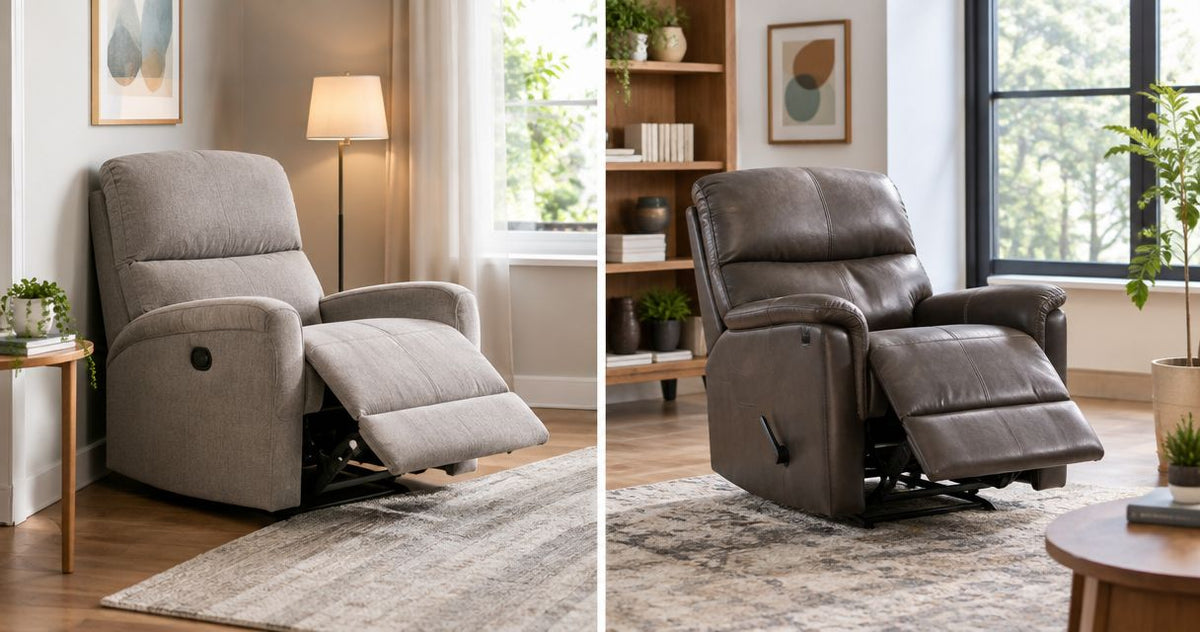
A wall-hugger recliner fits better when space behind the chair is limited; a standard recliner fits when you have room for its backrest to move rearward. Neither design guarantees a smaller overall footprint, so compare the exact chair’s wall clearance, fully reclined dimensions, and space for walking before choosing.
- Wall hugger vs regular recliner: choose by the full reclining footprint, not the upright chair size.
- Wall-hugger recliners reduce rearward space needs but still need room for the extended footrest.
- Edward Creation’s Nimbus wall-hugger recliner suits shoppers prioritizing wall-side placement, subject to the model’s required clearance.
- Power reclining and zero-gravity positioning do not provide lift assistance unless the chair explicitly includes a lift function.
Wall-hugger vs standard recliner: which fits your room?
Choose a wall-hugger for a wall-side position; choose a standard recliner when its rearward movement fits your layout. For your 2026 shortlist, compare the operating space rather than assuming either label tells you the chair’s size.
Edward Creation’s Nimbus zero-gravity power recliner with power headrest and wall-hugger design is a relevant wall-hugger option. Treat it as a recliner, not a lift chair, and confirm its model-specific clearance before planning its position.
| Room-fit question | Wall-hugger recliner | Standard recliner |
|---|---|---|
| Best for | Placement near a wall where rearward space is limited | Placement with room behind the backrest |
| How it reclines | Uses forward movement to reduce the space needed behind the chair | Typically moves the backrest rearward as it reclines |
| Main advantage | Reduces the rear clearance needed for reclining | Fits layouts where rearward movement is not an obstacle |
| Main limitation | Forward movement and footrest extension still occupy floor space | Requires space behind the chair for backrest movement |
| Measurement to confirm | Required wall clearance and fully reclined dimensions | Required rear clearance and fully reclined dimensions |
| Standing assistance | Not established by the wall-hugger label | Not established by the standard-recliner label |
A wall-hugger is not automatically narrow, and a standard recliner is not automatically oversized. Check width separately. A chair that clears the wall but crowds the doorway still fails the room-fit test.
Why this matters
A recliner occupies different amounts of space when upright and when extended. Your room must work in both positions, including when someone else walks past while you relax.
For a 2026 room update, start with the layout you actually use. Keep the route to the doorway available, preserve access to nearby seating, and account for the coffee table rather than measuring an empty corner.
This matters especially when you share the room with an older adult or someone with limited mobility. A chair that fits the floor plan must also leave a usable approach and exit. Saving space behind the chair is helpful only if its movement does not create another obstacle in front.
Wall-hugger recliners: best for wall-side placement
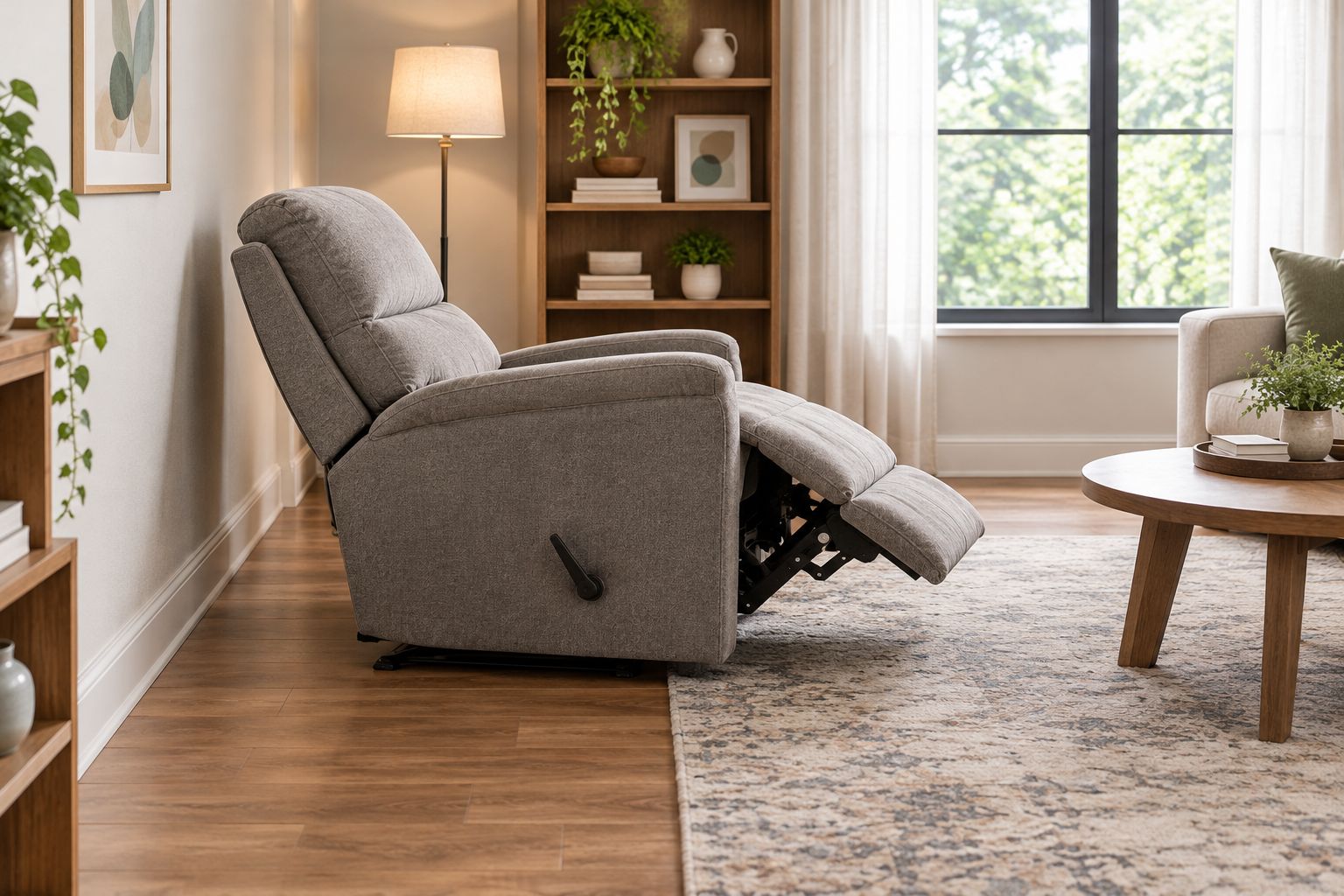
A wall-hugger mechanism moves the seating assembly forward as the chair reclines, reducing the space needed behind it. That makes the design relevant when you want the upright chair near a wall rather than sitting farther into the room.
The advantage is specific: less rearward clearance. It does not establish the chair’s overall width, extended length, seat fit, or delivery dimensions.
Where a wall-hugger makes sense
Consider a wall-hugger when the intended position backs onto a wall and moving the chair farther forward would disrupt your upright-room layout. It also deserves consideration when you want to preserve space behind the chair rather than leave a larger reclining gap there.
The trade-off sits at the front. The chair’s forward movement and extending footrest still need unobstructed space, so check the distance to the coffee table and the walking route beyond it.
Where the label is not enough
Do not select a wall-hugger solely because your room is small. A broad chair with a long extended footprint still needs substantial floor space, even if the mechanism reduces rear clearance.
Ask for the installation instructions for the exact model. Follow the specified gap rather than pushing the chair against the wall because the name sounds like permission to do so.
Verdict: choose the wall-hugger design when rear clearance is your main constraint and the forward operating space fits.
Standard recliners: best for layouts with space behind
A standard recliner typically sends its backrest rearward as it reclines. It fits a layout that accommodates that movement without contacting a wall, curtain, or nearby furniture.
The standard design is not automatically the wrong choice for a small room. Its actual dimensions matter more than the category name, particularly when you plan to position it away from the wall.
Where a standard recliner makes sense
Consider a standard recliner when the chair sits within an open seating arrangement and its full operating space remains clear. If you already have an appropriate gap behind the chair, reducing that gap is not necessarily your most useful shopping priority.
Focus instead on seat comfort, reachable controls, and whether the extended chair preserves the room’s walking route. Those needs remain important regardless of the reclining mechanism.
Where a standard recliner becomes awkward
A standard recliner becomes a poor fit when its backrest needs space your layout cannot provide. Moving it forward solves the rear-clearance problem only if the new position still leaves enough room in front.
Do not judge it from an upright showroom photo. Confirm how far the chair extends and where its backrest travels through the reclining movement.
Verdict: choose the standard design when its rearward movement fits without compromising the rest of the room.
Why recliner room fit varies
The wall-hugger label describes a mechanism, not a complete room-fit specification. Compare these factors on the exact model you are considering:
- Rear clearance: The installation instructions determine the gap needed behind the chair; there is no universal wall-hugger allowance.
- Overall width: Measure the outside of the chair, including its arms, rather than using seat width as the room footprint.
- Fully reclined dimensions: Backrest movement and footrest extension change the space the chair occupies.
- Nearby obstacles: Tables, curtains, baseboards, and other furniture affect where the chair operates without contact.
- Access and controls: Preserve a usable approach, space to stand, and access to the reclining controls.
- Delivery route: A chair that fits its destination still needs a workable route through the entrance and interior doorways.
For 2026 shopping, record the specifications against the exact product name. Do not carry a clearance figure from a different recliner into your room plan, even when both products use the same category label.
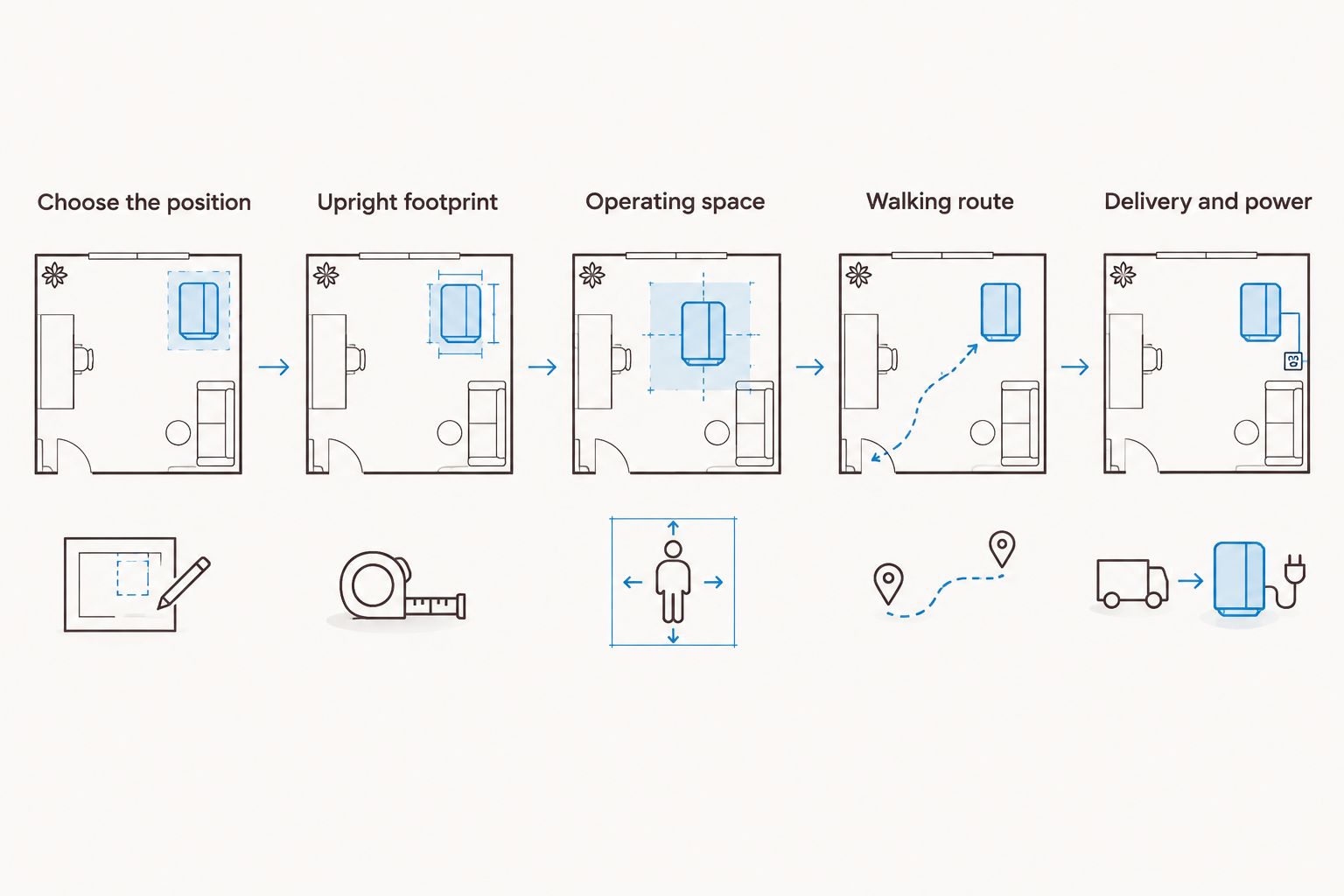
How do you measure your room for either recliner?
Measure the chair’s complete operating space, not just the spot where it stands upright. Use the manufacturer’s dimensions to mark both positions before committing to a layout.
1. Choose the position
Pick the chair’s intended location and viewing direction. Include nearby furniture in the plan rather than temporarily removing it to make the chair appear to fit.
Look at the wall behind the chair and the area in front. Identify anything the backrest or footrest would contact as the chair moves.
2. Mark the upright footprint
Use removable floor tape to mark the listed overall width and upright depth. This shows whether the chair crowds a side table, doorway, or neighboring seat before you consider reclining.
Keep seat width and outside width separate in your notes. Seat width describes the seating area; overall width tells you how much of the room the chair occupies.
3. Add the operating space
Mark the fully reclined footprint using the model’s published dimensions. Include the required wall gap, and ask for clarification if the listing does not explain where that measurement starts.
Do not estimate an extended footprint from a photograph. Perspective hides distances, and a raised footrest changes what you see compared with what the room must accommodate.
4. Check the walking route
Walk around the taped layout as if the chair were fully extended. Check access to the doorway, nearby seating, and the place where you would approach the chair to sit down.
If another household member uses mobility equipment, include that person’s actual approach in the layout check. Do not treat leftover floor space as automatically usable access.
5. Check delivery and power
Measure the entry route, including doorway openings and turns, against the product’s delivery information. Confirm whether the relevant dimensions describe an assembled chair or its shipping package.
For a power recliner, plan access to an appropriate outlet and follow the setup instructions for cable placement. Keep cords away from the walking route and moving parts.
Keep the measurements with your 2026 shortlist. A room-fit decision becomes easier when every candidate has the same fields completed instead of a mixture of dimensions, photos, and descriptive claims.
Does a wall-hugger recliner save space in front too?
A wall-hugger recliner saves rearward space, not necessarily front space. Its forward movement and extended footrest still need clearance, so a nearby coffee table remains part of the fit check.
Compare the fully reclined footprint with the table in its normal position. If reclining requires moving furniture every time, decide whether that routine works for everyone who uses the room.
Is a wall-hugger recliner automatically more comfortable?
A wall-hugger mechanism controls how a chair moves, not whether its seat fits you. Compare seat depth, seat height, back support, and footrest support separately from the room footprint.
When trying a chair, check whether you reach its controls comfortably and whether getting in and out feels manageable. For television or reading, assess your head position without assuming that every reclining angle supports the activity equally well.
Edward Creation’s recliner options should be assessed by those same fit questions. A useful feature does not replace a comfortable seated position or enough room to operate the chair.
Does power reclining help you stand up?
Power reclining adjusts the resting position; lift assistance raises the seated user toward standing. A wall-hugger label, a powered control, or a zero-gravity position does not establish a lift function.
If standing is your main difficulty, choose the function first and solve room fit second. Read the exact product description for an explicit lift feature rather than treating reclining and lifting as interchangeable.
This is a recliner comparison, not a lift-chair recommendation. Keep the distinction clear when shopping for yourself or helping a family member choose.
FAQ
What’s the main difference between a wall-hugger and a regular recliner?
A wall-hugger uses forward movement to reduce the space needed behind the chair, while a regular recliner typically moves its backrest rearward. Both need room for the extended footrest and their full operating footprint.
Is a wall-hugger recliner better for a small living room?
A wall-hugger is better when limited space behind the chair is the main problem. Compare overall width and fully reclined dimensions before deciding that it fits a small living room.
Can I put a wall-hugger recliner directly against the wall?
Do not place a wall-hugger directly against the wall unless its installation instructions explicitly permit that placement. Use the exact model’s required clearance rather than a category-wide estimate.
Does a wall-hugger recliner need space in front?
A wall-hugger needs space in front for its forward movement and extended footrest. Include nearby furniture and the walking route when checking its operating space.
Can a standard recliner work away from the wall?
A standard recliner works away from the wall when its complete reclining movement fits the layout. Check both the backrest travel and footrest extension before choosing its position.
Does a zero-gravity wall-hugger recliner lift me to standing?
Zero-gravity positioning and wall-hugger movement do not establish lift assistance. Choose a chair with an explicitly stated lift function if you need powered help moving toward standing.
What should I measure before ordering a recliner?
Measure the intended floor space, operating area, walking route, and delivery route. Compare those measurements with the exact model’s overall dimensions, fully reclined dimensions, and installation clearance.
Which Edward Creation recliner should I consider for wall-side placement?
Edward Creation’s Nimbus is a relevant option because its supplied product name specifies a wall-hugger design. Confirm its model-specific clearance and dimensions before choosing it, and do not treat it as a lift chair.
One last thing
Test the room with the footrest extended, not just the chair upright. The moment someone walks past while another person reclines is the layout test that a product photo cannot answer.
Before finalizing your 2026 choice, leave the taped operating footprint in place during an ordinary evening. Check whether the room still works without shifting the table or squeezing through a reduced walking route.