
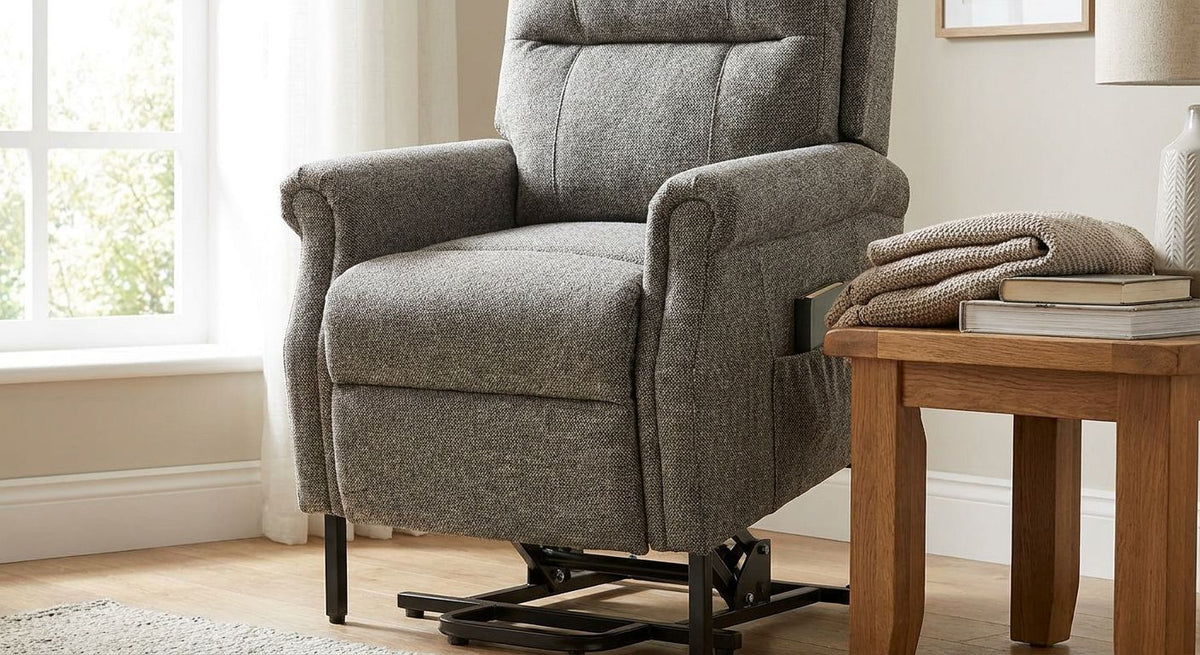
A weighted chair for stability is a heavier-frame lift chair or recliner built with reinforced steel, a wider base, and anti-tip rear legs so it stays planted while you sit down, stand up, or shift your weight. Seniors with balance concerns and big-and-tall users share the same core problem: a chair that rocks, slides, or tips under load is a fall risk, not a comfort feature. This guide breaks down what actually makes a weighted chair stable in 2026, not just heavy.
- Titan Lift Chair and GrandNest Lift Chair carry a 500 lbs frame rating, the top stability tier at Edward Creation in 2026.
- A true weighted chair needs a wide base, anti-tip rear legs, and a rated frame, not just a heavier price tag.
- Single-motor chairs are a poor match for fall-risk users; dual-motor and 4-motor designs give independent footrest and headrest control.
- Battery backup matters more for stability than fabric choice for anyone who lives alone or loses power often.
Why this matters for stability-focused shoppers
A lift chair does two jobs a regular recliner doesn't: it powers you up to standing, and it has to hold that position without wobbling while you find your footing. For someone recovering from a fall or managing a balance disorder, the seconds between "seated" and "standing" are the highest-risk moment in the whole transfer.
Big-and-tall users face a related but different problem: a chair rated for average body weight can flex at the frame joints or shift on the floor under load well before it fails outright. A weighted chair for stability solves both problems the same way — a heavier, wider base and a frame rated for real-world weight, not showroom weight.
How to choose a weighted lift chair for stability
Check the weight capacity rating before anything else
Marketing copy calls almost every oversized chair "heavy-duty." The number that actually matters is the rated frame capacity, and it should be printed on the product page, not implied by the word "extra wide."
- Confirm the capacity number in pounds, not just the seat width in inches
- Ask whether the rating includes cushions and accessories or just body weight
- Compare steel gauge or frame material if it's listed
- Treat "oversized" and "500 lbs capacity" as two separate claims — check both
- Avoid chairs where capacity isn't stated at all if stability is the priority
Measure your doorway and floor space for the base footprint
A wider, weighted frame needs more floor space than a standard recliner, both upright and reclined. Skipping this step is the single most common reason a stable chair ends up returned.
- Measure the narrowest doorway or hallway the chair has to pass through
- Measure the full reclined length, not just the seated footprint
- Check clearance behind the chair against the wall if it isn't a wall-hugger design
- Tape an outline on the floor before you order to confirm the fit
- Add a few inches of buffer for anti-tip rear legs, which extend the base
Match the recline mechanism to actual mobility level
The motor setup determines how much control you get during the highest-risk part of the transfer. A single motor lifts and reclines together; dual and 4-motor designs separate the footrest, backrest, and headrest.
- Single motor: fine for users with good grip strength and no footrest independence needs
- Dual motor: lets you set the footrest and backrest angle separately, useful for edema or joint pain
- 4-motor: adds independent headrest control, best for users who nap in the chair often
- Check remote button size and spacing if hand strength or tremor is a factor
- Confirm there's a manual backup release in case of motor failure
Models like the Titan lift chair with 500 lbs capacity pair a rated frame with a foot rest extension for taller users, which matters once you've confirmed the doorway and floor space work.
Test seat height and armrest grip for stand-assist stability
The chair can be rated for 500 lbs and still feel unstable if the seat height or armrests don't match the user's body. This is the step people skip when buying online without sitting in the chair first.
- Feet should sit flat on the floor with knees at roughly 90 degrees
- Armrests should be wide enough for a two-hand push during standing
- Look for textured or padded grip material, not smooth vinyl that slides under palms
- Test the lift angle — a chair that tilts too far forward too fast can startle a user with balance issues
- Check armrest height relative to the user's forearm length when seated
Add battery backup and anti-tip features
A weighted chair still needs power to lift and recline. For anyone living alone, losing power mid-recline isn't a minor inconvenience — it's a stuck-in-the-chair problem.
- Battery backup for power outages, especially in storm-prone areas
- Anti-tip rear legs built into the base, not an add-on bracket
- Non-slip pads or carpet grippers under the front legs
- Wall-hugger clearance if the room is tight, so the chair doesn't need to sit far from the wall
The GrandNest 500 lbs big & tall lift chair combines the dual-motor control from the last step with the same 500 lbs frame rating, plus a foot rest extension for longer legs.
Weigh frame durability against fabric and finish choices
Once capacity, footprint, and motors are settled, fabric and finish are the last decision — and the one that affects how the chair holds up to repeated stand-transfers over years, not months.
- Welded steel joints tend to outlast bolted frames under repeated stress
- Faux leather resists wear from repeated hand contact better than light fabric
- Darker upholstery hides scuff marks from walkers or canes bumping the base
- Confirm whether the inner frame is steel or reinforced wood before assuming durability


Weighted lift chair options compared
| Option | Best for | Capacity / frame | Key limitation |
|---|---|---|---|
| Titan Lift Chair, 500 lbs capacity | Big & tall users needing the highest rated frame | 28" wide seat, foot rest extension, 500 lbs | Larger footprint, needs extra floor clearance. Buy for max capacity needs. |
| GrandNest Lift Chair, 500 lbs, dual motors | Households wanting a heavy-duty frame with independent footrest control | 500 lbs, dual motors, foot rest extension | Heavier chair is harder to reposition once placed. Buy for balance-risk users needing footrest control. |
| Standard oversized lift chairs, 26-28" seat, single motor | Users who need width but not top-end capacity | Wide seat, standard frame | Weight rating typically lower than dual-motor big & tall models. Hold unless capacity is confirmed. |
| Manual heavy rocking chairs or glider bases | Budget-conscious households, minor stability needs | Solid steel or wood base, no motor | No powered lift assist — unsuitable for users who need help standing. Skip for fall-risk users. |
A weighted chair only delivers real stability when the frame rating, base footprint, and motor setup all match the user's actual body and mobility level — width alone doesn't fix a wobble.
Common mistakes people make buying a heavy-duty lift chair
- Buying by seat width alone. A 28-inch seat says nothing about frame capacity — check the pounds rating separately.
- Skipping the floor measurement. A weighted chair with anti-tip legs needs more clearance than the box dimensions suggest.
- Choosing single motor for a fall-risk user. Independent footrest control matters more than price when balance is the concern.
- Ignoring battery backup. Anyone living alone should treat this as a stability feature, not an add-on.
- Not testing armrest grip in person. A chair that looks stable in photos can still feel slick or narrow under real hands.
FAQ
What is a weighted chair used for stability?
A weighted chair for stability is a lift chair or recliner with a reinforced steel frame, a wider base, and anti-tip rear legs so it doesn't shift or tip during sitting and standing transfers. It's built for users managing balance issues or higher body weight who need the chair to stay planted under load.
How much weight can a heavy-duty lift chair hold?
The highest-rated frames from Edward Creation, including the Titan lift chair and GrandNest lift chair, carry a 500 lbs capacity in 2026. Standard oversized chairs typically sit below that rating even with a similarly wide seat.
Is a dual-motor lift chair more stable than a single-motor chair?
A dual-motor chair gives independent control over the footrest and backrest, which reduces sudden shifts during the stand-up transfer. For users with balance concerns, that independent control matters more than raw lift power.
Do weighted lift chairs need a wider doorway?
Yes, in most cases. A weighted chair's wider base and anti-tip legs add inches to both the upright and reclined footprint, so measuring the narrowest doorway or hallway before ordering avoids a return.
What's the difference between a lift chair and a weighted chair for stability?
Every lift chair has a powered lift mechanism, but not every lift chair is built for stability. A weighted chair adds frame reinforcement, a wider base, and anti-tip legs specifically so it doesn't rock or slide during the transfer.
Can a weighted lift chair help with fall prevention?
A stable base and anti-tip legs reduce the chance the chair shifts during standing, which is one factor in fall risk during transfers. It works alongside other fall-prevention steps, not as a standalone fix.
How much does a heavy-duty lift chair cost in 2026?
Pricing varies by frame capacity, motor count, and fabric choice, so check the current listing on the product page for exact figures rather than relying on a fixed number.
Do lift chairs need a battery backup?
Battery backup isn't required for every household, but it matters for anyone living alone or in an area with frequent power outages, since a chair without it can leave a user stuck mid-recline during an outage.
One last thing
Most buyers assume the fabric or the cushion is what makes a chair feel stable. It's almost always the base footprint and the anti-tip rear legs doing the real work — a 500 lbs frame on a narrow base can still feel less planted than a lower-rated chair with a wider stance. If balance is the main concern rather than raw weight capacity, prioritize anti-tip legs and wall clearance before motor count or fabric.