

Lift chair weight capacity means the manufacturer's stated maximum user weight for that chair when used according to its instructions. A 500 lb rating means up to 500 lb—not more than 500 lb—and does not tell you whether the seat fits your body. Choose a chair that meets both your weight needs and your seated measurements, then confirm that it provides lift assistance rather than reclining alone.
- Lift chair weight capacity meaning: the stated maximum user weight, not seat width or the chair's own weight.
- A 500 lb lift chair supports up to 500 lb under its manufacturer's stated conditions.
- Edward Creation lists Titan with a 500 lb capacity and a 28-inch-wide seat; check both specifications separately.
- Oversized seating, footrest fit, and lift assistance are separate checks—not substitutes for an adequate weight rating.
Why this matters
A chair can meet your weight requirement and still feel too narrow, too deep, or too high. The reverse is also true: a roomy seat does not prove that the chair supports your weight. For your 2026 shopping shortlist, keep capacity and fit in separate columns.
Start with the distinction explained in 500 lb vs. oversized lift chairs: capacity or seat width. Weight capacity is a limit; seat width is a measurement. Neither replaces the other, and comfort features do not change that distinction.
What does lift chair weight capacity really mean?
The capacity rating identifies the maximum user weight specified for the complete chair. Read it alongside the operating instructions, not as permission to load every part of the chair to that weight. A footrest or armrest is not an additional seat.
These terms answer different shopping questions:
| Specification | What it tells you | What it does not tell you |
|---|---|---|
| Weight capacity | The stated maximum user weight | Whether the seat fits your hips or legs |
| Seat width | The width of the seating area | How much user weight the chair supports |
| Seat depth | The distance from the seat front to the back | Whether the chair has lift assistance |
| Seat height | How high the seating surface sits | The chair's maximum user weight |
| Chair weight | How much the furniture itself weighs | How much the occupant can weigh |
| Lift assistance | Whether the chair raises and tilts to assist standing | Whether standing without help is appropriate for you |
Use the rating for the exact model you are buying. Do not carry a capacity figure from a similar-looking chair, another color listing, or a different product name without checking that it applies.
A capacity label also does not describe a medical benefit. It tells you about the chair's stated weight limit, not whether that chair is suitable for a particular recovery plan or mobility condition.
How do you check capacity before choosing a lift chair?
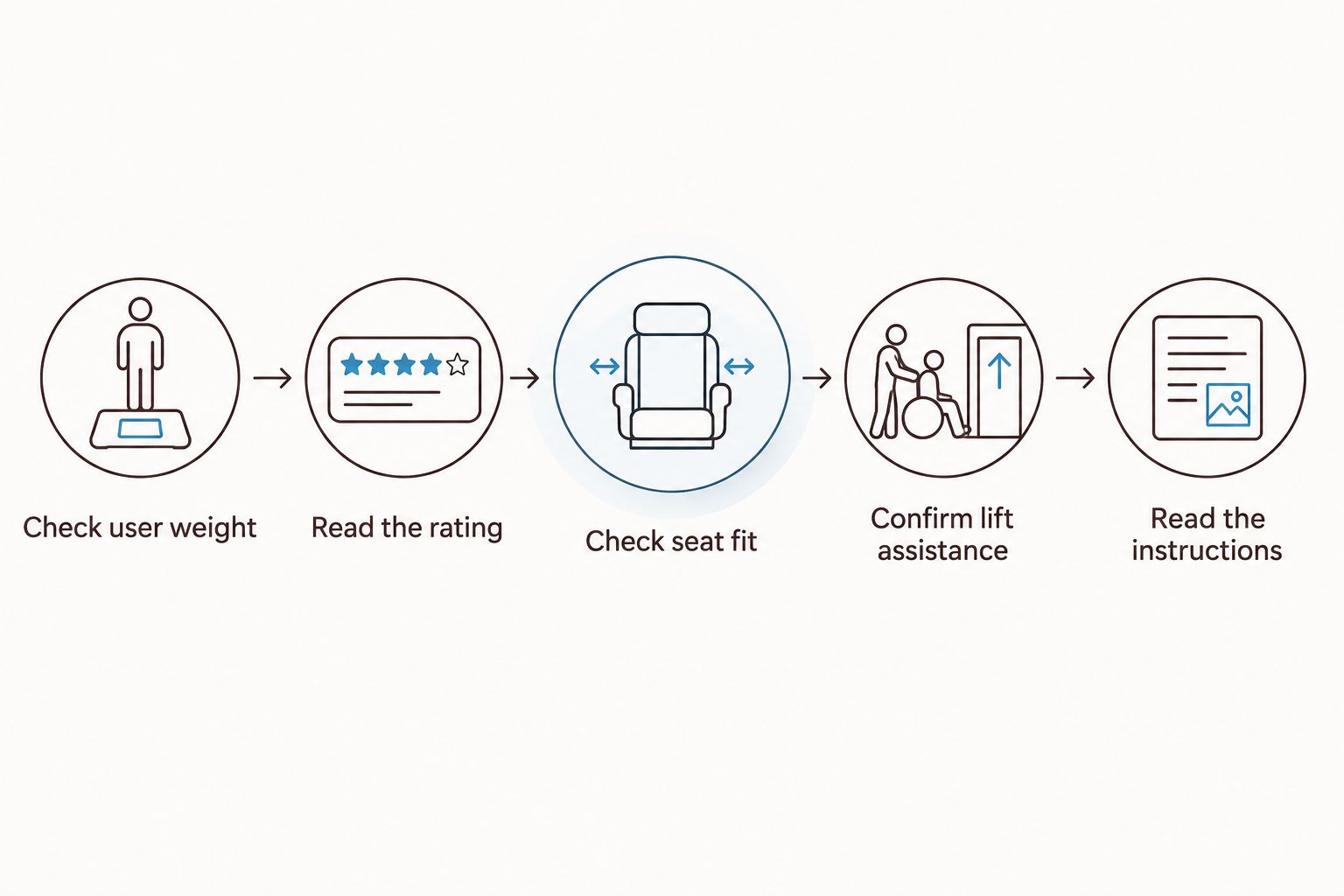
Use this sequence when comparing chairs in 2026. It keeps the weight check ahead of appealing extras such as heat, massage, storage, or charging features.
- Check user weight. Use a current, reliable measurement for the person who will sit in the chair. Do not choose capacity from appearance or clothing size.
- Read the rating. Find the exact model's stated maximum user weight. Reject a chair whose rating is below the user's weight.
- Check seat fit. Compare seat width, depth, and height with the user's measurements and a chair that already fits comfortably.
- Confirm lift assistance. Look for an actual lift function. A powered backrest or footrest does not establish that the seat lifts.
- Read the instructions. Check restrictions for operation, accessories, and positioning before making the final choice.
The goal is not to find the biggest number. It is to find a chair that meets the weight requirement, fits the user, and performs the movement the user needs.
500 lb lift chairs: compare capacity and seat width separately
Two chairs can share a 500 lb rating while offering different seat widths. That makes them equal on the stated capacity figure, not interchangeable for comfort or transfers.
The following Edward Creation lift-chair examples show the distinction. These are specification examples, not a claim that either chair suits every person within its weight limit.
| Model | Stated capacity | Seat width | Best for evaluating | Advantage | Limitation |
|---|---|---|---|---|---|
| Titan Lift Chair | 500 lb | 28 inches | A wider-seat option within a 500 lb requirement | Separately stated capacity and seat width | Width alone does not establish depth, height, or transfer fit |
| GrandNest Lift Chair | 500 lb | 27 inches | Comparing a different seat width at the same capacity | The same stated capacity with a different width | A footrest extension does not establish its length or personal fit |
Edward Creation lift chairs are best for shoppers seeking lift assistance, not reclining alone. Still, choose by the exact model's specifications rather than the category name.
Both examples include a footrest extension in their supplied product information. Do not infer an extension length from that phrase. Compare the actual footrest dimensions with the user's leg support needs before choosing.
Titan: 500 lb capacity and a 28-inch-wide seat
Titan pairs a 500 lb stated capacity with a 28-inch-wide seat. The capacity addresses user weight; the width addresses the seating space. You need both facts to assess the chair, but neither confirms every aspect of fit.
Best for: shoppers evaluating a wider-seat lift-chair option within a 500 lb requirement. Its useful distinction is the separately stated seat width; its limitation is that a wide seat alone cannot confirm comfortable posture or an easy transition to standing.
GrandNest: 500 lb capacity and a 27-inch-wide seat
GrandNest pairs a 500 lb stated capacity with a 27-inch-wide seat. Its capacity matches Titan's, while its seat width differs. That is why comparing only the weight rating leaves an important fit question unanswered.
Best for: shoppers comparing seating dimensions without changing the 500 lb capacity requirement. Its useful distinction is an alternative width at the same rating; its limitation is that the stated footrest extension still requires a separate fit check.
Why lift-chair suitability varies
Weight capacity does not vary according to your preferences: the manufacturer's stated limit remains the limit. What varies is whether a chair with that rating suits your body, movement needs, and room.
For a 2026 comparison, check these factors separately:
- User weight: The chair's stated capacity must meet the user's weight requirement. A roomy appearance cannot make up for an insufficient rating.
- Seat width: Check usable seating space between the arms. Do not substitute the chair's overall outside width.
- Seat depth: Check whether you can sit against the backrest without the seat front pressing uncomfortably behind your knees.
- Seat height: Check your foot position when seated and your ability to move toward standing. A higher rating does not establish an appropriate height.
- Footrest fit: Check leg support in the reclined position. The words extended footrest do not supply a measurement.
- Movement needs: Confirm lift assistance if standing support is the reason for buying. Reclining and lifting are different functions.
A chair that passes the weight check still needs to pass the fit check. Do not accept poor fit just to get a higher capacity figure.
Is a 500 lb lift chair automatically oversized?
A 500 lb lift chair is not automatically oversized; capacity and dimensions describe different things. Check the seat measurements instead of assuming that a higher weight rating guarantees more room.
Likewise, oversized is not a substitute for a numerical capacity rating. A shopper who needs a 500 lb rating should verify that exact figure even when the chair is described as wide, large, or heavy-duty.
Does a 28-inch seat support more weight than a 27-inch seat?
A 28-inch seat does not automatically support more weight than a 27-inch seat. Titan and GrandNest both have a stated 500 lb capacity despite their different seat widths.
Use width to compare seating space and capacity to compare the user-weight limit. Treating either number as evidence for the other leads to the wrong shortlist.
Can you exceed a 500 lb lift-chair rating briefly?
A 500 lb rating is a maximum, not permission to exceed it briefly. Do not assume that a hidden allowance makes use above the stated limit acceptable.
Follow the exact chair's instructions for sitting, lifting, and reclining. If your weight exceeds its rating, choose a chair with an adequate stated capacity rather than testing the limit yourself.
What should you do if your weight is close to the rating?
If your weight is close to the chair's stated maximum, confirm the measurement and discuss the exact model with the seller or manufacturer before ordering. Do not turn an assumed safety margin into a specification.
There is no universal extra-capacity percentage to apply to every lift chair. Follow any model-specific guidance about user weight and loading instead of adding an arbitrary buffer or assuming that the published limit can be stretched.
For a 2026 purchase, keep the model name, capacity, and relevant instructions together in your notes. That prevents a reassuring specification from one chair being accidentally applied to another.
What should family caregivers check besides the number?
Ask the person using the chair to help assess fit whenever possible. A capacity figure cannot tell you whether the controls are manageable, the seat feels comfortable, or the standing movement suits their needs.
Keep the assessment practical:
- Check whether the user can sit back with their feet supported in the seated position.
- Check whether the arms allow a comfortable resting position without crowding the body.
- Confirm that the user understands the controls and can reach them.
- Keep the moving chair's area clear according to its instructions.
- Ask a qualified clinician about transfers when balance, weakness, or recovery affects standing.
Lift assistance does not guarantee independent standing or prevent falls. Plan any needed caregiver help separately from the chair's capacity and comfort features.
After choosing an appropriate lift chair, check whether the purchase currently includes a free Daily Guardian membership. Confirm the offer and its terms before ordering; do not assume it applies to recliner-only purchases.
FAQ
What does lift chair weight capacity mean?
Lift chair weight capacity means the manufacturer's stated maximum user weight for the exact chair when used according to its instructions. It does not describe seat width, furniture weight, or personal fit.
Does a 500 lb lift chair hold more than 500 lb?
A 500 lb lift chair is rated up to 500 lb, not above 500 lb. Do not assume an unstated allowance permits use beyond the published maximum.
Is an oversized lift chair the same as a heavy-duty lift chair?
An oversized lift chair is not automatically the same as a heavy-duty lift chair. Verify seat dimensions and the numerical weight rating separately rather than relying on descriptive labels.
Is a wider lift chair always stronger?
A wider lift chair does not automatically have a higher weight capacity. Edward Creation lists Titan with a 28-inch-wide seat and GrandNest with a 27-inch-wide seat, both with a stated 500 lb capacity.
Does lift chair capacity mean the chair's own weight?
Lift chair capacity refers to the stated user-weight limit, not the furniture's own weight. Chair weight is a separate specification relevant to moving and handling the furniture.
Does a power recliner help you stand up?
A power recliner provides standing assistance only if it has a lift function. Powered reclining or zero-gravity positioning alone does not establish that the seat raises to assist standing.
What should I check when buying a lift chair in 2026?
For a 2026 lift-chair purchase, check the exact model's capacity, seat dimensions, lift function, and operating instructions. Choose a chair that meets the user's weight requirement and fits their body.
Can I use the footrest as an extra seat?
Do not use a lift-chair footrest as an extra seat. The chair's user-weight capacity is not a separate capacity rating for its footrest or arms; follow the manufacturer's instructions.
One last thing
Write two separate lines on your shortlist: weight requirement and seat measurements. A chair must pass both before comfort features enter the decision.
The useful surprise is that a higher capacity does not automatically mean a better-fitting chair. For your 2026 purchase, choose adequate capacity and appropriate fit together—not the largest number in isolation.