
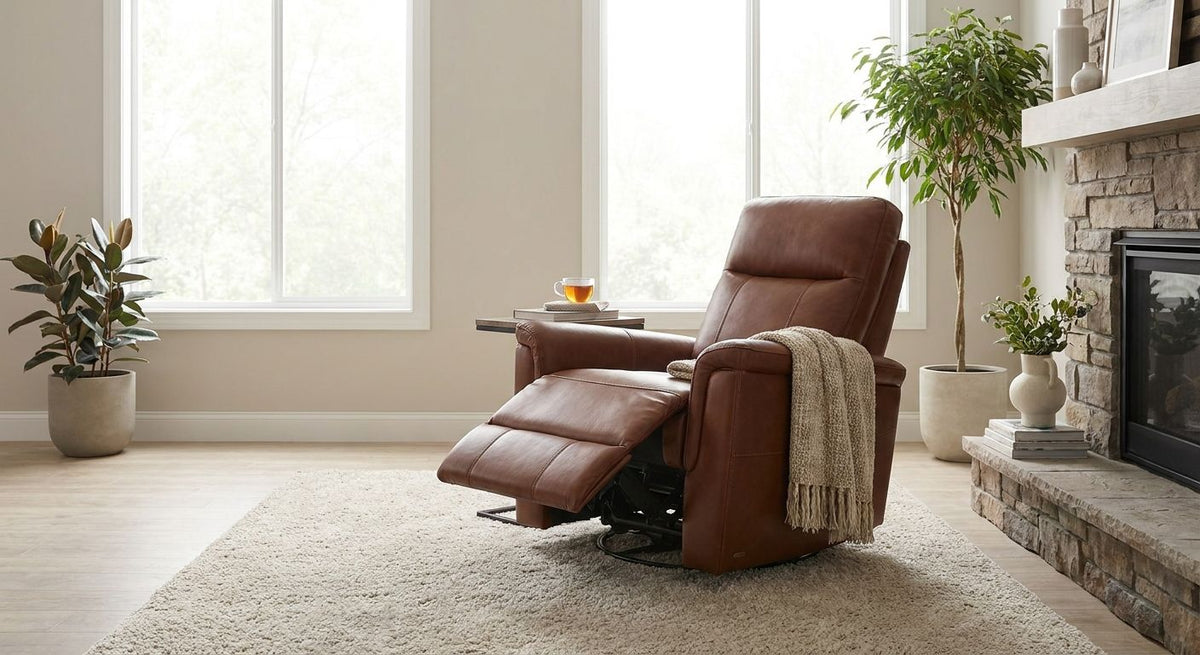
Zero gravity leather chairs for the living room recline to a weightless, feet-above-heart position while keeping the wipeable, cushioned surface that shared family spaces need. Living rooms carry different demands than a bedroom recliner: multiple people use the same chair, spills happen near coffee tables, and the chair has to look intentional next to a sofa, not medical. That combination of durability, decor fit, and recline range is what separates a living-room pick from a general recliner search.
- A zero gravity leather chair for the living room needs 8-10 inches of wall clearance or a wall-hugger frame to recline fully.
- Bonded and faux leather wipe clean faster than fabric, which matters in a room with foot traffic and food.
- Power recline with a wall-hugger design, like Edward Creation's Nimbus zero gravity power recliner, fits rooms under 12 feet deep.
- Manual zero gravity models cost less upfront but require more physical effort to recline and return upright.
- Weight capacity and seat width vary by model — check both before buying for a shared household chair.
Why zero gravity leather chairs matter for living room shoppers
A living room chair gets more visitors, more daily use, and more scrutiny on appearance than a bedroom recliner tucked out of sight. Shoppers searching "zero gravity leather chair" in 2026 are usually replacing an aging recliner that no longer matches the rest of the furniture or no longer reclines far enough to relieve pressure on the lower back and legs.
The recline angle itself is the functional reason zero gravity matters here: raising the legs to heart level reduces swelling and lower-back load, which is why the position shows up so often in recommendations for evening relaxation. Leather (real, bonded, or faux) is the fit reason — it resists spills and pet hair better than woven fabric, which is exactly what a living room needs.
Measure your living room before you shop
Wall clearance is the single most common reason a zero gravity chair disappoints after delivery. A standard reclining mechanism pushes the chair back 8 to 12 inches from the wall when fully reclined; a wall-hugger design cuts that to a few inches.
- Measure the distance from the intended chair spot to the nearest wall
- Check ceiling height if the room has sloped ceilings or low soffits
- Confirm doorway width for delivery — oversized lift and recline chairs often exceed 30 inches
- Note whether the chair sits near a window, radiator, or vent that limits placement
- Mark the footprint with tape on the floor before ordering
Match the leather finish to how the room actually gets used
Bonded leather and faux leather both wipe clean, but they wear differently under daily contact with jeans, pets, and kids. This is the point where the manual option and the faster path split: wiping down bonded leather weekly is free and takes five minutes, while choosing a chair built with a more durable leather finish from the start saves that maintenance over years of use.
- Bonded leather: lower cost, wipes clean, can crack after several years of heavy use
- Faux (PU) leather: consistent color, resists staining, softens with use
- Genuine leather: highest durability, patinas over time, higher price point
- Match the finish to whether pets or small children use the room daily
- Consider a darker shade if the chair sits near a sunlit window
Check the recline mechanism against your room's wall clearance
Once the leather finish is picked, the mechanism decides whether the chair actually reclines flat in your space. A Nimbus zero gravity power recliner with power headrest and wall-hugger design is built for exactly the wall-clearance problem above — the frame slides forward as it reclines instead of pushing backward.
- Wall-hugger frames work in rooms where the chair sits within a few inches of the wall
- Standard recline frames need the 8-12 inch clearance measured earlier
- Power headrests add independent head positioning without changing the seat angle
- Swivel bases help in rooms where the TV and conversation area face different directions
Decide between manual and power zero gravity mechanisms
Manual zero gravity chairs use a lever or push-back mechanism and cost less, but they take more physical effort from users with limited grip strength or shoulder mobility. Power mechanisms use a motor and hand control, which matters more in a living room where multiple household members, including older relatives, share the chair.
- Manual: no power cord needed, works during outages, lower price
- Power: one-button recline, easier for users with arthritis or limited strength
- Power with battery backup: reclines even if the power goes out
- Consider outlet placement near the chair before choosing power
Test seat width and weight capacity against household needs
A living room chair often serves more than one body type across a household. The ZeroG zero gravity lift chair recliner is built with a standard seat width; oversized frames elsewhere in the Edward Creation catalog run wider for larger users.
- Standard seat width fits most single-adult use
- Oversized and big-and-tall frames add width and raise weight capacity
- Check armrest height if the chair will be shared by users of different heights
- Confirm floor space for the widest point of the chair, not just the seat width
Add heat and massage only if it fits actual routine use
Heat and massage features add convenience but also add cost and another motor that can eventually need service. The CloudFloat zero gravity recliner in bonded leather with USB charging, heat, and massage bundles these into one control, which simplifies use for a shared living room chair.
- Heat settings help with lower-back or joint stiffness after sitting
- Massage motors add noise — test volume tolerance before buying for a shared room
- USB charging ports keep phones charged without an extra outlet strip
- Skip heat/massage if the chair sees light, occasional use
Compare warranty and battery backup before you commit
A battery backup means the lift or recline motor still works during a power outage — a real consideration for a chair a family member depends on daily. Warranty length varies by model, so confirm current coverage on the product page before ordering rather than assuming it matches another chair in the same line.
- Battery backup adds resilience during outages
- Confirm warranty coverage directly on each product page
- Ask about replacement parts availability for the motor and remote
- Check return policy specifics before ordering an oversized frame
Coordinate frame color and style with existing furniture
A living room chair sits in view of guests every day, unlike a bedroom recliner. Matching leather tone to the existing sofa and coordinating the frame silhouette with the rest of the room keeps the chair from looking like a hospital import.
- Match leather tone (black, brown, gray) to the dominant sofa color
- Pick a low-profile silhouette if the room already has bulky furniture
- Consider a swivel base if the chair needs to face two different sightlines
- Test fabric/leather swatches against existing throw pillows or rugs if possible
Comparison: zero gravity leather chair options for the living room
| Option | Best for | Recline type | Key limitation |
|---|---|---|---|
| ZeroG zero gravity lift chair recliner | Standard-size living rooms, single primary user | Power, standard clearance | Needs 8-12 inches of wall clearance |
| Nimbus zero gravity power recliner, wall-hugger | Small living rooms, apartments | Power, wall-hugger | Higher price point than manual models |
| CloudFloat zero gravity recliner, heat and massage | Users who want added heat/massage in one chair | Power, standard clearance | Extra motor noise during massage cycles |
| Manual zero gravity recliner (non-power) | Budget-conscious buyers, no outlet nearby | Manual push-back | Requires more physical effort to recline |
Verdict: the Nimbus zero gravity power recliner is the strongest pick for small living rooms because its wall-hugger frame reclines fully without the extra floor depth a standard mechanism needs.
“If the chair needs more than 10 inches of wall clearance to lay flat, measure twice before it ships — returns on oversized recliners are expensive to reverse.”
Common mistakes living room shoppers make
- Skipping the wall-clearance measurement. Buyers assume any recliner fits against any wall, then discover the chair can't fully recline in the spot they picked.
- Choosing fabric over leather in high-traffic rooms. Fabric absorbs spills and pet hair faster than bonded or faux leather, creating more cleaning work in a room that sees daily use.
- Ignoring seat width for a shared household chair. A single-adult seat width frustrates a larger family member; an oversized frame in a small room crowds the space.
- Underestimating delivery logistics. Oversized zero gravity chairs often exceed 30 inches wide, which can be tight for narrow hallways or stairwell turns.
- Adding heat and massage without testing noise tolerance. A massage motor running during a quiet movie night is a common regret buyers report after the fact.
Edward Creation stocks zero gravity leather chairs across standard, oversized, and wall-hugger frames, and the homepage lists current models by width and mechanism. Matching the mechanism to your room's wall clearance before ordering avoids the most common return reason for this category in 2026.
FAQ
What is a zero gravity leather chair best for?
A zero gravity leather chair is best for living rooms where users want a recline position that raises the legs to heart level while keeping a wipeable, spill-resistant surface. It suits shared family spaces better than fabric recliners because leather and faux leather clean faster.
How much wall clearance does a zero gravity recliner need?
Standard zero gravity recline mechanisms need roughly 8 to 12 inches of wall clearance to recline fully in 2026 models. Wall-hugger designs, like the Nimbus zero gravity power recliner, reduce that to a few inches by sliding the seat forward as it reclines.
Is a power or manual zero gravity chair better for a living room?
Power zero gravity chairs are better for shared living rooms with users who have limited grip strength or shoulder mobility, since one button controls the recline. Manual models cost less and still work during a power outage, which fits budget-conscious buyers without an outlet nearby.
Does bonded leather hold up in a high-traffic living room?
Bonded leather wipes clean and resists staining better than fabric, making it a reasonable living-room choice, though it can crack after several years of heavy daily use. Faux (PU) leather and genuine leather both last longer under constant contact but cost more upfront.
Can a zero gravity leather chair fit a small living room or apartment?
Yes, wall-hugger frames like the Nimbus zero gravity power recliner are built specifically for rooms where the chair sits close to the wall. Standard recline mechanisms need more floor depth and are a poorer fit for apartments under 12 feet deep.
Do zero gravity recliners come with heat and massage?
Some models, including the CloudFloat zero gravity recliner, bundle heat and massage with USB charging into one control. These features add convenience but also add motor noise, so test tolerance before buying for a shared room.
What weight capacity should a shared living room chair have?
Weight capacity varies by frame — standard seats fit most single-adult use, while oversized and big-and-tall frames raise both width and capacity for larger users. Check the specific product page for the exact capacity before ordering a chair meant for multiple household members.
Does a zero gravity chair need a battery backup?
A battery backup keeps the recline or lift motor working during a power outage, which matters if a household member depends on the chair daily. It's an added feature on select models rather than a standard on every zero gravity recliner.
One last thing
The detail buyers skip most often is testing the massage motor's noise level before committing to a heat-and-massage model for a shared living room — a chair that's perfect solo can turn into a source of household friction during a quiet evening. Measure wall clearance first, pick the leather finish for how the room actually gets used, and the mechanism choice narrows itself down fast.