
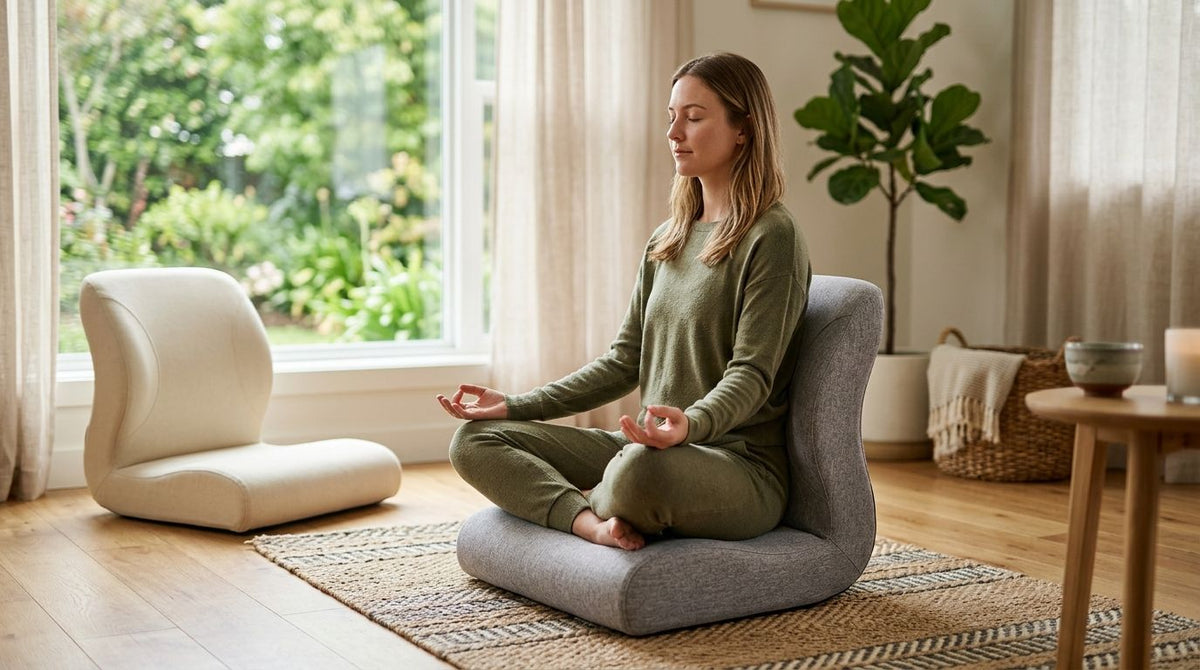
Best overall meditation chair with lumbar support in 2026: the adjustable-back floor meditation chair. Best for straight-spine seiza posture: the kneeling meditation bench with a lumbar pad. Best budget option: a zafu and zabuton cushion set. Best for chronic lower back pain: a high-back legged meditation chair with armrests. Best for travel: a portable tripod meditation stool.
- The adjustable-back floor meditation chair wins overall for daily lumbar support in 2026 — buy it if you sit indoors most sessions.
- Kneeling benches fix pelvic tilt mechanically but numb the shins past 20-30 minutes.
- Zafu and zabuton sets are the cheapest way into proper hip elevation but give zero back support alone.
- A high-back legged chair with armrests is the best meditation chair with lumbar support for chronic pain sitters.
- Portable tripod stools trade back support for packability — fine for travel, not for daily practice.
Why this matters
Sit unsupported for 20 to 45 minutes and the pelvis rolls backward, the lumbar curve flattens, and the lower back starts carrying weight it wasn't built to hold. That's the mechanical problem every meditation chair with lumbar support is trying to solve — some by adding a backrest, some by tilting the pelvis forward so the spine doesn't need one.
The right pick in 2026 depends less on brand and more on which mechanism matches your body: a backrest that reclines to your angle, a bench that shifts your hips, or a cushion that just gets you off the floor. Get the mechanism wrong and you'll fight your seat instead of meditating in it.
What makes the best meditation chair with lumbar support
- Backrest angle adjustability — a fixed 90-degree back forces one posture; a hinge that reclines toward 45 degrees lets you find the angle that actually holds your lumbar curve.
- Cushion fill and density — buckwheat hulls and kapok mold to the sit bones and hold shape longer than compressed foam.
- Hip-to-knee elevation — raising the hips even a few inches above the knees tilts the pelvis forward and takes pressure off the lower back.
- Portability and storage footprint — folding frames and stackable cushions matter if the chair lives in a closet between sessions.
- Weight capacity and frame durability — a wobbly frame undermines any posture benefit, no matter how good the backrest angle is.
- Ease of getting in and out — stiff hips or knee issues make a low floor chair harder to use daily than a slightly elevated one.
At a glance
| Chair | Best For | Standout Feature | Key Limitation |
|---|---|---|---|
| Adjustable-back floor meditation chair | Daily indoor practice | Hinge reclines to your lumbar angle | No armrests on most models |
| Kneeling meditation bench with lumbar pad | Seiza-style straight-spine sitting | Mechanically tilts the pelvis forward | Numbs shins past 20-30 minutes |
| Zafu and zabuton cushion set | Budget buyers with good hip mobility | Buckwheat fill molds to sit bones | Zero back support on its own |
| High-back legged meditation chair | Chronic lower back pain | Full backrest plus armrests | Bulkier, doesn't fold |
| Portable tripod meditation stool | Travel and outdoor sessions | Sets up level on uneven ground | No back support at all |
1. Adjustable-back floor meditation chair: best meditation chair with lumbar support for daily practice
A hinged frame folds nearly flat for storage and reclines from upright to roughly 45 degrees, letting you sit directly on the floor or a folded mat while dialing in the exact backrest angle that holds your lumbar curve.
Adjustable-back floor chair pros:
- Recline adjusts to your own lumbar angle instead of forcing one fixed posture
- Folds under a few inches thick for closet storage
- Frame typically handles seated weight without bottoming out
Adjustable-back floor chair cons:
- No armrests on most models
- Hinge point can pinch skin if you sit too far back on the seat
- Still needs a cushion underneath since the frame sits on the hard floor
Adjustable-back floor chair verdict: Buy. It's the closest thing to a custom-fit backrest for cross-legged and half-lotus sitters in 2026.
2. Kneeling meditation bench with lumbar pad: best for seiza-style posture
A two-legged bench you kneel over shifts weight onto the shins so the pelvis tilts forward on its own, letting the lumbar spine hold its natural curve without any backrest at all.
Kneeling bench pros:
- Removes the backrest question entirely by fixing pelvic tilt mechanically
- Compact footprint next to a cushion-and-frame chair
- Some models fold flat for travel
Kneeling bench cons:
- Not a fit if you have knee or ankle problems
- Sessions past 20-30 minutes can numb the shins
- No armrest or backrest if you need to lean back mid-session
Kneeling bench verdict: Buy, but only if your knees tolerate sustained kneeling — test one before committing to it as your only meditation chair with lumbar support.
3. Zafu and zabuton cushion set: best budget option
A round cushion — commonly 12 to 14 inches across, filled with buckwheat hulls or kapok — sits on a flat zabuton mat, raising the hips above the knees without any frame or backrest.
Zafu and zabuton pros:
- Lowest entry point into a properly elevated cross-legged posture
- Buckwheat fill molds to the sit bones over time
- Zabuton mat protects knees and ankles on hard floors
Zafu and zabuton cons:
- Zero back support on its own — lumbar sitters need a wall or bolster behind them
- Buckwheat hulls compress over months and eventually need refilling
- Not ideal if you can't sit cross-legged comfortably
Zafu and zabuton verdict: Buy for budget, Skip if you specifically need built-in back support without a wall nearby.
4. High-back legged meditation chair with armrests: best for chronic lower back pain
A low-to-ground chair with short legs, a full backrest, and armrests lifts you a few inches off the floor while keeping cross-legged posture possible underneath the seat.
High-back legged chair pros:
- Full lumbar-height backrest supports the spine through an entire session
- Armrests take weight off the shoulders during longer sits
- Legs lift you off cold floors year-round
High-back legged chair cons:
- Bulkier and heavier than any cushion-based option
- Doesn't fold, so storage becomes a factor
- Higher weight capacity models add width that can crowd a small meditation corner
High-back legged chair verdict: Buy. If sessions run past 30 minutes and your lower back is the limiting factor, this is the meditation chair with lumbar support that actually holds up.
If your back pain extends beyond meditation sessions into daily sitting, Aeva Vital's recliners built for back pain cover the same lumbar-support mechanics for hours-long seated time, not just a 20-45 minute practice.
5. Portable tripod meditation stool: best for travel
A three-legged folding stool with a narrow padded seat, no backrest, packs into a bag for outdoor or travel meditation on ground a floor cushion can't sit level on.
Tripod stool pros:
- Folds to backpack size
- Sets up level on grass, gravel, or sand
- Light enough to carry on a hike
Tripod stool cons:
- No back support at all
- Narrow seat isn't built for sessions past 15-20 minutes
- Three-point base can tip on soft ground if not planted carefully
Tripod stool verdict: Wait — only pick this up if outdoor or travel practice is a real part of your routine, not your primary meditation chair with lumbar support.
“If a kneeling bench numbs your shins before minute 20, the bench is wrong for your body, not your practice.”
How we ranked
Each chair got scored against the same six criteria: backrest adjustability, cushion fill and density, hip-to-knee elevation, portability, frame durability, and ease of entry. The adjustable-back floor chair topped the list because it's the only design that adjusts to your lumbar angle instead of forcing one posture on everyone.
Need lumbar support beyond the cushion?
See recliners engineered specifically for back pain relief.
Which meditation chair should you choose?
Still undecided going into 2026? Start with the adjustable-back floor meditation chair if you sit indoors most days — it's the only pick on this list that adapts to your lumbar angle instead of the other way around. Chronic lower back pain pushes the decision toward the high-back legged chair with armrests instead. Budget-first buyers with decent hip mobility do fine with a zafu and zabuton set, as long as a wall or bolster is nearby for back support.
FAQ
What is the best meditation chair with lumbar support in 2026?
The adjustable-back floor meditation chair is the best overall pick in 2026 because its hinge reclines to match your own lumbar angle instead of forcing one fixed posture. Chronic back pain sitters do better with a high-back legged chair that adds a full backrest and armrests.
Are kneeling benches better than cushions for lower back pain?
Kneeling benches fix the pelvic tilt mechanically, which helps some lower back pain by removing the backrest question entirely. They're not universally better, though — anyone with knee or ankle issues will find a cushion or legged chair more comfortable.
How long can you sit in a meditation chair before your back needs a break?
Most floor-based setups without a backrest start causing discomfort past 20-30 minutes, while a high-back legged chair with lumbar support can hold up through 45-minute sessions or longer. The limiting factor is usually the backrest, not the cushion.
Do zafu cushions provide back support?
No — a zafu cushion only elevates the hips above the knees to help pelvic tilt; it provides zero back support on its own. Pair it with a wall, bolster, or a zabuton-and-backrest combo if lumbar support matters to you.
What's the difference between a meditation chair and a regular recliner for back pain?
A meditation chair is built for short, focused seated sessions on or near the floor, while a recliner is built for hours of daily seated back pain relief with a reclining backrest and leg rest. If lumbar pain is a daily issue beyond meditation, a dedicated back pain recliner covers more ground.
Can a meditation chair replace a lumbar pillow?
A meditation chair with a built-in backrest can replace a lumbar pillow during seated practice, since the frame itself holds the recline angle. A standalone cushion like a zafu cannot — it needs a separate lumbar pillow or wall behind it.
What should I look for in a meditation chair if I have sciatica?
Look for adjustable recline and a seat that doesn't compress the back of the thighs, since sciatic nerve irritation often worsens with prolonged pressure on the sit bones. Chairs built for sciatica relief outside of meditation follow the same pressure-distribution principles.
Is a high-back meditation chair worth it for daily practice?
Yes, if sessions run past 30 minutes or lower back pain limits how long you can sit unsupported. For shorter daily sits with good hip mobility, a lighter cushion-based option is often enough.
One last thing
The backrest angle matters more than the cushion fill for most people — a zafu with perfect buckwheat density still won't stop a slouch if there's nothing behind your lower back by minute 15. Test the recline angle before you test the cushion.