
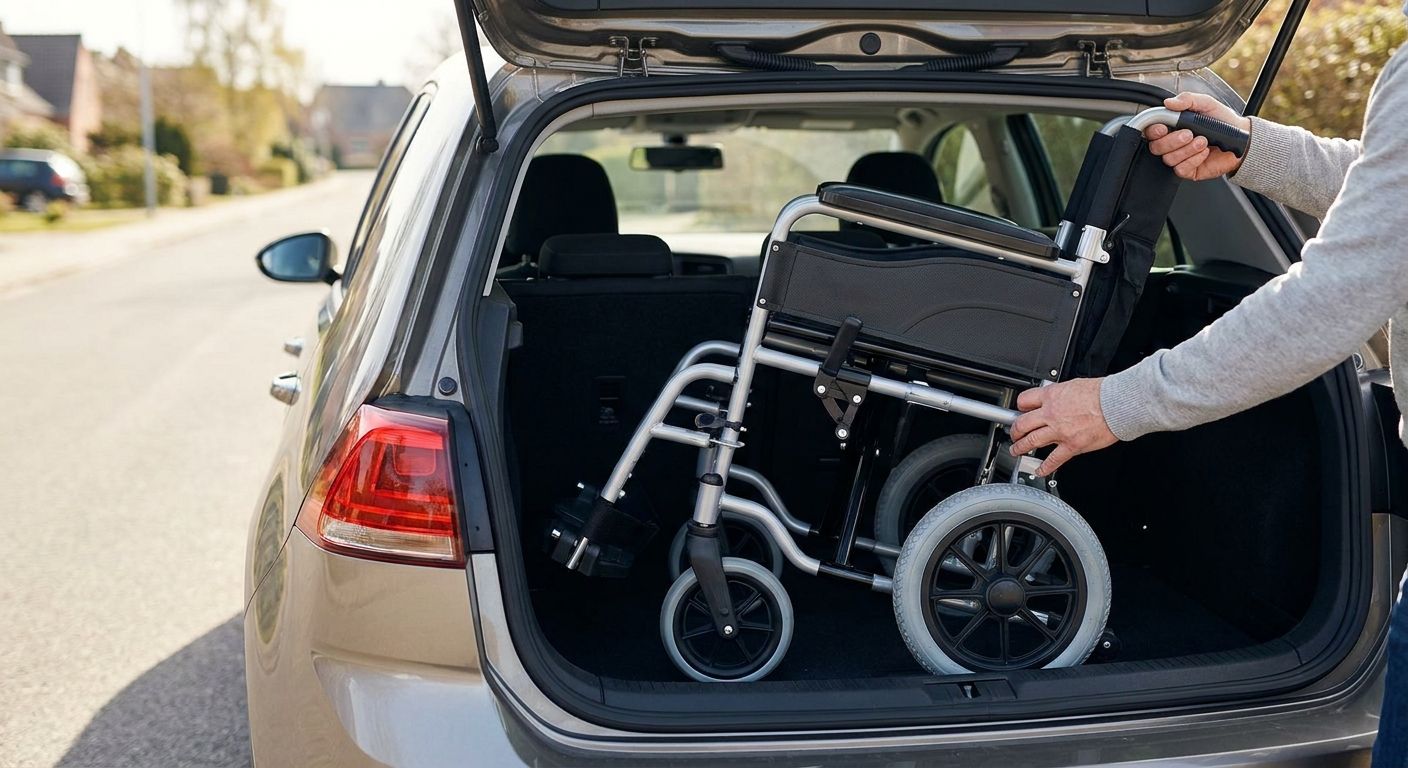
Fitting a wheelchair into a compact sedan or hatchback comes down to three numbers: folded width, total weight, and wheel size. Get those wrong and you're wrestling a 45-lb frame into a trunk that's barely 34 inches wide. This guide ranks the types of compact transport wheelchair by the job they actually do, so you can match one to your car and your caregiver's back before you buy in 2026.
- Best overall compact transport wheelchair: lightweight aluminum-frame chair at 19-22 lbs — folds one-handed for daily trunk loading.
- Best budget pick: steel-frame fixed-footrest chair, heavier but simpler and cheaper to maintain.
- Best for larger riders: bariatric-rated heavy-duty transport chair with a reinforced frame.
- Best for tight trunks and flights: ultra-compact travel chair with a carry bag, smallest folded footprint in 2026.
- Every transport chair is attendant-propelled — none of these are self-propelled wheelchairs.
Why this matters
A standard manual wheelchair runs 35-50 lbs with 24-inch rear wheels built for self-propulsion. A compact transport wheelchair drops the big wheels for 8-inch casters and a lighter frame, which is exactly what makes it liftable into a small-car trunk in the first place. That trade-off means someone else pushes — transport chairs are not self-propelled.
Edward Creation puts together guides like this one because the caregivers buying transport chairs are usually the same people researching lift chairs, grab bars, and fall-prevention gear for the same household. If a folding transport chair is the first purchase, it's rarely the last mobility decision this year.
What makes the best compact transport wheelchair
- Folded width — anything over 11 inches starts fighting a compact trunk opening.
- Total weight — under 25 lbs means a caregiver can lift it one-handed; over 30 lbs means two hands and a bad back by week three.
- Weight capacity — standard chairs top out around 250-300 lbs; bariatric models are built specifically for higher capacities.
- Footrest style — fixed footrests are simplest, swing-away footrests matter for pivot transfers after surgery.
- Brake and handle setup — attendant hand brakes are standard; check they're within reach for the person actually pushing.
- Seat width vs car width — a wider bariatric seat needs a wider trunk opening, not just a lighter frame.
Compact transport wheelchairs at a glance
| Type | Best for | Standout feature | Key limitation |
|---|---|---|---|
| Lightweight aluminum-frame chair | Everyday small-car trips | 19-22 lbs, lifts in one-handed | Frame flexes at higher rider weights |
| Steel-frame fixed-footrest chair | Budget-conscious caregivers | Simple mechanics, fewer moving parts | Closer to 30 lbs, harder to lift solo |
| Bariatric-rated heavy-duty chair | Larger-frame riders | Reinforced frame, higher capacity rating | Wider folded profile, tighter trunk fit |
| Swing-away elevating-footrest chair | Post-surgery transfers | Footrests swing clear for pivots | Adds width and weight over basic models |
| Ultra-compact travel chair with carry bag | Air travel, tightest trunks | Smallest folded footprint in the category | Narrower seat, less padding |
| Hybrid transport/wheelchair, removable arms | Side transfers | Arms lift off for lateral moves | Heaviest option on this list |
1. Lightweight aluminum-frame chair: best compact transport wheelchair for everyday small-car trips
This is the default pick for anyone loading and unloading a chair multiple times a week. Aluminum frames typically weigh 19-22 lbs, which is light enough for one person to lift into a hatchback trunk without help. The trade-off is a frame that flexes more than steel under sustained heavier loads.
Lightweight aluminum-frame chair pros:
- Easiest single-caregiver lift of any type on this list
- Folds to the narrowest width for tight trunk openings
- Least fatigue on repeated daily use
Lightweight aluminum-frame chair cons:
- Not rated for bariatric weight capacities
- Frame flex can feel less stable on rough sidewalks
Best for: caregivers loading and unloading a chair several times a day. Verdict: Buy.
2. Steel-frame fixed-footrest chair: best budget compact transport wheelchair
Steel frames cost less to manufacture and have fewer parts to break, which keeps this category simpler and generally cheaper than aluminum or hybrid designs. The catch is weight — steel-frame chairs run closer to 28-30 lbs, noticeably heavier to lift than the aluminum option above.
Steel-frame fixed-footrest chair pros:
- Straightforward mechanics, less to service
- Fixed footrests mean nothing to adjust or misalign
- Durable for occasional, not daily, transport
Steel-frame fixed-footrest chair cons:
- Heaviest common frame type to lift into a trunk
- Fixed footrests don't help with pivot transfers
Best for: occasional trips — appointments, family visits — rather than daily use. Verdict: Buy if lift weight isn't the deciding factor.
3. Bariatric-rated heavy-duty chair: best compact transport wheelchair for larger-frame riders
Bariatric transport chairs reinforce the frame and axle to handle higher rider weights than standard models. The seat is wider to match, which means the folded chair takes up more trunk width than the other five types here — this is the one case where fit-check matters as much as the capacity rating itself.
Bariatric-rated heavy-duty chair pros:
- Reinforced frame built for higher weight capacities
- Wider, more stable seat base
- Sturdier axle and caster hardware
Bariatric-rated heavy-duty chair cons:
- Wider folded profile can be tight in small hatchback trunks
- Heavier overall than standard transport chairs
Best for: riders who need a higher weight capacity than a standard transport chair offers. Verdict: Buy, but measure your trunk opening first.
4. Swing-away elevating-footrest chair: best compact transport wheelchair for post-surgery transfers
Swing-away footrests rotate clear of the seat path so a caregiver can pivot a rider straight from bed or car seat without lifting the legs over a fixed bar. That's the whole reason this type exists — it's a recovery-phase chair, not a daily-driver.
Swing-away elevating-footrest chair pros:
- Clears a straight pivot path for transfers
- Elevating option reduces leg swelling during recovery
- Reduces strain on the caregiver during transfers
Swing-away elevating-footrest chair cons:
- Adds width and weight versus fixed-footrest models
- More moving parts to check before each trip
Best for: short-term recovery after hip, knee, or spine surgery. Verdict: Buy for the recovery window, reassess after.
5. Ultra-compact travel chair with carry bag: best compact transport wheelchair for air travel
When the goal is the smallest possible folded footprint — for a subcompact car or a flight — this is the category built for it. These chairs shave inches off folded width compared to standard transport chairs, usually by narrowing the seat and trimming padding.
Ultra-compact travel chair pros:
- Smallest folded dimensions in the category
- Comes with a carry bag for handling as checked luggage
- Easiest of any type to fit in a subcompact trunk
Ultra-compact travel chair cons:
- Narrower seat width limits comfort on long outings
- Less padding than standard or bariatric models
Best for: flights, subcompact cars, and short trips where footprint beats comfort. Verdict: Buy for travel, skip for daily home use.
6. Hybrid transport/wheelchair with removable arms: best compact transport wheelchair for side transfers
This type bolts on removable armrests so a caregiver can lift them clear and slide a rider sideways from a bed, couch, or car seat. It's the heaviest chair on this list, which makes it the last one to reach for if daily trunk-lifting is the priority.
Hybrid transport/wheelchair pros:
- Removable arms simplify lateral transfers
- More seat customization than basic transport chairs
- Doubles as a semi-permanent seating option indoors
Hybrid transport/wheelchair cons:
- Heaviest option here, hardest to lift solo
- Overkill if transfers are always front-facing, not lateral
Best for: households doing frequent side transfers from bed or couch. Verdict: Buy only if lateral transfers are a regular need.
How this list was ranked
Each type was slotted against the six criteria above — folded width, weight, capacity, footrest style, brakes, and seat-to-trunk fit — and matched to the single use case where it wins outright. No two entries compete for the same job: that's deliberate, because a caregiver comparing these should land on one answer, not a leaderboard.
“A transport chair that's easy to fold and hard to lift into the trunk isn't compact — it's just narrow.”
Which compact transport wheelchair should you choose?
For most caregivers loading a chair into a small car several times a week, the lightweight aluminum-frame chair at 19-22 lbs is the right default in 2026 — it's the only type here built specifically around a single-person lift. Go bariatric-rated if the rider's weight exceeds a standard chair's capacity, and go ultra-compact if the trip involves a subcompact trunk or a flight. Everything else on this list solves a narrower problem: recovery transfers, side transfers, or a tighter budget.
Transport wheelchairs are one piece of a bigger mobility setup. Family caregivers researching this topic are often the same ones comparing mobility scooters for flying or reading Edward Creation's guide for caregivers on the go for day-to-day logistics beyond the chair itself.
Get more caregiver mobility guides
Browse home mobility solutions from Edward Creation.
FAQ
What is the best compact transport wheelchair for small cars in 2026?
A lightweight aluminum-frame transport chair weighing 19-22 lbs is the best fit for most small cars in 2026 because one caregiver can lift it into a trunk without help. Heavier steel-frame or bariatric models need more lift strength and more trunk width.
How much does a transport wheelchair weigh?
Most compact transport wheelchairs weigh 19 to 30 lbs depending on the frame material. Aluminum frames sit at the lighter end; steel-frame and bariatric models run heavier.
What's the difference between a transport wheelchair and a standard wheelchair?
A transport wheelchair uses smaller 8-inch rear casters and a lighter frame, built to be pushed by a caregiver rather than self-propelled. A standard wheelchair has larger 24-inch rear wheels sized for the user to push themselves.
Can a transport wheelchair fit in a compact car trunk?
Yes — most compact transport wheelchairs fold to a width of 9-11 inches, which fits into the trunk of a compact sedan or hatchback. Bariatric and swing-away footrest models fold wider and need a bigger trunk opening.
Are transport wheelchairs self-propelled?
No, transport wheelchairs are attendant-propelled. The smaller rear casters that make them light and foldable aren't built for the rider to push independently.
What weight capacity should I look for in a bariatric transport chair?
Bariatric-rated transport chairs use a reinforced frame and axle built for higher weight capacities than standard models. Check the manufacturer's listed capacity for the specific chair before buying, since ratings vary by model.
Do transport wheelchairs fold flat for air travel?
Ultra-compact travel transport chairs fold to the smallest footprint in the category and often come with a carry bag for handling as checked luggage. Standard and bariatric transport chairs fold too, but take up more space.
Is a transport wheelchair enough, or do I need a power wheelchair or scooter?
A transport wheelchair works when a caregiver is always available to push it; if independent movement matters, a mobility scooter or power chair is the better fit. Households often end up owning both for different situations.
One last thing
Most compact sedan trunks open to roughly 30-36 inches across, and a folded transport chair at 9-11 inches wide only uses a third of that space — the real bottleneck is almost always trunk depth and the height of the load-in lip, not width. Measure the trunk opening height before ordering, not just the folded chair dimensions listed on the product page.