
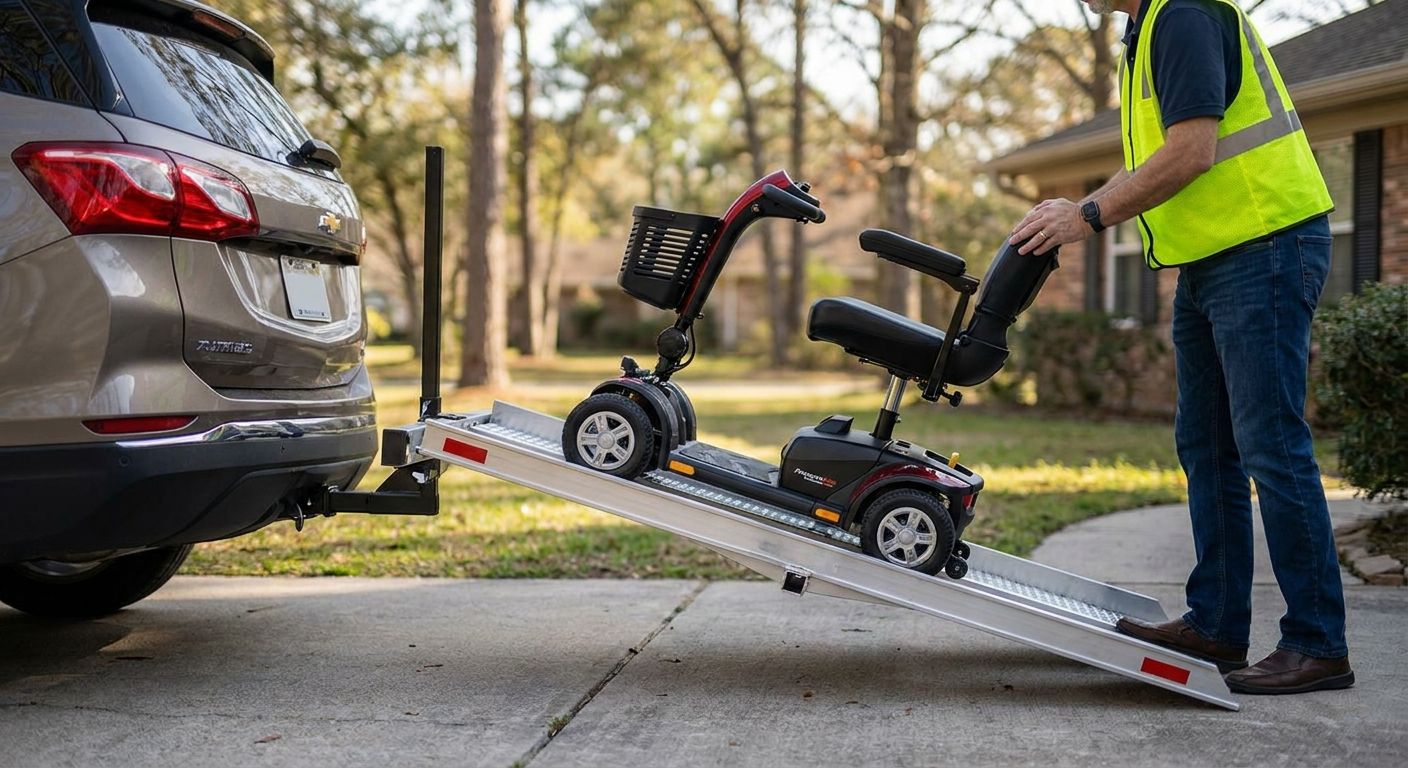
Family caregivers who load a mobility scooter carrier with ramp face one problem every single week: getting a 250-pound scooter onto a rack without straining a back or damaging the machine. A ramp carrier solves this by giving the scooter a rolling path up to the platform instead of a lift-and-heave motion, and for caregivers who drive a parent or spouse to appointments several times a month, that difference matters more than any other spec on the carrier.
- A mobility scooter carrier with ramp beats a lift-style carrier for caregivers who load solo, several times a week, in 2026.
- Match hitch class and tongue weight rating to your scooter's actual weight before buying anything.
- Ramp length should give a gentle climb, not a steep one -- steepness is the top cause of stalled loading attempts.
- Strap the scooter at two points minimum and re-check tension after the first mile of driving.
Why mobility scooter carrier with ramp matters for family caregivers
Searches for "mobility scooter carrier with ramp" run steady month over month, which tells you this isn't a one-time purchase decision people research once and forget. Caregivers search it repeatedly because the loading routine happens every outing, and a carrier that works fine in a driveway test can fail in a parking lot with a curb, wind, or a scooter with a lower ground clearance than expected.
The stakes are different for a caregiver than for a solo scooter owner. A caregiver often loads the scooter alone while the rider waits in the passenger seat, so there's no second set of hands to catch a rolling scooter or hold a ramp steady. That's the whole reason the ramp matters more than the price tag: a carrier with a smooth, wide ramp turns a two-person job into a one-person job. Edward Creation hears this from readers managing transport wheelchairs for caregivers on the go constantly, and the same physics apply to scooters.
How to choose and use a mobility scooter carrier with ramp
Measure your scooter's weight and footprint first
Before comparing carriers, get the actual numbers for the scooter you're transporting. Manufacturer specs list unloaded weight, but batteries and accessories add pounds that matter once you're near a carrier's rated capacity.
- Weigh the scooter with batteries installed, not the advertised base weight
- Measure overall length and width, including mirrors or baskets that stick out
- Note wheelbase and ground clearance -- low-clearance scooters need a shallower ramp angle
- Check if the scooter folds or disassembles, which changes carrier options entirely
- Write these numbers down before you shop; guessing is how carriers get returned
Match your vehicle's hitch class to the carrier's tongue weight
A carrier rated for more weight than your hitch can handle is a safety problem, not a convenience upgrade. Most vehicles have a hitch rating printed on the hitch itself or in the owner's manual.
- Confirm your hitch class (I, II, III, or IV) before ordering any carrier
- Add the carrier's own weight to the scooter's weight -- that combined number is what the hitch must support
- Check tongue weight rating separately from towing capacity; they're not the same number
- Ask your vehicle's dealer to confirm hitch rating if the sticker has worn off
- Leave a buffer of at least 50 pounds between your total load and the hitch's max rating
Pick a ramp length and angle that your scooter can actually climb
Ramp angle is where most loading failures happen. A short ramp on a tall carrier creates a steep climb that underpowered scooter motors can't handle, especially with a rider's added weight still on board during a quick load.
- Choose the longest ramp your vehicle and garage space allow -- longer means gentler
- Look for ramps rated for the scooter's full loaded weight, not just an average
- Test the ramp on flat, dry ground before your first real trip
- Avoid loading with the rider still seated; unload the rider first, then drive the empty scooter up
- If the scooter struggles to climb under its own power, the ramp is too steep for that model
Secure the scooter with proper tie-downs every time
A carrier only works if the scooter stays put during turns, stops, and highway speeds. Skipping tie-downs, or reusing loose straps from a previous trip, is the fastest way to damage a scooter or lose it off the back of a vehicle.
- Use at least two independent tie-down points, front and rear
- Choose ratchet straps over bungee cords -- bungees stretch and loosen over miles
- Re-check strap tension after the first five minutes of driving; vibration loosens the first setting
- Cover exposed wiring or throttle components so straps don't crush them
- Confirm the carrier's platform lock or pin is fully seated before pulling away
Practice the full loading routine before you need it
The worst time to learn a carrier's quirks is in a hospital parking lot on a rushed morning. Run through the entire process at home first, timing yourself and noting anything that feels awkward.
- Do a dry run in daylight, then again at dusk to see how visible the ramp edges are
- Time the full load-and-strap process so you can budget for it on real trips
- Note any spot where the scooter's wheels catch or slip on the ramp surface
- Practice unloading too -- reverse loading has its own failure points
- Keep a short written checklist in the glove box for the days you're distracted or tired
Maintain the carrier so it performs the same way every trip
A carrier that worked perfectly last year can develop play in the hitch pin, rust on the ramp hinge, or a worn strap that looks fine but isn't. Family caregivers who transport a scooter weekly put more cycles on a carrier than an occasional user does, so maintenance intervals should be shorter.
- Inspect the hitch pin and lock for wear every few months
- Lubricate ramp hinges if they start to stick or squeak
- Replace straps at the first sign of fraying, not after they snap
- Check the ramp surface for cracks or delamination, especially after winter driving
- Wipe down the platform after wet-weather trips to prevent rust at weld points
“If the scooter can't climb the ramp under its own power on a dry driveway, the ramp is too steep for real-world loading.”
Comparison: carrier types for family caregivers
| Option | Best for | Key limitation |
|---|---|---|
| Hitch-mounted ramp carrier | Caregivers loading solo, multiple times a week | Requires a rated hitch and enough rear clearance to swing the ramp down |
| Platform lift carrier (no ramp) | Caregivers who can't drive the scooter up under power | Slower to load; more moving parts that need maintenance |
| Enclosed cargo trailer | Long trips or scooters that need weather protection | Bulkier to store, tow, and maneuver in tight parking |
| Folding scooter stored in trunk | Owners with lightweight, disassembling scooters | Not viable for heavier or non-folding scooter models |
A hitch-mounted mobility scooter carrier with ramp is the right call for caregivers who load and unload multiple times a week and drive a vehicle rated for the combined weight. It's the option that turns a two-person lifting job into a routine one person can do in a few minutes.
Common mistakes family caregivers make with scooter carriers
- Buying the carrier before weighing the scooter. Guessing at weight leads to a carrier that's underrated or oversized for the job.
- Skipping the hitch class check. A carrier that's fine on paper can overload a Class I hitch fast once the scooter and carrier weight combine.
- Loading with the rider still on the scooter. This adds unnecessary weight to a climb that's already the hardest part of the process, and it removes the rider's ability to bail out safely.
- Reusing old bungee cords instead of ratchet straps. Bungees loosen with vibration over a drive, which is exactly when you need the scooter to stay locked in place.
- Never practicing the routine before the first real trip. The first attempt under time pressure, in bad weather, or in an unfamiliar parking lot is the worst place to discover a carrier's blind spots.
Read more caregiver transport guides
Practical guidance for loading, moving, and supporting a loved one's mobility gear.
FAQ
What is the best mobility scooter carrier with ramp for 2026?
The best option in 2026 is a hitch-mounted carrier with a full-length ramp rated for the scooter's loaded weight, not just its base weight. It lets one caregiver load and unload without lifting the scooter by hand.
Do I need a special hitch for a scooter carrier?
Yes, the hitch needs a rating that covers the combined weight of the carrier and the scooter, not just the scooter alone. Check your hitch class sticker or owner's manual before buying a carrier.
How steep can a scooter carrier ramp be?
The ramp needs to be shallow enough that the scooter climbs it under its own motor power on a dry, flat surface. If the scooter struggles or stalls during a test climb, the ramp is too steep for that model.
Is a ramp carrier better than a lift carrier?
For a caregiver loading solo several times a week, a ramp carrier is usually faster and requires fewer moving parts than a lift. A lift carrier makes more sense when the scooter can't be driven up a ramp under its own power.
Can one person load a mobility scooter onto a carrier alone?
Yes, with a properly sized ramp carrier and the rider off the scooter during loading, one person can drive the empty scooter up and secure it without help. This is the main reason caregivers choose ramp carriers over lift-style models.
How do I secure a scooter on a carrier for highway driving?
Use at least two independent ratchet strap tie-down points, front and rear, and re-check tension after the first few minutes of driving. Bungee cords are not reliable for highway speeds because they loosen with vibration.
What weight capacity should a scooter carrier have?
The carrier's rated capacity should exceed your scooter's fully loaded weight, including batteries and accessories, with a safety buffer. Weigh the scooter as-equipped rather than relying on the manufacturer's base weight listing.
How often should I inspect a scooter carrier?
Caregivers transporting a scooter weekly should check the hitch pin, straps, and ramp hinges every few months, more often after winter driving. Replace any strap showing fraying immediately rather than waiting for it to fail.
One last thing
The detail most caregivers skip is timing the loading routine at home before the first real trip. A carrier that seems simple in a showroom or a video can eat ten extra minutes in a cold parking lot when the rider is waiting and the ramp edge is harder to see than it was in daylight. Run the full routine once in your own driveway, at the time of day you'll actually use it, and fix the awkward parts before they show up on a day that matters.