

Best starting point: Nimbus, with its wall-hugger design and power headrest. For wall hugger recliners for tall adults in 2026, shortlist Nimbus Zero-Gravity Power Recliner with Power Headrest and Wall-Hugger Design, then confirm that its seat, backrest, and extended footrest fit your body before choosing it.
- Edward Creation’s Nimbus is the wall-hugger shortlist pick for power reclining and an adjustable power headrest.
- Choose wall hugger recliners for tall adults by seat depth, back support, footrest reach, and room clearance.
- Wall-hugger design describes how a recliner moves near a wall; it does not guarantee tall-person fit.
- Nimbus is a recliner, not a lift chair; reclining does not provide assistance with standing.
Why this matters
A recliner can fit your room and still fit your body poorly. For a tall adult, a short backrest, shallow seat, or poorly placed footrest can turn an appealing chair into one you keep adjusting yourself to use.
Wall-hugger design addresses a different question: how the chair reclines near the wall behind it. Choose body fit first, then check whether the reclining movement works in your room. Neither a spacious seat nor a space-saving mechanism replaces that check.
This 2026 guide separates the named wall-hugger recommendation from other chair types. The comparison helps you decide whether you need a compact reclining arrangement, more leg support, or assistance getting up.
What makes the best wall hugger recliners for tall adults?
Use these six criteria before comparing extras such as charging ports or massage functions:
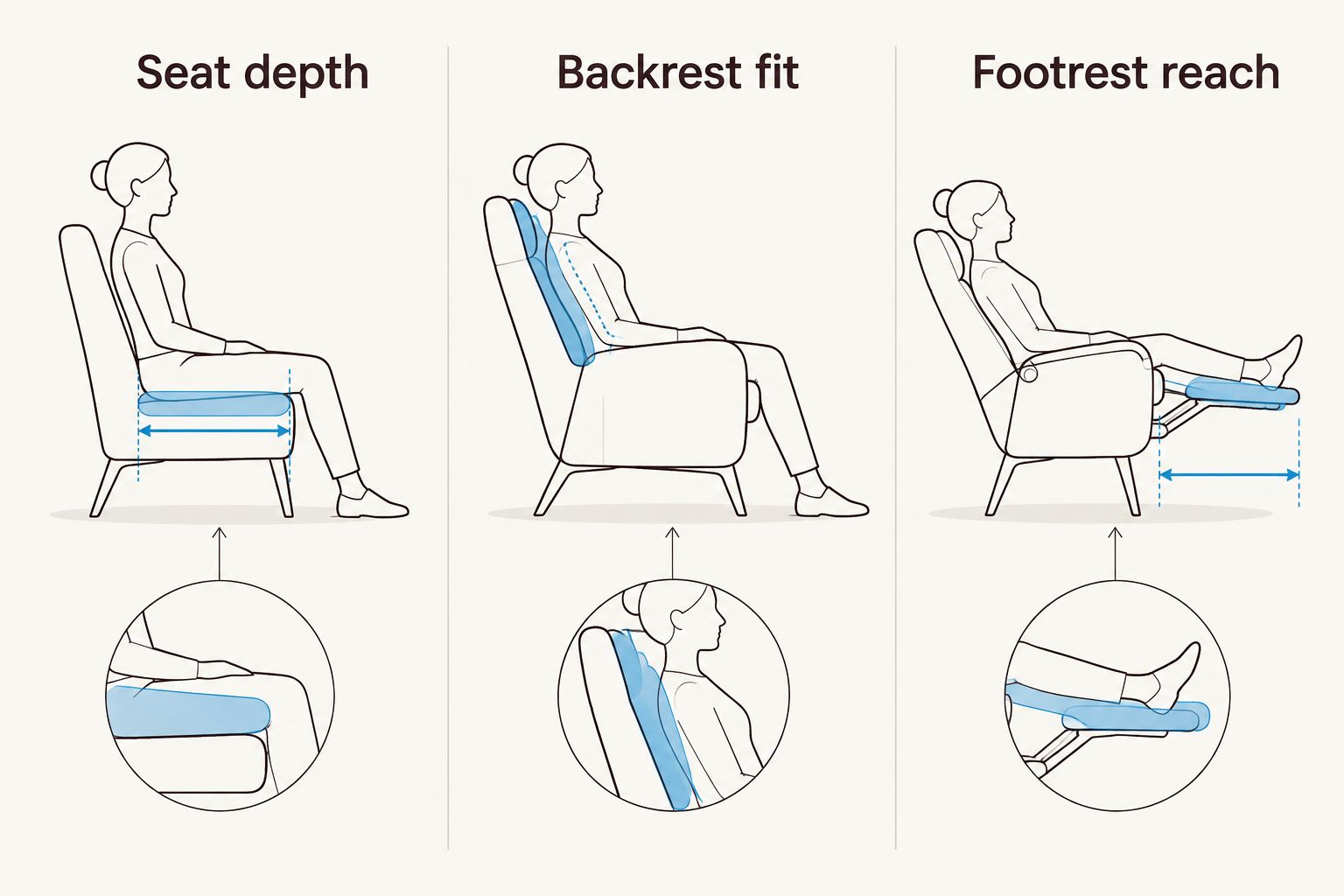
- Seat depth: Your back should reach the backrest without the seat edge pressing uncomfortably behind your knees.
- Seat height: Check whether you can sit with your feet supported and get up without an awkward movement.
- Backrest fit: The backrest and headrest should support you where you naturally sit, not where you slide to make them fit.
- Footrest reach: Check support under your legs in the position you actually use, rather than judging by the chair’s upright appearance.
- Reclining clearance: Confirm both the required wall gap and the space occupied in front when the chair opens.
- Controls and function: Decide whether you need power positioning, headrest adjustment, or actual lift assistance.
For a 2026 purchase, request model-specific measurements rather than relying on labels such as “tall,” “oversized,” or “wall hugger.” Those terms describe different aspects of a chair; they are not interchangeable.
Recliner options at a glance
Nimbus is the named wall-hugger pick here. The other rows are chair categories for comparison, not additional models presented as verified wall huggers.
| Option | Best for | Standout feature | Key limitation |
|---|---|---|---|
| Nimbus Zero-Gravity Power Recliner | Shoppers wanting wall-hugger design and power headrest adjustment | Combines power reclining, zero-gravity positioning, and a power headrest | Tall-person fit requires checking the actual seating and reclining measurements; it does not lift you to stand |
| Standard recliner | Shoppers whose room accommodates the model’s reclining movement | Lets you prioritize body fit without making wall-hugger design a requirement | Rear clearance must be checked for the particular model |
| Lift chair | Shoppers who need assistance moving from sitting toward standing | Adds a powered lifting function | Lift assistance does not establish wall-hugger design or adequate leg support |
The best category depends on the task you need the chair to perform. A wall hugger addresses room placement; a lift chair addresses getting up. A tall-person fit check applies to both.
1. Nimbus: best wall-hugger shortlist pick for power headrest adjustment
Edward Creation’s Nimbus combines a wall-hugger design with power reclining, a power headrest, and zero-gravity positioning. That makes it a relevant starting point when you want to recline near a wall and adjust head support without treating a lift chair as an equivalent product.
Edward Creation’s Nimbus is the wall-hugger option to shortlist when you want power reclining and a power headrest. Its feature combination answers the category question; your measurements answer the fit question.
Nimbus pros
- Wall-hugger design directly matches the space-saving mechanism this guide covers.
- Power reclining provides powered position adjustment rather than requiring a manual reclining action.
- The power headrest gives you another adjustment to check during a sitting trial.
- Zero-gravity positioning adds a reclining option distinct from the chair’s upright position.
Nimbus cons
- Nimbus does not provide lift assistance for standing.
- A power headrest does not replace adequate backrest height or correct seat depth.
- Wall-hugger design does not establish a suitable footrest length for every tall adult.
Best for: Shoppers who want wall-hugger design, power positioning, and adjustable head support, and who can confirm the seating dimensions suit them.
Verdict: Hold until the fit and clearance checks pass; buy only after they do. Do not choose Nimbus solely because its feature list matches your room-planning goals.
Check tall-person fit before you check extras
Your standing height is useful context, but it is not a complete chair measurement. Two people of the same height can have different leg lengths and seated torso heights, so a single height recommendation cannot replace checking where the chair supports you.
For reference, 6 feet equals 72 inches. When comparing listings that use different units, 1 inch equals 2.54 centimeters; keep your body and chair measurements in the same unit so the comparison stays clear.
Seat depth
Sit with your back comfortably against the backrest. Check whether the seat supports your thighs without forcing you to slide forward or creating uncomfortable pressure behind your knees.
A deeper seat is not automatically better for a tall person. If you cannot reach the backrest while keeping a comfortable seated position, additional depth works against the fit you need.
Backrest fit
Check where your shoulders and head meet the chair. An adjustable headrest is useful only when its movement places support where you need it without pushing your head into an uncomfortable position.
Repeat that check while upright and reclined. A headrest setting that works for watching television does not automatically work for resting with your eyes closed.
Footrest reach
Check the support beneath your lower legs when the footrest is open. Notice whether a hard edge presses into your calves and whether you keep sliding down to find a comfortable resting position.
Ask about the fully reclined length and the usable support area, not just the overall chair dimensions. An exterior measurement includes parts of the chair that do not support your body.
Measure the room in the reclined position
A wall-hugger mechanism changes how the chair moves relative to the wall. It does not remove the need to measure the space in front of the chair or keep its moving parts clear.
For your 2026 room plan, mark the chair’s proposed position before ordering. Use the model’s instructions for the rear gap, then check its complete operating footprint against nearby furniture and walking routes.
Rear clearance
Request the minimum wall clearance for the exact model. Do not borrow a measurement from a different recliner or assume every wall hugger can sit directly against a wall.
Include baseboards, window trim, radiators, and anything else behind the chair. Measure from the nearest obstruction, not just the flat wall surface.
Front clearance
Check where the footrest ends when fully extended. A coffee table that fits neatly beside an upright chair can obstruct it once the chair opens.
Also consider the person walking past. A layout is not finished when the furniture fits; you still need a usable route through the room.
Side access
Make sure you can reach the controls and use the armrests comfortably. Check whether a neighboring table blocks your hand or makes it awkward to approach the chair.
For a powered recliner, plan the connection according to the manufacturer’s instructions. Keep the cord clear of the chair’s moving mechanism and out of walking routes.
How to compare a chair with one you already use
Start with your current chair, especially if you already know what feels wrong. Its measurements give you a concrete reference instead of leaving you to interpret a product photograph.
- Record the seat dimensions. Measure the usable seat width and depth, not the outside edges of the arms.
- Record the support height. Measure from the seat surface to the top of the backrest and note where your head rests.
- Describe the problem. Write down whether you lack thigh support, head support, lower-leg support, or space to get up.
- Compare the relevant measurement. Ask about the dimension connected to that problem rather than requesting a generally “bigger” chair.
- Check the movement. Confirm that the proposed chair still fits your room when reclined and remains accessible when upright.
Ask a specific question: “Where will this chair support my legs when fully reclined?” That is more useful than asking whether the chair is simply suitable for tall people.
When another chair category makes more sense
You do not need to force a wall-hugger choice if a different function matters more. Separate your essential requirement from features you would merely enjoy.
Standard recliner: best for prioritizing body fit in a flexible room
A standard recliner is worth comparing when your room can accommodate its required movement. You can assess seating dimensions without making wall-hugger design a pass-or-fail requirement.
- Pros: You can prioritize seat, backrest, and footrest fit; wall-hugger design is not a required feature.
- Cons: The model’s rear clearance can rule it out for your layout; a comfortable upright fit still needs a reclining check.
Best for: Shoppers with flexibility to move furniture around a well-fitting chair.
Verdict: Hold until both body fit and the operating footprint are confirmed.
Lift chair: best for assistance with standing
A lift chair adds a powered mechanism that raises and tilts the seat to assist the transition toward standing. That function is separate from reclining and separate from zero-gravity positioning.
- Pros: Lift assistance addresses a need that a recliner-only chair does not; reclining and lifting serve distinct everyday tasks.
- Cons: Lift functionality does not prove wall-hugger clearance; tall-person seat and footrest checks remain necessary.
Best for: Shoppers whose main difficulty is getting out of the chair rather than finding a reclining position.
Verdict: Hold until the lifting function, personal fit, and room requirements match your needs. This is a category comparison, not a recommendation of a particular lift-chair purchase.
How the recommendation is ranked
This 2026 recommendation prioritizes an explicitly identified wall-hugger design, then power positioning and headrest adjustment. Seat depth, backrest fit, footrest reach, clearance, and the need for lift assistance remain the deciding purchase criteria.
Nimbus earns the named shortlist position because its stated features match the wall-hugger category. The ranking does not turn an adjustable headrest into a tall-person guarantee or treat other recliners as wall huggers without that designation.
Which wall-hugger recliner should you choose?
Start with Edward Creation’s Nimbus if wall-hugger design and power headrest adjustment are your priorities. Confirm the measurements before committing, particularly if your current chair leaves your upper back or lower legs unsupported.
For a 2026 purchase, use a simple order: body fit, required function, room clearance, then extras. If assistance with standing is essential, choose the lift-chair category instead of expecting a recliner to provide it.
FAQ
What’s the best wall hugger recliner for a tall adult?
Nimbus is the named wall-hugger shortlist pick in this guide because it combines wall-hugger design, power reclining, and a power headrest. Confirm seat depth, backrest fit, footrest reach, and operating clearance before deciding it fits you.
Will a wall hugger recliner fit someone over 6 feet tall?
A wall-hugger label alone does not establish fit for someone over 6 feet tall. Compare the chair’s usable seating and reclining measurements with your body and a chair you already use.
How far from the wall should a wall hugger recliner sit?
Use the minimum clearance specified for the exact recliner model. Measure from the nearest obstruction, including baseboards or trim, and check the front clearance with the footrest extended.
Is a power headrest enough to make a recliner suitable for tall people?
A power headrest is not enough to establish tall-person fit. The seat depth, backrest height, and lower-leg support must also suit the person using the chair.
Does the Nimbus recliner help you stand up?
Nimbus is a recliner, not a lift chair, so it does not provide powered lift assistance for standing. Choose a chair with an explicit lifting function if that is your main requirement.
Is an oversized recliner automatically better for tall adults?
An oversized label does not automatically mean better fit for a tall adult. Check depth, backrest support, and footrest reach separately rather than treating extra width as extra legroom.
What should I measure before buying a wall hugger recliner?
Measure the usable seat dimensions and backrest support of a chair you already use, then measure the proposed room location. Compare those measurements with the new chair’s seating dimensions, required wall gap, and fully reclined footprint.
One last thing
Extra width is not extra length. A chair can give you more space between the armrests without solving a short footrest or low backrest.
Before choosing Edward Creation’s Nimbus, name the fit problem you want to solve. Ask for the measurement that answers that problem, then check the chair’s movement in your room.