
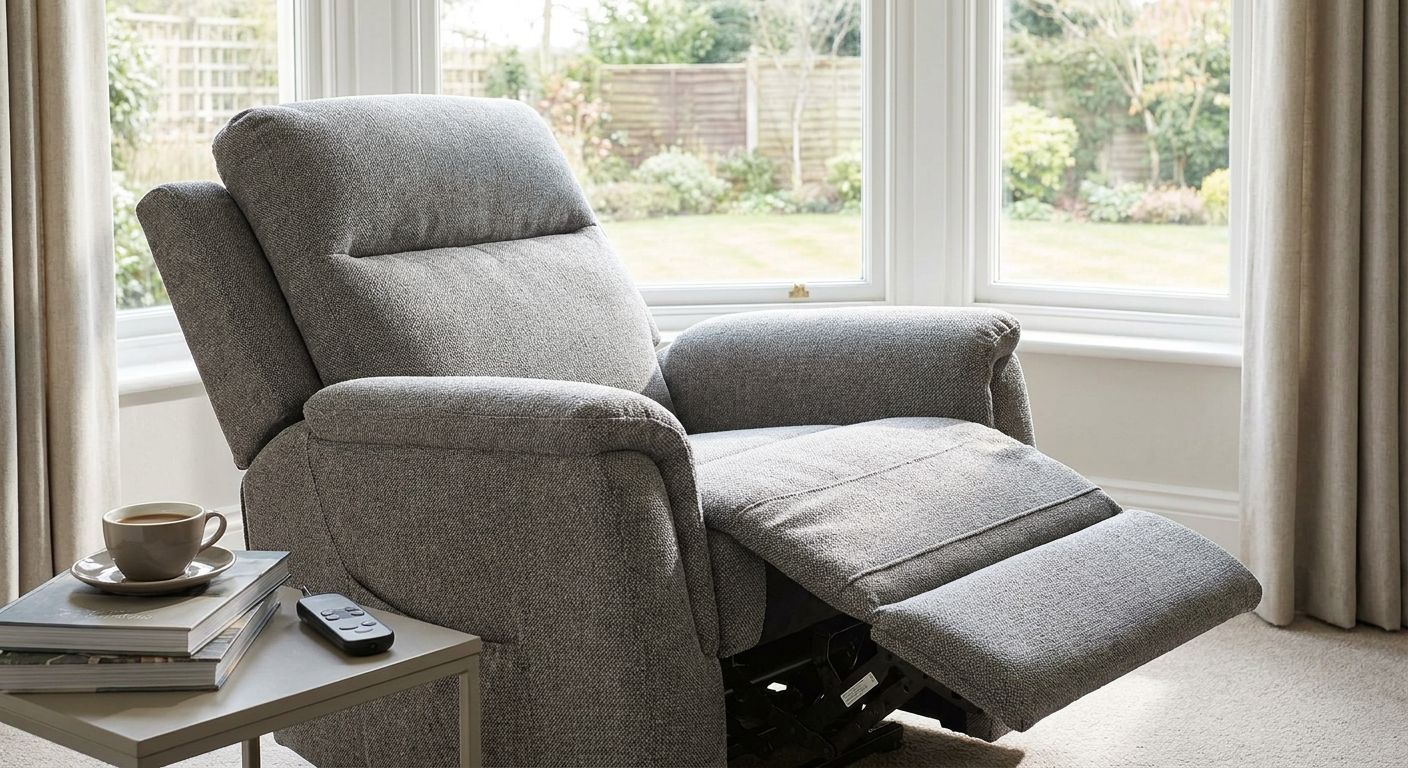
Post-surgery and arthritis recovery patients need a dual motor recliner that lifts the footrest and reclines the backrest on separate motors, so leg elevation never forces an unsafe hip angle. This guide breaks down how to size, test, and buy one in 2026, plus which Edward Creation models are actually built for that kind of independent control versus which ones only look like it on the product page.
- A dual motor recliner runs the footrest and backrest on separate motors -- a single motor moves both together.
- SleepingTitan Origin dual motor recliner: 25.1 inch seat, 74.2 inch lay-flat length -- best for hip and arthritis recovery. Buy.
- GrandNest Lift Chair holds 500 lbs with dual motors and a foot rest extension -- best for larger frames. Buy.
- Skip single-motor recliners if a surgeon limits hip flexion -- one motor forces the backrest to follow the footrest.
Why dual motor recliners matter for post-surgery and arthritis recovery
Hip replacement recovery usually comes with a flexion limit, often close to 90 degrees, set by the surgeon. On a single-motor recliner, the footrest and backrest are mechanically linked, so raising your legs to reduce swelling can also push your hips past that limit before the chair reaches a comfortable recline. A dual motor recliner separates those two motions so you can lift the legs above heart level while the back stays at whatever angle your hip precautions allow.
Arthritis flares work the opposite way some days: you need the back reclined more than the legs, or the legs elevated without the back moving at all. The hip replacement recovery guide breaks down specific angle ranges people use after surgery, and it's worth reading before you shop if you're under active surgical precautions in 2026. Spinal stenosis and edema management both lean on the same mechanical fact: two motors, not one, is what lets the chair follow two different medical needs at once.
A dual motor recliner is the right category when your legs and your back need to be in two different positions at the same time — not just at the same time, in sync.
Confirm you actually need independent motors
Before comparing chairs, confirm the mismatch you're solving for. Most people who end up disappointed with a single-motor purchase skipped this step.
- Log which position brings relief: legs elevated above heart level, or a partially reclined back with knees bent
- Note if a surgeon gave you a hip flexion limit, often near 90 degrees after replacement surgery
- Check whether swelling eases faster with legs up while the torso stays upright for eating or reading
- Flag if the same chair needs to switch between an upright daytime position and a flatter nap position
- Note if a caregiver needs to reposition your legs without disturbing your upper body
Test motion at a showroom before you buy anything
This is the free way to confirm motor count, and it works regardless of what any listing claims.
- Ask the retailer to run the footrest up first and watch whether the backrest tilts too
- Request the spec sheet and look for the words "dual motor" or "2 motors" -- "power recline" alone often means one motor
- Press only the footrest button while seated; if the backrest moves too, it's a single motor
- Check the remote for two separate rocker switches instead of one combined lever
- Look under the chair for two visible motor housings, which usually confirms true dual motor construction
Shortlist chairs that name the motor count outright
Once you've confirmed you need independent control, the faster path is shopping listings that state the motor count instead of guessing from marketing copy. The SleepingTitan Origin dual motor recliner does this directly: a 25.1 inch wide seat and a 74.2 inch lay-flat length, built for people who need to nap in the chair as often as they sit in it.
- Shortlist chairs that name the motor count outright, like the dual motor recliner built by Edward Creation, instead of assuming from photos
- Compare lay-flat length against your height if you plan to sleep in the chair
- Look for a stated seat width matching your hip measurement plus 2-3 inches of clearance
- Confirm the listing separates the lift motor, which raises the whole chair to standing, from the recline motor, which tilts the back
- Read the warranty terms tied to the motor components specifically, not just the frame
Match footrest elevation to your medical limit
The footrest is the motor doing the actual medical work in most edema and post-surgery cases. Test it before it's delivered, not after.
- Ask your surgeon or physical therapist for the exact hip flexion limit, often close to 90 degrees after hip replacement
- Test the footrest at its highest setting in the showroom; some chairs cap footrest lift lower than advertised
- For edema, confirm the footrest holds a position above heart level while you sit upright, not just at full recline
- Check whether the footrest angle locks independently, not just as one of several combined presets
- Avoid chairs where the footrest only reaches full height when the backrest is also fully reclined
Match backrest recline range to your actual task
Don't buy more recline than you'll use, and don't buy less than you need for overnight sitting.
- Decide your primary use: upright for reading and TV, or full lay-flat for naps and overnight recovery
- A backrest that reaches close to a 180-degree position works for people sitting overnight after surgery
- If you only need a slight recline for reading, skip paying for a lay-flat mechanism you won't use
- Sit at the angle your neck and lower back tolerate for at least 20 minutes before deciding
- Check for a separate headrest or lumbar motor, which some 3- and 4-motor chairs add on top of the base two
Check weight capacity and seat width against your actual frame
Weight capacity gets ignored more than any other spec, and it's the one that causes motor burnout.
- Match the stated weight capacity to your body weight plus any daily-use blankets or cushions, not just base weight
- Measure hip width while seated and compare it to the seat width spec, adding room for bulky clothing
- For larger frames, the GrandNest Lift Chair pairs dual motors with a 500 lb capacity and a foot rest extension, giving more margin than a standard-width lift chair
- Check the chair's own weight and base footprint if it has to fit through a narrow hallway
- Confirm seat height suits your leg length so feet reach the floor without the footrest engaged
Confirm battery backup before you're stuck reclined
A power outage with no backup means sitting reclined until the power returns, or forcing the manual release.
- Ask if a battery backup pack is available for the model, so an outage doesn't trap you in a reclined position
- Confirm how long the backup holds enough charge to cycle the chair back to an upright, exit-ready position
- Check where the backup battery sits, under the seat or in a separate pack, for ease of replacement
- If outages are frequent where you live, treat battery backup as a requirement, not an upgrade
- Test the manual release lever every chair should have as a mechanical backup to the battery
Compare warranty terms before you buy
Motor warranties and frame warranties aren't always the same length, and that gap matters most on a two-motor chair.
- Compare warranty length on motor components separately from the warranty on frame and upholstery
- Ask what's covered if one motor fails but the other still works -- some warranties are per-part, not whole-chair
- Check if the warranty requires proof of professional assembly or voids on self-assembly
- Confirm the return window if the recline range turns out too aggressive or too shallow once delivered
Comparing your options in 2026
| Option | Best for | Motor count | Key limitation |
|---|---|---|---|
| Manual recliner | occasional users with no mobility limits | 0 (hand lever) | no power lift assist, unsafe for weak grip |
| Single motor recliner | budget buyers with no leg-back positioning conflict | 1 motor, footrest and back move together | can't isolate leg elevation from backrest angle |
| Dual motor recliner | post-surgery and arthritis recovery needing separate control | 2 motors, independent footrest and backrest | costs more, heavier chair to reposition |
| Multi-motor lift chair (3-4 motors) | users who also want independent headrest or lumbar adjustment | 3-4 motors | more moving parts to service over time |


“If your footrest and backrest move together at the same rate, you don't have independent control -- you have a single motor with two buttons.”
Common mistakes post-surgery and arthritis shoppers make
- Assuming "power recline" means dual motor -- it usually means one motor moving both parts together
- Skipping the hip flexion check with a surgeon before buying, then finding the footrest angle exceeds the limit after delivery
- Buying on seat width alone and ignoring lay-flat length for taller frames
- Treating battery backup as optional in an area with frequent power outages
- Not testing the remote in person, then struggling with two separate rockers once the chair arrives
FAQ
What is a dual motor recliner?
A dual motor recliner is a power chair with two separate motors, one for the footrest and one for the backrest, so each moves independently instead of together. Single-motor recliners tie both movements to one motor, which limits positioning options.
Is a dual motor recliner better than a single motor recliner?
For post-surgery, arthritis, or edema needs, yes -- independent footrest and backrest control lets you elevate legs without forcing an unsafe back angle. For someone with no positioning conflict, a single motor recliner does the job with fewer moving parts.
Do dual motor recliners cost more than single motor models?
Dual motor construction adds a second motor and more wiring, so it typically runs above single-motor recliners in the same size and material class. Check current listings for exact figures since pricing shifts through 2026.
Can a dual motor recliner lay flat?
Many dual motor lift chairs, including the SleepingTitan Origin, reach a lay-flat position near 74 inches in length, which works for overnight sitting after surgery. Not every dual motor chair lays fully flat, so check the stated lay-flat length before buying.
Are dual motor recliners good for hip replacement recovery?
Yes -- independent footrest control lets you elevate legs above heart level while keeping the backrest within a surgeon-set flexion limit, often near 90 degrees. A single motor chair can force both to move together past that limit.
What's the difference between a dual motor and a 4-motor lift chair?
A dual motor chair separates footrest and backrest; a 4-motor chair adds independent headrest and lumbar motors on top of those two. The extra motors help with neck and lower back support but add more parts to maintain.
Do dual motor recliners need a battery backup?
A battery backup isn't required to operate the chair, but it prevents you from being stuck in a reclined position during a power outage. Most dual motor lift chairs include a manual release lever as a mechanical backup regardless.
How do I know if a recliner is really dual motor and not just marketed that way?
Check the spec sheet for the words "2 motors" or "dual motor" explicitly, then test it by pressing only the footrest button -- if the backrest moves too, it's a single motor. Marketing terms like "power recline" alone don't confirm motor count.
One last thing
A chair marketed as "dual motor" but missing an explicit "2 motors" line on the spec sheet is worth a second look before buying in 2026 -- that gap is usually where a single-motor chair gets relabeled with dual-motor language. Read the spec sheet, not the headline, and test the footrest button alone in the showroom before anything ships.