
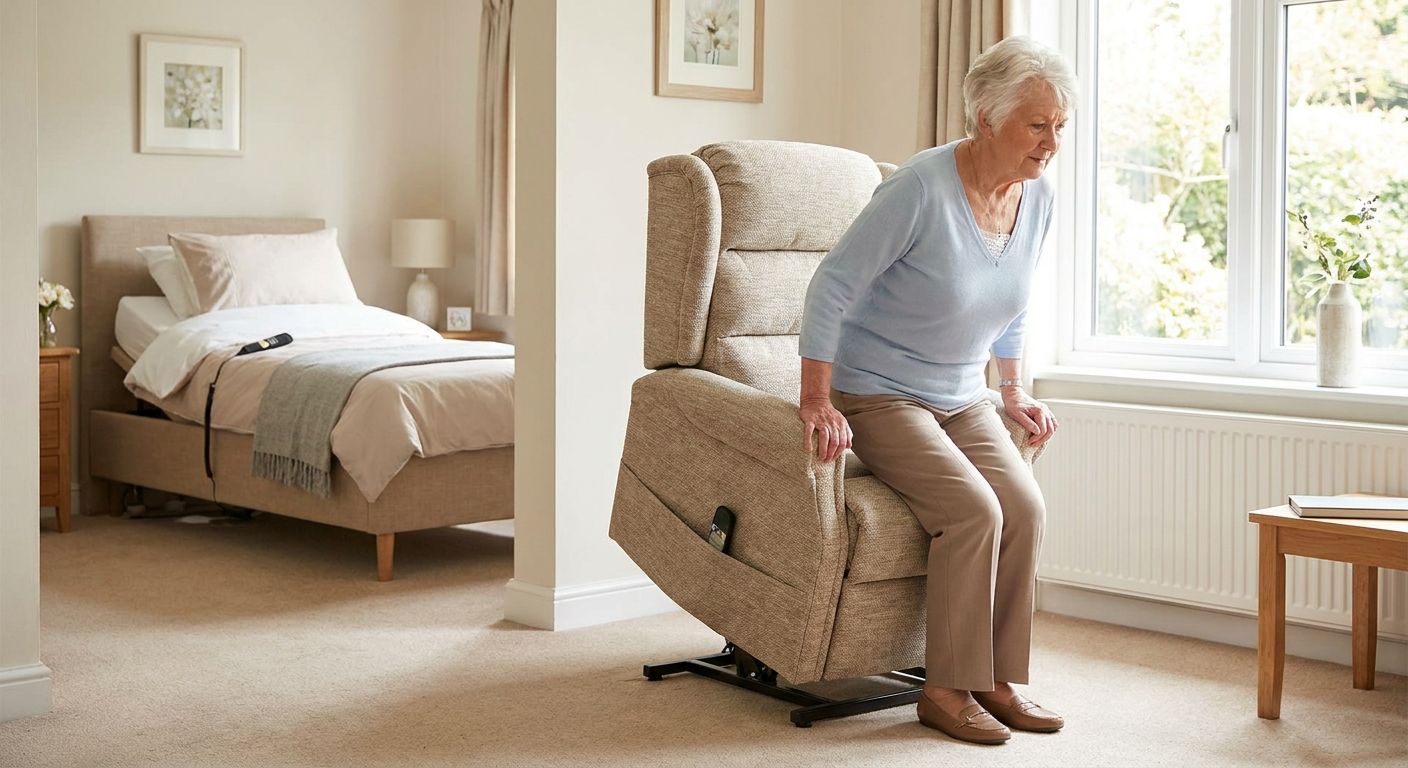
People who live alone need electric lift recliners and electric lifting beds that stand them up automatically, removing the fall risk and the wait for help that come with solo living. A chair or bed that works for a household with a spouse or a caregiver down the hall is not automatically safe for someone with nobody to call if the motor stalls at 2 a.m. — the priority list flips: battery backup, one-touch controls, and a proven weight margin move to the top, ahead of fabric color or armrest style.
- An electric lifting bed with battery backup beats a standard lift chair for solo seniors who need overnight stand-assist.
- CozyRead power lift recliners run $798 and suit single-room daytime use, not full lay-flat sleep.
- RiseEase electric lifting bed costs $2,199 and gives a full night's sleep plus stand-assist in one frame.
- A $200 electric bed lifting backrest retrofits an existing bed but caps out at 300 lbs.
- Test the lift cycle alone before day one — don't wait for an emergency to find the failure point.
Why electric lift recliners and electric lifting beds matter for people who live alone
A lift chair or lift bed for someone who lives with family is a comfort upgrade. For someone who lives alone, it's the difference between getting up on your own schedule and being stuck in a chair until a neighbor happens to check in. The fall prevention features that matter for balance disorders — slow, controlled lift speed, a stable base, side rails — matter twice as much when there's no second person in the room to steady you.
Solo seniors also can't rely on someone else resetting a breaker or calling for service the same day. That's why battery backup and simple, reachable controls aren't optional extras on this segment's shopping list — they're the whole point of buying an electric lift recliner or electric lifting bed in the first place.
Map your daily transfers before you shop
Watch where you actually get stuck during a normal day — bed to chair, chair to standing, chair to bathroom. Buying for the wrong transfer point wastes money on the wrong feature set.
- Time how long each transfer takes you right now, without assistance
- Note which transfer (lying to sitting, sitting to standing) causes the most strain
- Check if you use a walker or cane during any transfer
- Write down which room you spend the most waking hours in
- Flag any transfer that has caused a near-fall in the last 12 months
Check seat width and weight capacity before anything else
A chair sized for an "average" build will pinch or tip for anyone outside that range, and living alone means no one is there to catch a tip. Measure hip width sitting down, not standing.
- Measure hip-to-hip width while seated in your current chair
- Confirm the listed weight capacity leaves at least 20-30 lbs of margin
- Check seat depth against your thigh length, not just width
- Look for models rated 500 lbs capacity if body size is a factor
- Rule out any chair whose weight rating sits close to your actual weight
Prioritize battery backup over aesthetics
A power outage doesn't wait for a good time. For someone who lives alone, a lift chair or lift bed that only works on wall power is a chair you can get stuck in. The lay-flat lift chair with battery backup sold through Edward Creation covers this exact gap — a 25.1-inch-wide seat, 74.2-inch length for full lay-flat sleep, and a backup battery so the lift function still runs when the grid doesn't.
- Confirm the model has a rechargeable backup battery, not just a wall adapter
- Check how many lift cycles the backup battery is rated for per charge
- If your current chair lacks backup power, a battery backup for power recliners can be added separately
- Keep the remote charged and stored in the same spot every night
- Test the backup battery manually once a month, not just when the power actually goes out
Set up one-touch, reachable controls
A control pad on the wrong side of the chair defeats the whole purpose of a lift recliner — you shouldn't have to twist to reach the button that stands you up.
- Mount or place the remote on your dominant-hand side
- Choose large, single-function buttons over multi-function touchscreens if dexterity is a concern
- Keep a phone or emergency call device within arm's reach of the seat, not across the room
- Label the lift and recline buttons if the remote has more than 4 functions
- Avoid remotes that require holding two buttons simultaneously to operate
If the chair's control pad sits on your weaker side, you will call for help before the motor ever moves.
Add fall-prevention accessories around the chair or bed
The chair itself is only half the setup. What's within reach of it determines whether a 2 a.m. bathroom trip is routine or risky.
- Install a nightlight along the path from chair or bed to bathroom
- Keep a rolling side table within reach for water, medication, and the remote
- Clear any rugs or cords in the direct path of the transfer zone
- Add grab bars near the chair if standing balance is unsteady
- Position the chair or bed so the exit path is never blocked by furniture
Test the lift cycle alone, before you rely on it
Don't wait for the first real emergency to discover the chair doesn't fit your bathroom doorway, or the lift cycle takes longer than you expected. Run a full dry test in the first week.
- Time a full lift cycle from seated to standing
- Practice the transfer at the slowest recline setting first
- Confirm the chair clears doorways and hallway turns if it needs to move rooms
- Check that the footrest retracts fully before you attempt to stand
- Note any hesitation or stall point and flag it for warranty service immediately
Plan for power outages and moves
Electric lift chairs and electric lifting beds are heavy, wired furniture — moving one or losing power to one both need a plan made in advance, not during the event.
- Confirm the chair or bed has a manual backup release in case the battery also fails
- Know which breaker or outlet the chair is plugged into
- Keep the manual and warranty documents somewhere you can find them without help
- If space is tight, a wall hugger recliner needs only a few inches of clearance from the wall to fully recline
Comparison: lift chair vs. lift bed options for solo living
| Option | Best for | Starting price | Key limitation |
|---|---|---|---|
| CozyRead power lift recliner | Solo daytime living in one main room | $798 | Doesn't recline fully flat for overnight sleep |
| RiseEase electric lifting bed | A full night's sleep plus stand-assist in one frame | $2,199 | Needs bedroom floor space for a full bed frame |
| Electric bed lifting backrest | Retrofitting stand-assist onto an existing bed | $200 | 300 lb weight capacity, no seat width to size |
| Lay-flat lift chair with battery backup | One chair that covers both sitting and full lay-flat rest | Check current listing | Heavier chair, harder to relocate once placed |
Verdict: for someone who lives alone and needs overnight independence, the electric lifting bed or a lay-flat lift chair with battery backup beats a standard recliner — the daytime-only chair is fine as a second seat, not a primary safety fixture.


Common mistakes people living alone make when buying a lift chair or lift bed
- Buying by chair "size name" instead of measuring hip width — a "large" from one brand fits differently than a "large" from another.
- Skipping battery backup because outages feel rare — the one time the power drops is the one time you can't afford to be stuck.
- Mounting the control pad on the wrong side — reaching across your body to hit the lift button undermines the entire setup.
- Never test-running the lift cycle before an emergency — the first time you find out a doorway is too narrow shouldn't be during a crisis.
- Ignoring weight capacity margin — a chair rated close to your actual weight wears out the motor faster and voids some warranty terms.
FAQ
What's the best electric lift recliner for someone who lives alone?
A lift chair with a rechargeable battery backup is the safest choice for solo living in 2026, since it keeps working through a power outage. The lay-flat lift chair with battery backup sold through Edward Creation covers both sitting and overnight rest in one seat.
Is an electric lifting bed better than a lift chair for solo seniors?
An electric lifting bed gives a full night's sleep plus stand-assist, which a recliner-style lift chair generally can't match unless it's a lay-flat model. Choose the bed if overnight independence is the main concern; choose a lay-flat lift chair if floor space is tight.
How much does an electric lift chair cost in 2026?
Basic power lift recliners start around $798, while full electric lifting beds run closer to $2,199 as of 2026. Retrofitting an existing bed with a lifting backrest starts near $200.
Do lift chairs work during a power outage?
Only if the chair has a battery backup — a standard wall-powered lift chair stops working the moment the power drops. This is the single most important spec for someone who lives alone and has no one else to help during an outage.
What weight capacity should a solo senior look for?
Pick a capacity with at least 20-30 lbs of margin above your actual weight, not a rating that sits close to it. Bigger frames rated to 500 lbs give more room for error and typically hold up longer under daily use.
Can one person operate an electric lifting bed alone?
Yes — that's the entire design purpose of an electric lifting bed. The stand-assist lift function is built to work with a single push of the remote, without a second person present.
How wide should a lift chair seat be for a solo senior?
Measure hip-to-hip width while seated and add a few inches of clearance rather than guessing from a chair's marketed "size" label. Oversized models with 26-28 inch seats fit larger or unsteady frames more securely.
Is a wall hugger recliner good for small apartments?
Yes — a wall hugger design needs only a few inches of clearance from the wall to fully recline, which matters in a studio or one-bedroom apartment. This makes it a practical pick for solo living in a smaller footprint.
One last thing
The detail most solo buyers skip in 2026 isn't the motor or the fabric — it's the manual backup release. Every electric lift chair and electric lifting bed has one, and if you don't know where it is before the battery ever fails, you'll be looking for it in the dark during the one moment you actually need it.