
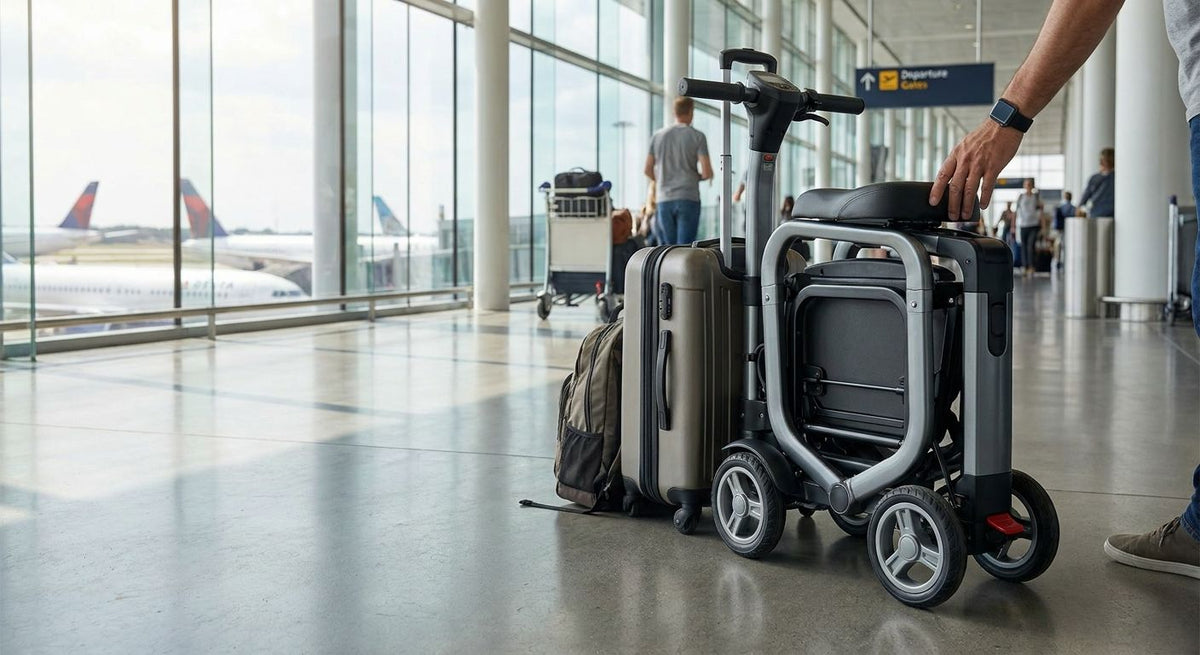
A travel mobility scooter is a foldable or disassembling scooter built to survive gate checks, aircraft cargo holds, and airline battery rules while still getting you from curb to gate on your own. Flying with one in 2026 means planning around lithium battery limits and airline notice windows, not just picking a light model.
- A travel mobility scooter needs a lithium battery at or under 300 Wh to skip special airline approval in 2026.
- Folding travel scooters typically weigh 30 to 50 pounds unfolded, light enough for one gate agent to lift into cargo.
- Notify your airline at least 48 hours before departure under DOT accessibility rules to guarantee gate-to-gate assistance.
- Carry the battery certification card and charger in your cabin bag, never in checked baggage.
- Edward Creation's mobility collection groups scooters by weight capacity and fold size so you can match one to airline limits before you buy.
Why travel mobility scooters matter for air travelers
A scooter that works fine at the grocery store can get rejected at the gate. Airlines follow FAA guidance on lithium-ion batteries: units at or under 300 watt-hours generally travel without special sign-off, batteries between 300 and 360 Wh usually need airline approval in advance, and most carriers cap spare batteries at two. That single number decides whether your scooter flies with you or gets bumped to the next flight.
The other constraint is size. Cargo holds and jet bridges have hard limits on what fits through the door and down the aisle, so a scooter that doesn't fold or break into checkable pieces becomes a logistics problem the airline solves by leaving it on the tarmac. If you shop Edward Creation for a mobility scooter with air travel in mind, battery watt-hours and folded dimensions matter more than top speed or seat width.
Confirm the battery type and watt-hour rating
Before you book a flight, find the watt-hour number printed on the battery casing or in the manual. This single spec determines whether you need airline paperwork at all.
- Look for a printed "Wh" rating on the battery label
- If it's only listed in amp-hours (Ah), multiply by voltage to get watt-hours
- Confirm the battery is lithium-ion, not sealed lead-acid, since rules differ
- Save a photo of the label on your phone for gate agents who ask
- Check whether the battery is removable, since non-removable batteries face different handling
Check folded dimensions against airline gate-check limits
Gate-checked mobility devices still have to physically fit through the cargo door and down the aisle if the crew needs to move them mid-flight.
- Measure the scooter folded, not assembled
- Compare against your specific airline's mobility device policy, not a generic chart
- Ask if your model breaks into pieces rather than folding, since some airlines prefer that
- Confirm the folded scooter clears standard jet bridge width
- Note the unfolded weight for the two-person lift requirement most airlines use over 50 pounds
Call the airline's disability desk ahead of departure
Under 14 CFR 382, airlines are required to accommodate advance notice of an assistive device, and giving that notice early avoids day-of surprises.
- Call at least 48 hours before departure
- Get the confirmation in writing or a reference number
- Ask specifically about your battery's watt-hour rating, not just "is a scooter allowed"
- Confirm whether the scooter can go all the way to the aircraft door or needs to be checked at the ticket counter
- Ask about connecting flights separately, since policies can differ by carrier on codeshares
Pack the battery certification and charger separately
Gate agents and TSA officers ask for documentation more often than most first-time flyers expect.
- Keep the manufacturer's battery spec sheet in your carry-on
- Pack the charger in the cabin, never in checked luggage
- Tape a laminated watt-hour label directly to the battery housing
- Bring the scooter's user manual page showing battery specs
- Screenshot the airline's written approval if one was required
Choose a scooter light enough for one-person lifting
A scooter that two airport employees have to wrestle into a cargo hold slows your whole boarding process down and increases damage risk.
- Prioritize models in the 30 to 50 pound unfolded range for solo lifting
- Check if the battery pack detaches to cut handling weight further
- Confirm the frame folds in one motion rather than requiring tools
- Look for a built-in carry handle or wheels for rolling it through the terminal
- Browse Edward Creation's mobility-focused blog on outdoor and travel use for real-world handling notes before you buy
Protect the scooter during baggage handling
Cargo holds are rough on unprotected frames and exposed control panels.
- Use a padded travel bag or hard case rated for the scooter's folded size
- Tape over exposed switches and the display panel
- Remove and carry any detachable basket or accessory separately
- Label the case with your name, flight number, and a "fragile - mobility device" tag
- Photograph the scooter before check-in in case of damage claims
Plan mobility for the moment you land
Your scooter needs to be usable the second you clear the jet bridge, not just packed correctly.
- Confirm the airport has an accessible route from the gate to baggage claim
- Ask ground staff where gate-checked mobility devices get returned
- Bring a spare charge cable if your destination uses a different outlet standard
- Consider a rental scooter at the destination if your trip involves multiple short flights
- Build in extra connection time for any flight where the scooter is gate-checked
Comparison: travel scooter formats for flying
| Option | Best for | Key limitation |
|---|---|---|
| Folding 3-wheel travel scooter | Solo travelers prioritizing light weight and tight turns | Smaller battery range than 4-wheel models |
| Folding 4-wheel travel scooter | Travelers who want more stability on uneven terminal floors | Bulkier fold, heavier to lift alone |
| Disassembling heavy-duty scooter | Users needing higher weight capacity for daily use at home too | Multiple pieces mean more handling steps at check-in |
| Destination rental scooter | Multi-leg trips where checking a personal scooter each time is impractical | No control over unit condition or battery type |
Each format trades weight against stability. The right call is whichever format your specific airline will approve with the least paperwork — verify that before comparing features.
“The battery's watt-hour rating decides whether your scooter flies with you, not how fast it goes or how it looks.”
Common mistakes air travelers make with mobility scooters
- Assuming any scooter is airline-approved. Battery chemistry and watt-hours vary by model, and airlines check the actual spec, not the brand name.
- Skipping the 48-hour notice window. Walking up day-of with an unregistered mobility device slows boarding for everyone and risks a denied gate-check.
- Not weighing the folded unit. A scooter that's light when assembled can still be too heavy folded for a single gate agent to lift safely.
- Packing the charger in checked luggage. A dead battery on arrival with no charger in the cabin bag turns a trip into a wait.
- Forgetting connecting flights have separate rules. A codeshare partner may enforce a different battery policy than your booking airline.
Match a scooter to your next flight
Compare folding scooters and mobility gear built for real-world travel.
FAQ
Can I bring a mobility scooter on a plane in 2026?
Yes, most airlines allow mobility scooters as a checked or gate-checked item at no extra charge under disability accommodation rules, as long as the lithium battery meets watt-hour limits. Call the airline's disability desk to confirm your specific model before booking.
What is the battery limit for a travel mobility scooter on a flight?
Lithium-ion batteries at or under 300 watt-hours generally fly without special approval, while batteries between 300 and 360 Wh usually need airline sign-off in advance. Anything above that range is typically not permitted.
Is a folding mobility scooter better than a disassembling one for flying?
A folding scooter is usually faster to check in since it collapses in one motion, while a disassembling model can offer higher weight capacity but takes more handling steps at the counter. Choose based on how much lifting help you'll have at each airport.
Do I need to notify the airline before flying with a mobility scooter?
Yes, giving at least 48 hours notice is the standard recommendation under U.S. air carrier accessibility rules so ground staff can prepare the right equipment. Skipping this step doesn't guarantee denial, but it increases the risk of delays at the gate.
How much does a travel mobility scooter weigh?
Most folding travel scooters fall between 30 and 50 pounds unfolded, light enough for one person to lift into a cargo hold. Heavier disassembling models can weigh more but split into smaller pieces for handling.
Can I keep my mobility scooter until I board the plane?
In most cases yes, airlines let you use your scooter up to the aircraft door and gate-check it there, returning it at the door on arrival. Confirm this specific handling with your airline since policies vary by carrier.
What documents should I carry for a mobility scooter battery?
Carry the manufacturer's watt-hour spec sheet and, if required, the airline's written approval for batteries over 300 Wh. Keeping a labeled photo of the battery casing on your phone speeds up gate questions.
Are spare batteries allowed when flying with a mobility scooter?
Most airlines allow up to two spare lithium batteries within the approved watt-hour range, carried in the cabin rather than checked. Confirm the exact limit with your airline since it can differ by carrier.
One last thing
The detail that trips up most first-time flyers isn't the scooter itself, it's the battery label. Gate agents in 2026 are trained to ask for a watt-hour number on the spot, and travelers without it often get sent to customer service while the flight boards without them. Photograph the battery label before you leave home and keep it on your phone alongside your boarding pass.