
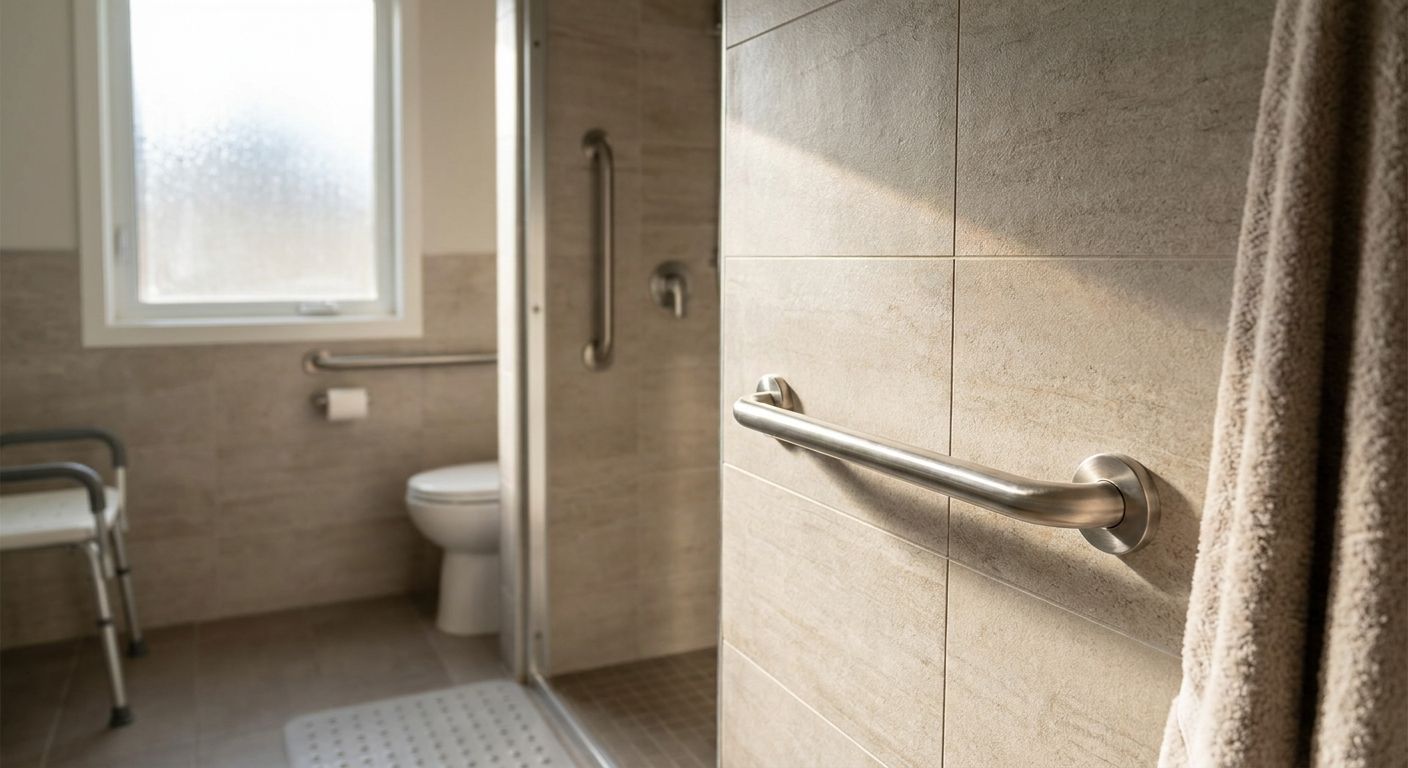
Best overall grab bar: a straight stainless-steel bar anchored into wall studs. Best for tight bathrooms: a fold-down (flip-up) grab bar. Best budget or rental option: a suction-cup grab bar for short-term use. Every other type on this list fills a specific gap those three leave open, and the right pick depends on where the fall risk actually happens in your bathroom.
- Stud-mounted straight grab bars for elderly bathroom use hold 250-500 lbs; suction models often don't.
- ADA-standard bars run 1.25 to 1.5 inches in diameter, mounted 33 to 36 inches above the floor.
- Fold-down bars work best beside toilets in small bathrooms where a fixed bar blocks clearance.
- Suction-cup bars install without drilling but need a flat, non-porous surface and regular re-checking.
- Grab bars pair well with elevated seating and lift chairs for full fall-prevention coverage at home.
Why this matters
The CDC reports that more than one in four adults 65 and older falls each year, and bathrooms are one of the most common rooms where it happens — wet tile, low toilets, and nothing to grab onto. A properly rated grab bar for elderly bathroom use is one of the cheapest interventions with the clearest safety return, but the wrong type (a suction bar treated like a load-bearing one, for example) creates false confidence instead of actual support.
Grab bars solve the bathroom. They don't solve the living room, the bedroom, or the moment someone needs to stand up from a low chair without straining a hip. Edward Creation's lift chairs for balance disorders and fall prevention cover that second half of the fall-risk picture, and the two categories work together rather than competing.
What makes the best grab bar for elderly bathroom safety
- ADA-compliant diameter (1.25 to 1.5 inches) so a hand can close fully around the bar
- Stud-mounted weight rating of at least 250 lbs, ideally 300-500 lbs for heavier users
- Rust-resistant finish — stainless steel or powder-coated aluminum for constant moisture exposure
- Textured or knurled grip that stays functional with wet or soapy hands
- Mounting height in the ADA range of 33 to 36 inches above the floor
- Visible load rating or ANSI/ADA marking on the packaging, not just a marketing claim
At a glance: grab bar types compared
| Type | Best for | Standout feature | Key limitation |
|---|---|---|---|
| Straight grab bar | Shower walls, general support | Simple stud installation, highest weight ratings | Needs a stud or blocking behind drywall |
| Angled grab bar | Toilet-side stability | Combines vertical and horizontal grip in one bar | Costs more to install than a single straight bar |
| Fold-down grab bar | Small bathrooms, toilet clearance | Swings up out of the way when not in use | Moving parts mean more to maintain over time |
| Suction-cup grab bar | Renters, travel, temporary need | No drilling, repositionable | Not rated for full body weight; needs a flat surface |
| Textured/foam-grip bar | Wet hands, arthritis | Grip surface stays secure when soapy or wet | Foam sleeves wear down and need replacing |
1. Straight grab bar: best grab bar for shower and tub walls
A straight bar mounted horizontally or vertically into wall studs is the standard fixture for shower and tub walls, and it's what most occupational therapists recommend first. It gives a consistent, predictable grip point exactly where someone pivots to step over a tub wall or lower themselves onto a shower seat.
Straight grab bar pros:
- Highest weight ratings when anchored into studs (commonly 250-500 lbs)
- Widest range of finishes and lengths, from 12 to 48 inches
- Simplest installation for a contractor or handy family member
Straight grab bar cons:
- Requires studs or blocking behind the wall — retrofits in older bathrooms sometimes need reinforcement
- Fixed placement means it only helps at that one spot
Best for: anyone entering or exiting a shower or tub. Verdict: Buy.
2. Angled grab bar: best grab bar for toilet-side stability
An angled bar combines a horizontal and vertical section in one fixture, usually mounted beside the toilet. It gives a grip option for both the sitting-down motion and the push-up-to-stand motion, which a single straight bar can't do as well from one location.
Angled grab bar pros:
- Two grip angles in one installation
- Reduces the number of separate bars needed near a toilet
- Works well for users transitioning from a wheelchair or walker
Angled grab bar cons:
- More expensive per unit than a straight bar
- Bulkier profile can feel tight in a small toilet alcove
Best for: toilet transfers for users with limited leg strength. Verdict: Buy.
3. Fold-down grab bar: best grab bar for small bathrooms
A fold-down or flip-up bar mounts to the wall beside a toilet and swings vertical when not in use, freeing floor space for a walker or wheelchair to pull alongside. This is the pick for bathrooms where a fixed bar would block the door swing or the transfer path.
Fold-down grab bar pros:
- Clears floor space when raised
- Handles walker and wheelchair transfers well
- Some models include an integrated toilet paper holder
Fold-down grab bar cons:
- Moving hinges need periodic tightening and inspection
- Not appropriate for shower walls — it's a toilet-area fixture only
Best for: apartments and small bathrooms with tight toilet clearance. Verdict: Buy.
4. Suction-cup grab bar: best grab bar for renters and travel
A suction-cup bar attaches with vacuum locks to tile, fiberglass, or acrylic surfaces without any drilling, which makes it the only option that works in a rental unit or a hotel bathroom on a trip. It's genuinely useful for that narrow use case and genuinely risky outside it.
Suction-cup grab bar pros:
- Zero drilling, fully repositionable
- Ideal for short-term stays, rentals, or testing placement before a permanent install
- Sets up in under five minutes
Suction-cup grab bar cons:
- Not rated for full body-weight support the way a stud-mounted bar is
- Requires a smooth, non-porous, and consistently dry surface to hold suction
- Needs a manual seal check before every use
Best for: renters and travelers who can't drill into walls. Verdict: Buy for short-term use, Skip as a primary support.
5. Textured or foam-grip grab bar: best grab bar for wet-hand grip
This is a finish variant rather than a mounting style — a straight or angled bar wrapped in a knurled, ribbed, or foam-covered surface designed to stay grippable when hands are wet, soapy, or affected by arthritis. It solves a specific complaint: smooth stainless steel gets slick.
Textured grip bar pros:
- Stays secure with wet or soapy hands
- Foam versions are gentler on arthritic joints and reduce cold-metal discomfort
- Available on both straight and angled bar styles
Textured grip bar cons:
- Foam sleeves compress and wear out, usually needing replacement over a few years
- Slightly reduces the maximum weight rating compared to bare stainless steel
Best for: users with arthritis or reduced grip strength. Verdict: Buy.
How this ranking works
Each type above is scored against the six criteria listed earlier: diameter, weight rating, finish durability, grip texture, mounting height compliance, and certification. Straight and angled bars anchored into studs top the list because they hit every criterion at the highest level; suction bars rank lower specifically because they fail the weight-rating criterion by design, not by defect.
Which grab bar should you choose?
For a permanent bathroom fix, a stud-mounted straight bar in the shower plus an angled bar by the toilet covers the two highest-risk transfer points in the room. Add a fold-down bar only if floor clearance is tight. Suction bars are the right call for a rental or a trip, never as the only support in a home you own long-term.
Beyond grab bars: fall-prevention aids for the rest of the home
Grab bars fix the bathroom, but most falls among people 65 and older happen during the sit-to-stand motion in any room — a low sofa, a soft armchair, a bed that's too low. That's where elevated and power-lift seating closes the gap grab bars can't reach. Elevated chairs designed for easier standing reduce the leg strength required to get upright, which is the same mechanical problem a toilet-side grab bar solves in a different room.
A broader home fall-prevention plan usually layers several fixes at once: bathroom grab bars, better lighting on stairways, removing loose rugs, and seating that assists the stand-up motion instead of fighting it. Resources on preventing falls at home walk through that layered approach room by room, which is worth reviewing alongside any bathroom-specific fix.
For the living room specifically, a power lift chair that stands the user up mechanically removes the fall risk of pushing off a low cushion altogether. Browsing the full lineup at Edward Creation shows the range of lift and recliner options built around that same standing-assist principle.


FAQ
What's the best grab bar for elderly bathroom use?
A straight stainless-steel grab bar mounted into wall studs is the best choice for shower and tub walls in 2026, rated to hold 250-500 lbs. Add an angled bar by the toilet for full coverage of both major transfer points.
Are suction cup grab bars safe for seniors?
Suction-cup bars are safe for light, temporary support in rentals or on trips but are not rated for full body weight like stud-mounted bars. They need a flat, non-porous surface and a manual seal check before every use.
How high should a grab bar be mounted in a bathroom?
ADA guidance places grab bars 33 to 36 inches above the floor. Exact placement should also account for the specific user's height and the transfer motion at that fixture.
Can grab bars be installed without hitting a stud?
Heavy-duty wall anchors rated for the bar's full weight can work on drywall without a stud, but they carry lower weight ratings than direct stud mounting. For full body-weight support, mounting into studs or added blocking is the safer standard.
What's the weight capacity of a bathroom grab bar?
Stud-mounted straight and angled grab bars typically hold 250 to 500 lbs. Suction-cup models are not designed for full body-weight support and should not be relied on as a primary safety fixture.
Is a straight or angled grab bar better near the toilet?
An angled bar works better beside a toilet because it gives both a horizontal grip for sitting and a vertical grip for pushing up to stand. A straight bar alone only supports one of those two motions well.
Do grab bars need to be ADA compliant for home use?
ADA compliance isn't legally required in a private home, but the same specs — 1.25 to 1.5 inch diameter, 33 to 36 inch mounting height — represent the tested standard for grip and support, so matching them is the safer default.
What other fall-prevention aids help seniors besides grab bars?
Power lift chairs and elevated seating reduce fall risk during the sit-to-stand motion in living rooms and bedrooms, the same problem grab bars solve in the bathroom. Non-slip flooring and better stairway lighting round out a layered fall-prevention setup.
One last thing
The detail most buying guides skip: a suction-cup grab bar's rated hold weakens on textured or matte tile, even when the surface looks flat. If the bathroom tile isn't glossy and non-porous, skip the suction option entirely and go straight to a stud-mounted bar — it's the only version that performs the same on day 400 as it does on day one.