
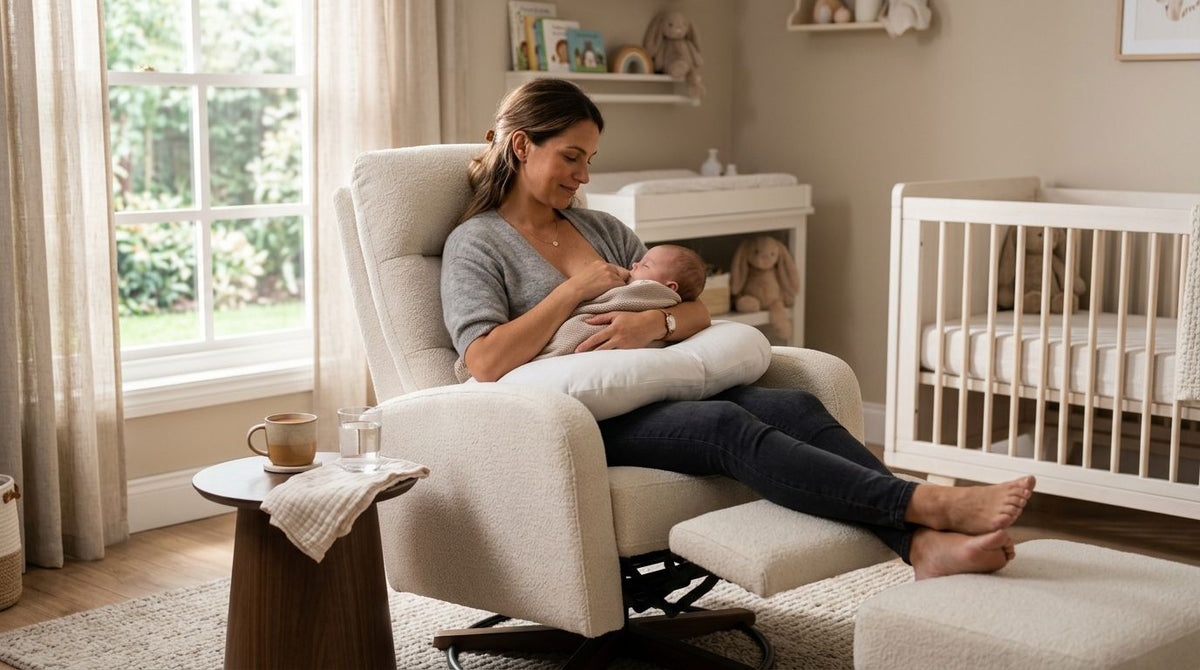
A swivel rocker recliner for nursing mothers is a chair built to pivot on its base, rock gently at the hips rather than the whole frame, and support a feeding session that can run 20 to 45 minutes multiple times a night. Nursing mothers need a different spec sheet than the general recliner buyer: seat depth that keeps knees clear of a baby's head, armrests low enough to cradle an infant without shoulder strain, and a swivel base that lets you turn toward a crib or bassinet without standing up. This guide breaks down what actually matters in 2026, not what a showroom tag claims.
- A swivel rocker recliner for nursing mothers needs 18-20 inch seat depth and armrests at or below elbow height for latch support.
- 360-degree swivel matters more than deep recline for 2 a.m. feeds - it lets you turn toward the crib without standing.
- Independent rocking motion, not a combined recline-and-rock mechanism, reduces jostling during a sleeping baby's transfer.
- Washable performance fabric outlasts tufted velvet once spit-up enters the picture.
- Power features like USB charging add convenience for late-night feeds but never substitute for correct seat geometry.
Why this matters for nursing mothers
A feeding chair gets used more hours per week in the first year than almost any other piece of furniture in the house, and the wrong seat depth or armrest height shows up as shoulder and lower-back strain within days, not months. Standard living-room recliners are built for lounging, not for holding a 7 to 12-pound infant at a fixed angle for half an hour at a stretch.
The category most parents land on in 2026 is the best swivel rocker recliners roundup, because swivel-plus-rock is the combination that solves the nighttime-transfer problem: turn toward a bassinet without a full stand-up, then rock without the jerky start-stop motion of a basic glider.
Postpartum bodies also need different lumbar support than they did pre-pregnancy. Diastasis recti, C-section incisions, and general core weakness in the first 6 to 8 weeks change how much low-back support a chair has to provide.
How to choose a swivel rocker recliner for nursing
Measure your nursing space and swing clearance
Measure the room before comparing chairs. A swivel base needs clearance on all sides, not just in front, and a rocking motion needs floor space behind the chair that a stationary recliner does not.
- Leave 24 to 30 inches of clearance behind the chair for the rocking arc
- Confirm the swivel radius clears side tables and crib rails
- Measure doorway width if the chair moves rooms after the nursery phase
- Check the fully reclined profile against ceiling height under a sloped roof
Check seat depth and armrest height
Seat depth is the most-skipped spec, and it decides whether your knees carry the baby's weight or your arms do.
- Target 18 to 20 inches of seat depth; deeper seats push knees too far forward for a cradle hold
- Confirm armrest height sits at or just below elbow height when seated so shoulders stay relaxed
- Test armrest width - narrow arms cut into forearms during a 30-minute feed
- Favor a firmer seat cushion; soft sinking foam tilts the pelvis back and rounds the shoulders forward
Prioritize independent swivel and rocking motion
Not every chair labeled a rocker recliner rocks independently of the recline mechanism. Some combine the two into one motion that jostles a sleeping baby during transfer.
- Confirm the base rotates a full 360 degrees, not a limited 90-degree arc
- Test the rocking motion within the return window; it should feel smooth, not sprung
- Separate rock-and-swivel mechanisms from combined glide-recline mechanisms on the spec sheet
- Look for a locking base if the chair sits near stairs or a crib edge
Test the recline angle and head support
A nursing chair rarely needs a flat recline. Most feeding happens between 100 and 130 degrees, upright enough to keep latch visibility.
- Look for a recline range starting near 100 degrees rather than jumping straight to 160
- Match head and neck support height to your seated height
- Confirm the headrest does not force the chin down during long feeds
- Test lever or button reach from a seated, baby-in-arms position
Choose washable, stain-resistant upholstery
Spit-up, formula, and diaper-change spills are a certainty in the first year, not a risk.
- Performance fabric and faux leather wipe clean faster than tufted velvet or chenille
- Removable machine-washable cushion covers add years of usable life
- Darker or patterned fabrics hide stains better than solid pastels
- Check the fabric cleaning code (W, S, or WS) when the retailer lists one
Add lumbar and nursing pillow support
Built-in lumbar support helps, but most chairs still need supplemental pillows for correct positioning.
- A firm lumbar pillow behind the lower back keeps posture upright through a long feed
- A nursing pillow across the lap raises the baby to breast height without hunching
- A footstool or matching ottoman keeps knees at a comfortable angle
- Reassess pillow needs at the 3 and 6-month marks as your body changes
Consider power features for late-night feeds
Once geometry and motion are right, powered extras earn their place for 2 a.m. sessions - never before the fundamentals above.
- A USB charging port in the armrest keeps a phone or white-noise app powered through a feed
- A power recline button removes the need to pull a manual lever with a baby in arms
- Motor noise matters more at night than during the day; test volume if you can
- Battery backup only matters on chairs that double as lift chairs
See 2026's top swivel rocker recliners
Compare seat depth, swivel range, and fabric options side by side.
Comparison: nursing chair options in 2026
| Option | Best for | Key strength | Key limitation |
|---|---|---|---|
| Swivel rocker recliner | Nighttime feeds needing crib access | 360-degree turn plus independent rock | Bulkier footprint than a basic glider |
| Upholstered glider, non-swivel | Small nurseries with fixed chair placement | Smooth, quiet glide motion | No swivel - you stand to turn toward the crib |
| Power recliner with USB charging | Parents feeding with a phone or tablet in hand | Powered recline and built-in charging | More mechanism to maintain |
| Standard living-room recliner | Occasional daytime feeding only | Already owned, no new purchase | Wrong seat depth and armrest height for regular nursing |
The swivel rocker recliner wins for nursing mothers who feed at night and need to reach a crib without standing up. A fixed glider or a standard recliner only holds up for daytime, occasional use.
Common mistakes nursing mothers make when buying
- Buying for nursery aesthetics over seat depth - a chair that matches the room but runs 22-plus inches deep forces poor knee support at every feed
- Skipping the swivel test - some chairs marketed as swivel rotate only 90 to 180 degrees, not enough to face a crib across the room
- Choosing maximum recline over upright support - a 160-degree lounge position looks comfortable and drops the chin out of latch-visibility range
- Ignoring armrest width - sculpted narrow arms photograph well and dig into forearms by week three
- Underestimating cleanability - a velvet chair becomes a stained chair within the first month of spit-up exposure
FAQ
What makes a recliner good for nursing mothers?
A good nursing recliner has 18 to 20 inches of seat depth, armrests at or below elbow height, independent swivel and rocking motion, and a recline range starting near 100 degrees. Those four specs matter more than fabric pattern or brand name.
Is a swivel rocker better than a glider for nursing?
A swivel rocker is better for nighttime feeds because it lets you turn toward a crib or bassinet without standing up. A fixed glider is fine for daytime feeding in a room where you never need to change facing direction.
How much recline do you need for breastfeeding?
Most feeding happens comfortably between 100 and 130 degrees of recline, upright enough to keep eye contact and latch visibility. A full 160-degree flat recline is not needed for nursing and drops the chin uncomfortably.
Do nursing recliners need power features like USB charging?
No. A USB port adds real convenience during late-night feeds when a phone or white-noise app needs power, but seat depth, armrest height, and swivel range matter far more than any powered extra.
What fabric is best for a nursing chair?
Performance fabric or faux leather with a removable, machine-washable cushion cover holds up best against spit-up and formula. Tufted velvet and chenille look better in photos and stain far faster.
Can you use a regular recliner for nursing instead?
A regular living-room recliner works for occasional daytime feeding but usually has the wrong seat depth and armrest height for repeated use, which shows up as shoulder and lower-back strain within days.
How wide should armrests be on a nursing recliner?
Wide enough to support the full forearm without pressing into the wrist or elbow across a 20 to 45-minute feed. Narrow sculpted arms commonly fail this test even when the rest of the chair fits.
When should you buy a nursing recliner during pregnancy?
Most parents buy 4 to 8 weeks before the due date to cover shipping and assembly time and to test the fit before the baby arrives. That window also leaves room to add lumbar pillows or return a chair that sits wrong.
One last thing
The detail most parents miss until week three: a locking swivel base is worth more than extra recline positions. The moments you actually need the lock - setting a sleeping baby down, standing up one-handed - happen every day in 2026, while the deepest recline angle gets used maybe twice a week.