
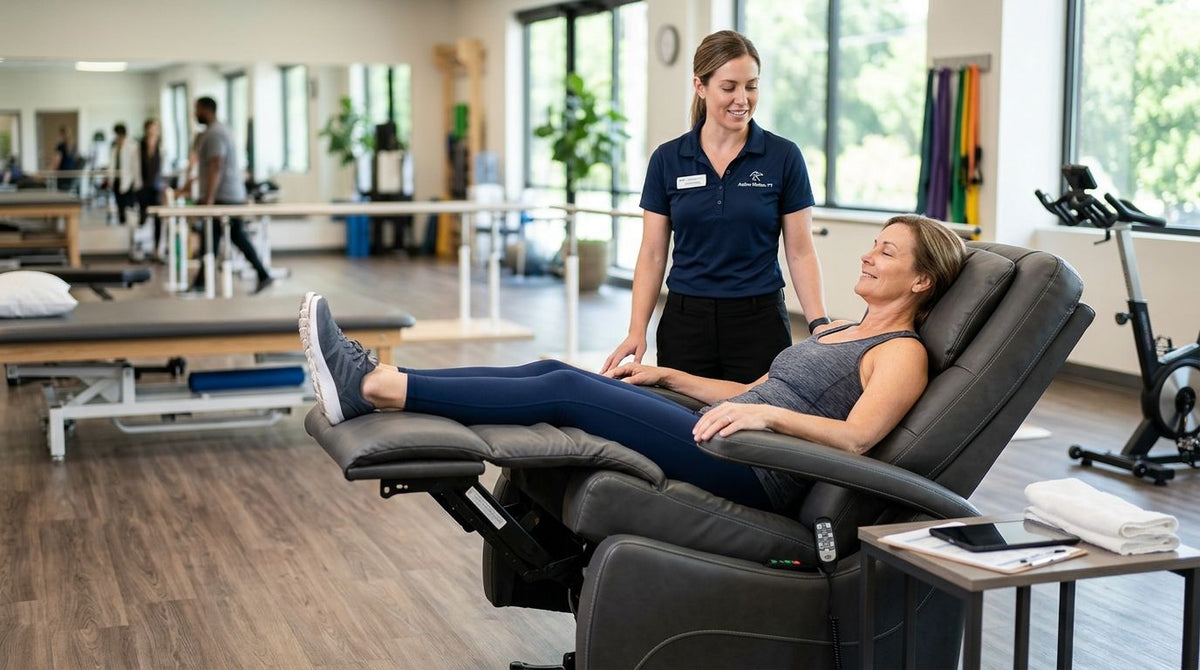
Zero gravity recliners for physical therapy clinics need dual-motor lift mechanisms, wipeable upholstery, and a weight rating that survives multiple patients per day, not a single owner over ten years. The gap between a home recliner and a clinical one comes down to duty cycle, cleanability, and how precisely staff can stage a patient's recline angle for a given protocol.
- Dual-motor zero gravity recliners let PT staff set back and footrest angles independently, which single-motor units cannot do.
- Weight capacity of 300 to 350 lbs per unit matters more in a clinic than in a home, since multiple patients cycle through daily.
- Vinyl or faux leather upholstery is the clinical standard for 2026 because fabric can't be disinfected between patients.
- Aeva Vital's zero gravity recliner lineup and its zero gravity adjustable bed base share the same independent-motor positioning mechanics.
- Verdict: buy dual-motor, 300+ lb-rated recliners built for daily multi-patient cycling, not single-user home models.
Why zero gravity recliners matter for physical therapy clinics
A home buyer runs a recliner a few times a week. A physical therapy clinic runs the same chair through six, eight, sometimes twelve patients a day, five days a week, for years. That duty cycle is the entire reason clinical shopping for zero gravity recliners looks different from browsing a furniture showroom in 2026.
Zero gravity position elevates the legs above heart level and distributes body weight across the spine instead of concentrating it at the seat pan and lower back. That mechanical fact is why PT clinics use the position for post-op recovery staging, traction support, and decompression rest between active treatment. A chair that can't hold that angle precisely, or can't survive repeated adjustment cycles, undermines the protocol it's supposed to support.
Step 1: Define the clinical use case before you shop
Not every treatment bay needs the same chair. A recovery bay for post-surgical patients has different requirements than a waiting area or a cold-plunge transition zone.
- Post-operative recovery positioning between active treatment sessions
- Traction or spinal decompression staging where recline angle needs to hold steady
- Pre- and post-treatment rest for patients moving to or from an ice bath or cold plunge station
- General waiting room seating that occasionally doubles as overflow recovery space
- Home-transition training, where staff show patients how to replicate the position at home
Step 2: Set a minimum weight capacity across the fleet
Don't average capacity across your patient population. Order to your heaviest realistic patient plus margin, and verify per unit, not per brand line.
- Check the capacity rating printed on the specific model, not the manufacturer's general marketing claim
- Confirm capacity holds at full recline, not just in the upright seated position
- Standardize on one capacity tier across a fleet so staff never have to remember which chair is rated for which patient
- Ask for the rating in writing before purchase, not verbally from a sales rep
- Treat 300 to 350 lbs as the practical clinical floor for 2026, not the ceiling
Step 3: Prioritize dual-motor zero gravity mechanisms
Single-motor recliners move the back and footrest together as one unit. Dual-motor chairs let staff set the backrest angle independently from the leg rest, which is the difference between a general recline and an actual staged clinical position.
- Test the motor split in person: back should move without forcing the footrest to follow
- Confirm the remote has clearly separated back and leg controls, not a single combined recline button
- Ask whether the motor holds position under load without drifting over a treatment session
- Verify the chair reaches true zero gravity angle, not just a deep recline that looks similar
- Check that Aeva Vital's zero gravity recliner options and comparable dual-motor units list independent back and leg motors as a spec, not a feature name
Aeva Vital's zero gravity recliner lineup and its adjustable bed base frame both use independent-motor positioning built around the same neutral-body-angle principle clinics rely on for recovery staging.
Step 4: Check cleanability and material specs
Fabric upholstery is a liability in a room where one chair sees a dozen different patients a day.
- Specify vinyl or faux leather over any fabric or microfiber option
- Ask whether seams are welded or stitched — welded seams resist fluid intrusion better
- Avoid fabric-wrapped remotes; a hard-shell or wipeable remote survives disinfectant wipes
- Confirm the manufacturer states the upholstery is compatible with standard clinic-grade disinfectants
- Reject any chair with exposed foam edges that can't be sealed or wiped
Step 5: Measure your treatment room footprint at full recline
A zero gravity recliner needs clearance the sales floor rarely shows you. Measure before you order, not after delivery.
- Measure wall clearance needed for the full recline swing, not just the upright footprint
- Check aisle width between bays with all chairs reclined simultaneously
- Confirm doorway and hallway width for delivery and any future replacement
- Account for full footrest extension length, which adds 12 to 18 inches beyond the seated footprint on most models
- Decide upfront whether chairs will be bolted for stability or left free-standing
Step 6: Evaluate motor duty rating for high-use rooms
A motor built for occasional home recline will wear out faster in a clinic running it dozens of times a day.
- Ask the manufacturer for a duty cycle or cycles-per-day rating, not just a warranty term
- Test motor response under simulated load before committing to a bulk order
- Confirm whether the lift function has battery backup in case of a power outage
- Decide between corded and wireless remotes based on how often chairs get repositioned
- Rule out any unit marketed strictly for residential, occasional use
Step 7: Standardize staff positioning protocols
The best chair still underperforms if every staff member sets it differently.
- Post a quick-reference recline angle guide near each chair for common protocols
- Assign a default chair-per-bay pairing so staff aren't hunting for the right unit
- Label back and leg controls clearly if the stock remote icons are ambiguous
- Log any mechanical stiffness or noise immediately to catch motor wear early
- Review positioning consistency during onboarding for new staff, not just once a year


Comparing recliner options for PT clinic use
| Option | Best for | Key limitation |
|---|---|---|
| Manual recline recliner | Low-traffic waiting rooms | No motor control; staff must manually reposition every patient |
| Single-motor power lift recliner | Small clinics with light patient loads | Back and footrest move as one unit, limiting staged positioning |
| Dual-motor zero gravity lift recliner | Multi-patient treatment bays needing precise positioning | Higher unit cost than single-motor equivalents |
| Bariatric-rated dual-motor recliner | Clinics serving heavier patient populations | Larger footprint requires wider bay clearance |
Verdict: dual-motor zero gravity recliners are the correct default for any PT clinic running more than two or three patients through the same chair per day in 2026. Buy dual-motor for active treatment bays. Hold on manual units except for pure waiting-room seating. Skip single-motor chairs anywhere staged positioning matters.
Common mistakes PT clinics make
- Buying on home-recliner reviews. A five-star home review says nothing about duty cycle under clinical use.
- Standardizing on fabric upholstery. It can't be disinfected between patients and fails infection-control audits faster than expected.
- Skipping the full-recline footprint check. Chairs that fit fine upright can collide with walls or neighboring bays once reclined.
- Assuming brand-wide weight capacity applies to every model. Capacity varies by SKU, not by brand name.
- Never training staff on recline presets. Inconsistent positioning across shifts undermines the clinical value of the equipment itself.
“A chair that can't hold true zero gravity angle under load isn't a clinical recliner, it's a recliner that happens to sell to clinics.”
FAQ
What's the best zero gravity recliner for a physical therapy clinic in 2026?
The best option is a dual-motor model rated for at least 300 lbs with vinyl or faux leather upholstery, since PT clinics cycle multiple patients through the same chair daily. Aeva Vital's zero gravity recliner lineup and comparable dual-motor units meet that spec profile.
How much weight can a clinical zero gravity recliner hold?
Most commercial-grade models are rated between 300 and 350 lbs, with bariatric versions rated higher. Always confirm the rating on the specific model, not the brand's general marketing claim.
Is a dual-motor recliner better than a single-motor recliner for PT use?
Yes, dual-motor recliners let staff set the backrest and footrest angles independently, which single-motor chairs cannot do. That independent control is what enables staged clinical positioning rather than a generic recline.
Can zero gravity recliners be disinfected between patients?
Vinyl and faux leather models with welded seams can be wiped down with standard clinic-grade disinfectant between patients. Fabric upholstery cannot be reliably disinfected and should be avoided in treatment bays.
Do PT clinics need medical-grade recliners or will consumer models work?
Consumer models are built for occasional home use and wear out faster under daily multi-patient cycling. Clinics need units rated for higher duty cycles even if they aren't marketed as strictly medical devices.
How long do commercial zero gravity recliners last with daily multi-patient use?
Lifespan depends heavily on motor duty rating and how many recline cycles the chair sees per day, so ask the manufacturer for a cycles-per-day figure before buying. Chairs bought for occasional home use tend to fail years earlier under clinic-level cycling.
What's the difference between a lift chair and a zero gravity recliner?
A lift chair is built to power the seat forward and up to help a patient stand, while a zero gravity recliner is built to recline into a position that elevates the legs above heart level. Some models combine both functions in one chair.
How many zero gravity recliners does a treatment bay need?
Most clinics run one chair per active treatment bay, with additional units in shared recovery or waiting areas depending on patient volume. Match the count to your daily patient flow rather than buying a fixed number upfront.
One last thing
The same independent-motor mechanism that makes a dual-motor zero gravity recliner useful in a treatment bay shows up in Aeva Vital's zero gravity adjustable bed base frame — worth knowing if your clinic sends patients home with instructions to replicate the recline angle for continued recovery. Pair that with a portable cold plunge tub for clinics running combined heat-and-cold protocols in 2026, and the recovery room extends past the chair itself.